
History
The Shahed-107 is an Iranian one-way attack unmanned aerial vehicle developed within the Shahed family of strike drones. It was publicly unveiled by Iran's Islamic Revolutionary Guard Corps in June 2025 and subsequently appeared in Russian operations against Ukraine.
The aircraft combines a relatively simple composite airframe, piston propulsion and an explosive warhead. Ukrainian examination of a recovered example identified a 15 kg cumulative high-explosive fragmentation warhead, a Chinese DLE 111 gasoline engine and a fuel capacity of 28 liters.
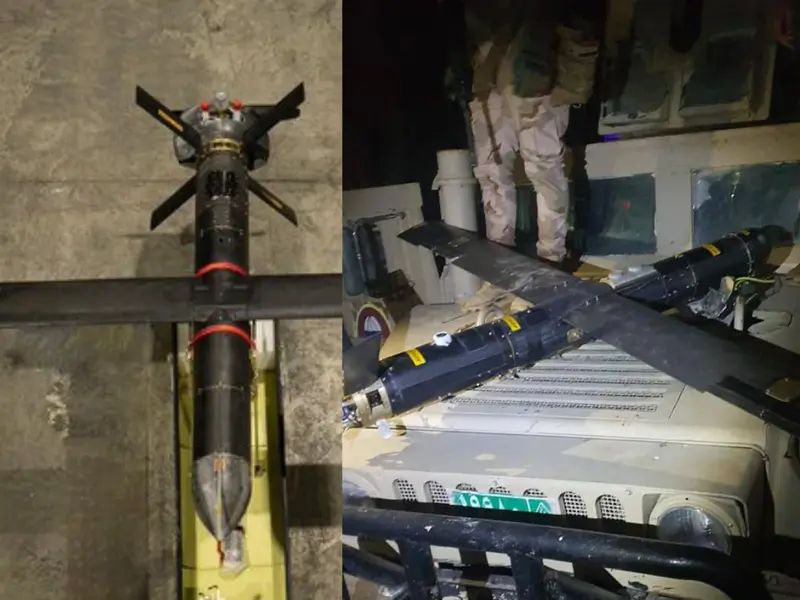
In August 2026, Iraqi authorities reported dismantling a pro-Iranian militant network that possessed at least 12 Shahed-107 drones and was allegedly preparing attacks against targets believed to include Saudi Arabia. The seizure provided another documented example of the type outside the Russia-Ukraine theater.
Development and introduction
The Shahed-107 was first publicly demonstrated in June 2025. Reporting based on analysis by Ukraine's Defense Intelligence described it as an Iranian-made attack UAV with a three-meter wingspan and an X-shaped tail. The airframe uses carbon-fiber composite material, while important structural elements are made from aluminum alloy. A detailed description of the examined aircraft was published by Defense Express.
By late 2025, Russia was documented using the Shahed-107 against Ukraine. On December 30, 2025, Ukrainian reporting described what was presented as the first documented interception of the type, when a Sting interceptor drone operated by personnel associated with Ukraine's 47th Separate Mechanized Brigade destroyed a Shahed-107.
Design
Airframe
The Shahed-107 is a high-wing unmanned aircraft with an approximately 3 m wingspan. Its X-shaped tail provides stability in flight. The examined airframe described by Ukrainian intelligence used carbon-fiber composite construction with aluminum structural components.
Powerplant and fuel system
The examined Shahed-107 was powered by a Chinese-made DLE 111 two-stroke gasoline engine. Its fuel capacity was reported as 28 liters. This commercial-type piston powerplant is consistent with the emphasis on relatively simple propulsion found in several Iranian and Russian unmanned systems.
Navigation and flight control
Analysis of the recovered aircraft identified an inertial navigation system, an anti-jamming protection module and a four-element interference-resistant antenna. Flight control was handled by an FCU autopilot that commanded the control-surface servos and engine throttle.
Warhead
The examined Shahed-107 carried a 15 kg cumulative high-explosive fragmentation warhead. Reporting on the drones seized in Iraq in August 2026 also identified 15 kg warheads, supporting the use of this payload on operational examples.
Operational history
Russia-Ukraine War
Russia began using the Shahed-107 against Ukraine by 2025. Ukrainian analysis of recovered examples allowed intelligence specialists to document the airframe, propulsion, navigation equipment and foreign-produced electronic components. Reporting also indicated that components originated from several countries, including the United States, Switzerland, China, Japan, Taiwan, the Netherlands and Ireland.
On December 30, 2025, Ukrainian media reported the destruction of a Shahed-107 by a Sting interceptor UAV. The report described the incident as the first documented shootdown of the model.
Iraq and alleged planned attack on Saudi Arabia
On August 7, 2026, Iraqi security forces seized at least 12 Shahed-107 strike drones from a pro-Iranian militant network, according to photographs and subsequent reporting. Iraqi officials said the Counter-Terrorism Service and Iraqi Intelligence Service had infiltrated and dismantled the armed network.
The cell was accused of preparing drone attacks against designated targets, with Saudi Arabia reported as the probable target. The seized aircraft were described as carrying 15 kg warheads and having a range of more than 300 km. The incident was reported by Militarnyi.
Operators
- Russia: Documented using Shahed-107 drones against Ukraine by 2025.
Specifications (Shahed-107)
General characteristics
- Length: approximately 2.5 m, according to a comparative Shahed-family assessment published by the Takshashila Institution.
- Wingspan: approximately 3 m.
- Airframe materials: carbon-fiber composite with aluminum structural elements.
- Fuel capacity: 28 liters.
- Powerplant: one DLE 111 two-stroke gasoline engine.
Performance
- Range: approximately 300 km for the example analyzed by Ukrainian intelligence; Iraqi reporting described the seized drones as capable of more than 300 km. A separate Takshashila assessment lists approximately 1,500 km, indicating that publicly reported range figures are not consistent.
- Speed: 120-185 km/h according to the Takshashila comparative assessment.
Armament
- Warhead: 15 kg cumulative high-explosive fragmentation warhead on the examined example.
 Argentina
 Armenia
 Australia
 Austria
 Austria-Hungary
 Belgium
 Brazil
 United Kingdom
 United States
 Brunei
 Bulgaria
 Canada
 Chile
Chile China
China Colonial America
 Colombia
 Confederate States
 Croatia
 Czech
Czech Denmark
 Egypt
Egypt Finland
 France
 Georgia
 Germany
 German Imperial
 Greece
 Holland
 Hungary
 India
India Indonesia
 Iraq
Iraq Ireland
 Israel
 Italy
Italy Japan
Japan Japan (1940)
 Jordan
 Kingdom of Italy
 Malaysia
 Mexico
 Myanmar
 Nazi Germany
 Netherlands
 New Zealand
 North Korea
 Norway
 Pakistan
 Peru
Peru Philippines
 Poland
 Portugal
 Prussia
 Romania
 Russia
 Saudi Arabia
 Serbia
 Singapore
 Slovakia
 Slovenia
 South Africa
 South Korea
 Soviet Union
 Spain
Spain Sweden
 Switzerland
 Syria
Syria Taiwan
 Thailand
 Turkey
 UAE
UAE Ukraine
 Vietnam
 Yugoslavia