

History
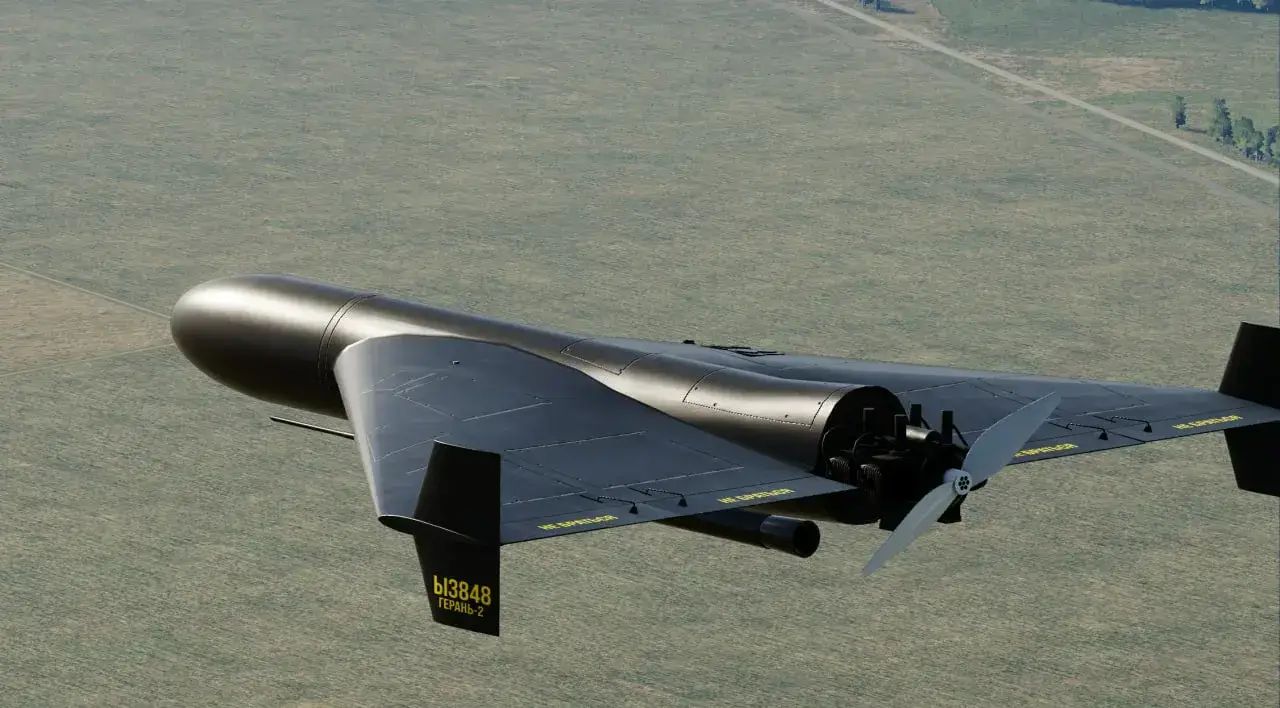
The Geran-2 is a Russian long-range one-way attack unmanned aerial vehicle derived from the Iranian Shahed-136. It is a delta-wing aircraft with a rear-mounted piston engine and an explosive warhead.
Russia employs the Geran-2 against targets in Ukraine, often launching the aircraft in large groups. The design has undergone repeated changes to its navigation, communications, sensors and payloads in response to Ukrainian countermeasures.
Russian production is concentrated at JSC Alabuga in the Alabuga Special Economic Zone in Tatarstan. By August 2026, Ukraine's Defence Intelligence estimated output at approximately 2,800 Geran-2 aircraft per month, equivalent to more than 33,600 per year.
A reported Russian-Iranian agreement in late 2022 supported domestic production of the Shahed-136 design under the Geran-2 designation. One available equipment reference places the type's initial operational capability in 2024, although Russian development and production arrangements began earlier.
Production and supply chain
The Alabuga complex became the main Russian production center for Geran-family aircraft. Its facilities and associated accommodation expanded as output increased. Russian manufacture combined high-volume assembly with continuing changes to the airframe, electronics and combat equipment.
Despite efforts to localize production, an investigation described by Militarnyi reported that examined Geran-2 aircraft contained hundreds of foreign components. These included microchips, receivers, transistors, diodes and antennas produced in the United States, China and Europe. Components manufactured in 2025 in Germany, Japan, Switzerland and the United States were reportedly found in aircraft recovered during 2026.
Continuing development
The Geran-2 evolved from a comparatively simple pre-programmed strike aircraft into a platform supporting protected navigation, cameras, cellular modems and online control. A July 2026 analysis by Defence24 characterized this development as movement toward network-centered operation.
By late 2025, at least one Geran-2 had been observed carrying an R-60M air-to-air missile. This configuration was apparently intended to threaten aircraft and helicopters intercepting the drone. Another reported configuration carried a Verba man-portable surface-to-air missile while retaining the Geran-2's strike warhead.
Further equipment observed in 2026 included electro-optical systems on rotating mounts, VOR/DME radio-navigation equipment and infrared illuminators. A separate carrier concept was intended to transport FPV drones, but the available information does not establish that this concept entered regular operational service.
Design
Airframe and propulsion
The Geran-2 retains the Shahed-136's tailless delta-wing arrangement. Available descriptions identify a composite honeycomb structure and a rear-mounted MD-550 two-stroke, four-cylinder piston engine rated at approximately 50 hp. The pusher propeller is located behind the airframe.
The aircraft can be launched with rocket assistance from a ground launcher or moving vehicle. Its low-altitude flight profile and small signature complicate detection, while the large delta wing provides internal volume for fuel, avionics and different warheads.
Navigation and communications
Basic missions use satellite and inertial navigation to reach pre-programmed coordinates. Later configurations reportedly added multi-element controlled-reception-pattern antennas intended to resist satellite-navigation jamming and spoofing.
Some aircraft have carried cellular modems, cameras and data links for position reporting or in-flight control. Other observed communications configurations have used Ukrainian mobile networks or satellite communications. The equipment is not uniform across all Geran-2 aircraft.
Payload and survivability modifications
Reported warhead configurations range from approximately 40 to 90 kg. Heavier warheads reduce the fuel available for a mission and therefore affect range. Described payload types include high-explosive, thermobaric and fragmentation effects.
A rear-facing camera has been installed on some aircraft to detect approaching interceptor drones and support evasive maneuvers. Geran-2 aircraft have also been observed with rearward-oriented PTM-3 anti-tank mines. These have been interpreted as an active-protection measure against interceptors, although their effectiveness has not been established. A detailed overview of observable configurations is available from Covert Shores.
Operational history
Russia has used the Geran-2 extensively during its invasion of Ukraine. Missions have included attacks against military facilities and critical infrastructure. The aircraft are frequently combined with cruise missiles, ballistic missiles and other drones in coordinated raids intended to complicate detection and consume air-defense resources.
Large-scale production permits repeated mass launches while modified aircraft test new navigation, communications and payload arrangements. By August 2026, Ukraine reported that more than 120,000 Shahed-type aircraft had attacked the country since the start of the full-scale invasion. This total includes the wider Shahed and Geran family and should not be interpreted as a confirmed production total for the Geran-2 alone.
Variants
- Standard strike configuration: Piston-powered one-way attack aircraft guided toward pre-programmed coordinates and fitted with an explosive warhead.
- Data-linked configuration: Modified aircraft with cameras, modems and communications equipment for position reporting or online control.
- R-60M carrier: Observed Geran-2 modification carrying a forward-facing R-60M air-to-air missile for use against aerial interceptors.
- Verba carrier: Reported configuration fitted with a Verba surface-to-air missile while retaining its main strike warhead.
- Electro-optical configuration: Aircraft observed in 2026 with a rotating electro-optical mount and other equipment supporting visually assisted operation.
- FPV carrier concept: Proposed carrier arrangement intended to deploy smaller FPV drones. Regular operational use has not been confirmed.
Operators
- Russia: Operates and manufactures the Geran-2 for long-range strikes during the war against Ukraine.
Specifications (Geran-2)
General characteristics
- Crew: None
- Length: Approximately 3.5 m
- Wingspan: Approximately 2.5 m
- Weight: Approximately 200 kg
- Powerplant: One MD-550 two-stroke, four-cylinder piston engine, approximately 50 hp
- Launch method: Rocket-assisted launch from a ground platform or moving vehicle
Performance
- Maximum speed: Approximately 150–185 km/h, depending on the cited configuration
- Operational range: Published estimates range from approximately 1,500 to 2,500 km
Armament
- Warhead: Approximately 40–50 kg in commonly described configurations; reported heavier configurations can carry up to 90 kg with a reduced fuel load
- Optional external weapon: R-60M air-to-air missile or Verba surface-to-air missile on observed or reported experimental configurations
Published values differ because the Geran-2 has been produced in multiple configurations and payload weight affects fuel capacity and range. A broader technical assessment of its development is available from RuAviation.
Related equipment
- Shahed-136: Iranian one-way attack UAV that provided the basis for the Geran-2.
- Geran-3: Turbojet-powered member of the Russian Geran family developed for substantially higher speed.
 Argentina
 Armenia
 Australia
 Austria
 Austria-Hungary
 Belgium
 Brazil
 United Kingdom
 United States
 Brunei
 Bulgaria
 Canada
 Chile
Chile China
China Colonial America
 Colombia
 Confederate States
 Croatia
 Czech
Czech Denmark
 Egypt
Egypt Finland
 France
 Georgia
 Germany
 German Imperial
 Greece
 Holland
 Hungary
 India
India Indonesia
 Iran
Iran Iraq
Iraq Ireland
 Israel
 Italy
Italy Japan
Japan Japan (1940)
 Jordan
 Kingdom of Italy
 Malaysia
 Mexico
 Myanmar
 Nazi Germany
 Netherlands
 New Zealand
 North Korea
 Norway
 Pakistan
 Peru
Peru Philippines
 Poland
 Portugal
 Prussia
 Romania
 Saudi Arabia
 Serbia
 Singapore
 Slovakia
 Slovenia
 South Africa
 South Korea
 Soviet Union
 Spain
Spain Sweden
 Switzerland
 Syria
Syria Taiwan
 Thailand
 Turkey
 UAE
UAE Ukraine
 Vietnam
 Yugoslavia