

History
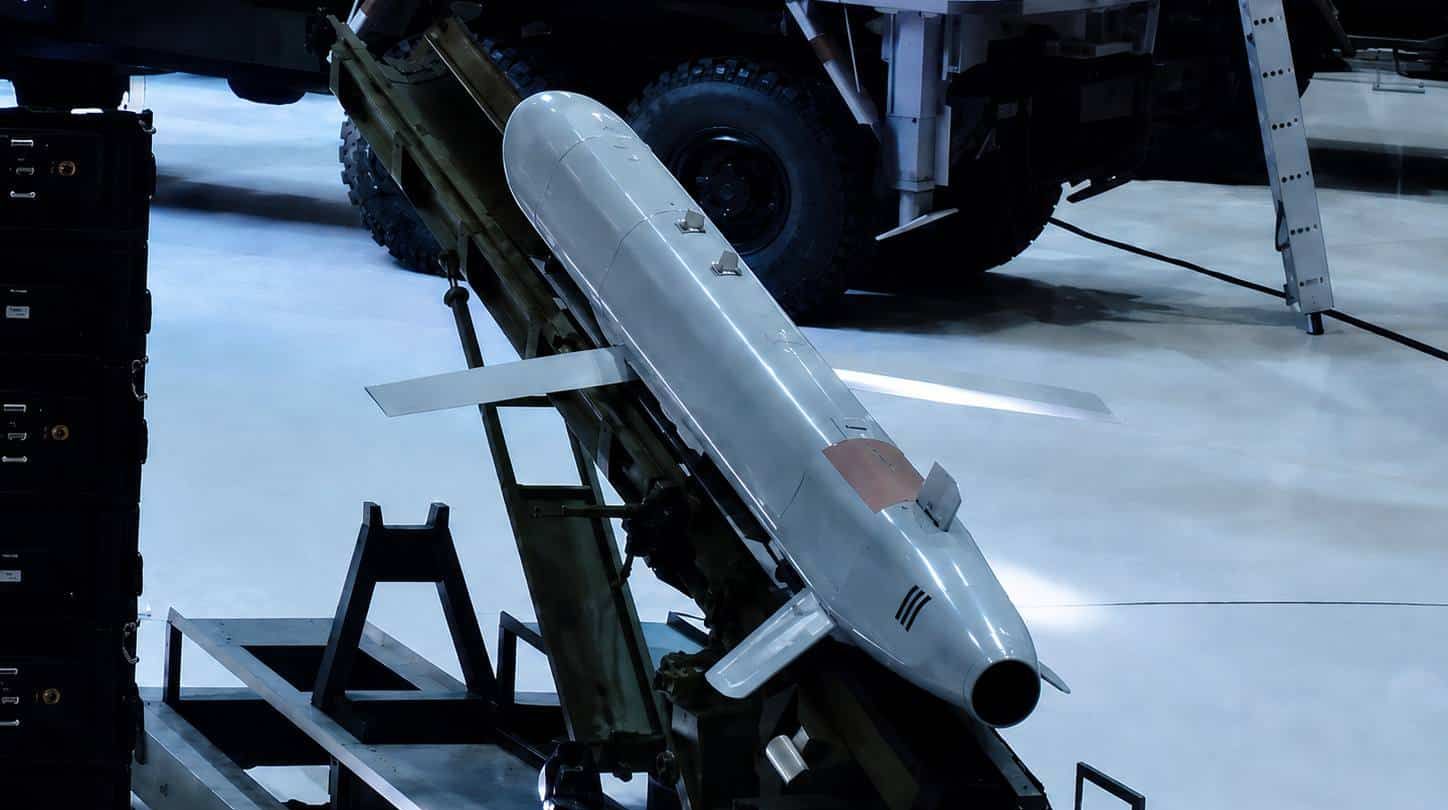
The Kronshtadt S8000 Banderol is a compact Russian cruise missile developed for strikes against fixed targets. It was initially associated with the Kronshtadt Orion unmanned aircraft, but later reports identified launches from Mi-28 helicopters and ground-based launchers.
Ukrainian military intelligence disclosed the weapon publicly in May 2025 after obtaining relatively intact examples. Examination of recovered missiles indicated that the design combined Russian systems with numerous commercially available foreign components.
The missile entered combat use during the Russo-Ukraine War. Reported characteristics place it between slower one-way attack drones and larger conventional cruise missiles in speed, payload, and cost.
Development and production
The available evidence does not establish when development formally began. Analysts cited by Ukrainian media reported that the missile may have been observed during testing at the Kapustin Yar range in late 2024. Its first clearly documented physical examples were recovered and examined in 2025.
According to Ukrainian intelligence, comparisons between missile remains from 2025 and 2026 showed continuing design changes. In July 2026, intelligence officials reported that testing had been completed and serial production had begun. They estimated production capacity at approximately 80 missiles per month, although this figure has not been independently confirmed.
The initial launch platform was the Orion unmanned aircraft manufactured by Kronshtadt. Integration with the Mi-28 attack helicopter was subsequently reported. By 2026, Russian forces were also reportedly launching the missile from a newly developed ground system in occupied Crimea. Ground launch may require a booster or other changes because an aircraft-launched missile begins its flight with greater altitude and forward speed, but the available sources do not identify the precise modifications.
Design
Airframe
The S8000 has a conventional cruise-missile arrangement with a slender fuselage and folding wings. Reported dimensions are approximately 5 m in length, 0.30 m in body diameter, and 2.2 m across the deployed wings. The compact configuration permits carriage by an unmanned aircraft and other comparatively light launch platforms.
Ukrainian intelligence described the missile as more maneuverable than several larger Russian cruise missiles. This characteristic reportedly permits turns with a smaller radius while retaining a conventional cruise-missile flight profile.
Powerplant
Propulsion is provided by a Chinese Swiwin SW800Pro-series turbojet originally marketed for large model aircraft. The engine reportedly weighs about 8.5 kg and produces approximately 800 N, or 81.6 kgf, of thrust at its maximum rotational speed of about 65,000 rpm. Aviation kerosene is used as fuel.
Reported cruising speed is 520–560 km/h, while maximum speed is generally given as 620–650 km/h. Some published descriptions cite a maximum of about 700 km/h. The claimed maximum range is 500 km, although Ukrainian intelligence has also reported an effective range of approximately 350–400 km.
Guidance and control
The guidance system combines inertial navigation with satellite navigation. Recovered equipment reportedly included a six-axis inertial measurement unit, a Russian Kometa-M8 controlled-reception-pattern antenna, an RFD900x telemetry modem, Murata batteries, and Dynamixel MX-64AR servos.
Investigators identified components originating in China, the United States, Switzerland, Japan, South Korea, and Australia. These included commercially available microcontrollers, sensors, communications equipment, batteries, and control actuators. A detailed summary of the recovered components was published through the Ukrainian War and Sanctions project and reported by the New Voice of Ukraine.
Warhead
The missile carries an OFBCh-150 fragmentation and high-explosive warhead. Detailed examination gave the warhead assembly a mass of 114.3 kg, including approximately 49.5 kg of explosive. Earlier descriptions used a rounded combat-load figure of about 150 kg; this should not be interpreted as the confirmed mass of the complete OFBCh-150 assembly.
Operational history
Russia began using the S8000 against Ukraine by 2025. Ukrainian intelligence reported that early attacks were launched from Orion unmanned aircraft. Later launches were attributed to Mi-28 helicopters and ground launchers positioned in Russian-occupied Crimea.
By July 2026, the weapon was reportedly being used more frequently against fixed targets in southern Ukraine, including ports, logistics facilities, terminals, and warehouses. Investigators associated numerous fragments recovered after attacks on Odesa with the S8000.
On 17 August 2026, a missile identified by Ukrainian authorities as a Banderol crossed into Moldova near Transnistria and continued toward the central part of the country. Moldova's Ministry of Defence reported detecting an unidentified aerial object on a route from Cuciurgan toward Tiraspol. The central sector of Moldovan airspace was closed for approximately 15 minutes. The object subsequently disappeared from radar near Talmaza, where authorities examined recovered wreckage.
Launch platforms
- Kronshtadt Orion: The original and principal air-launch platform identified in early reports.
- Mi-28: Russian attack helicopter reported as an additional air-launch platform.
- Ground launcher: A launcher documented in 2026 and reportedly used from occupied Crimea. Details of its configuration and any missile modifications remain limited.
Operators
- Russian Armed Forces: The only confirmed operator. The missile has been used during the Russo-Ukraine War since at least 2025.
Specifications (S8000 Banderol)
General characteristics
- Type: Cruise missile
- Length: Approximately 5 m
- Body diameter: Approximately 0.30 m
- Wingspan: Approximately 2.2 m with wings deployed
- Engine: Swiwin SW800Pro-series turbojet
- Engine mass: Approximately 8.5 kg
- Engine thrust: Up to approximately 800 N (81.6 kgf)
- Fuel: Aviation kerosene
- Guidance: Inertial and satellite navigation
Performance
- Cruising speed: Approximately 520–560 km/h
- Maximum speed: Approximately 620–650 km/h; some sources report up to 700 km/h
- Claimed maximum range: Up to 500 km
- Reported effective range: Approximately 350–400 km
Armament
- Warhead: OFBCh-150 fragmentation and high-explosive warhead
- Warhead assembly mass: Approximately 114.3 kg
- Explosive mass: Approximately 49.5 kg
 Argentina
 Armenia
 Australia
 Austria
 Austria-Hungary
 Belgium
 Brazil
 United Kingdom
 United States
 Brunei
 Bulgaria
 Canada
 Chile
Chile China
China Colonial America
 Colombia
 Confederate States
 Croatia
 Czech
Czech Denmark
 Egypt
Egypt Finland
 France
 Georgia
 Germany
 German Imperial
 Greece
 Holland
 Hungary
 India
India Indonesia
 Iran
Iran Iraq
Iraq Ireland
 Israel
 Italy
Italy Japan
Japan Japan (1940)
 Jordan
 Kingdom of Italy
 Malaysia
 Mexico
 Myanmar
 Nazi Germany
 Netherlands
 New Zealand
 North Korea
 Norway
 Pakistan
 Peru
Peru Philippines
 Poland
 Portugal
 Prussia
 Romania
 Saudi Arabia
 Serbia
 Singapore
 Slovakia
 Slovenia
 South Africa
 South Korea
 Soviet Union
 Spain
Spain Sweden
 Switzerland
 Syria
Syria Taiwan
 Thailand
 Turkey
 UAE
UAE Ukraine
 Vietnam
 Yugoslavia