
History
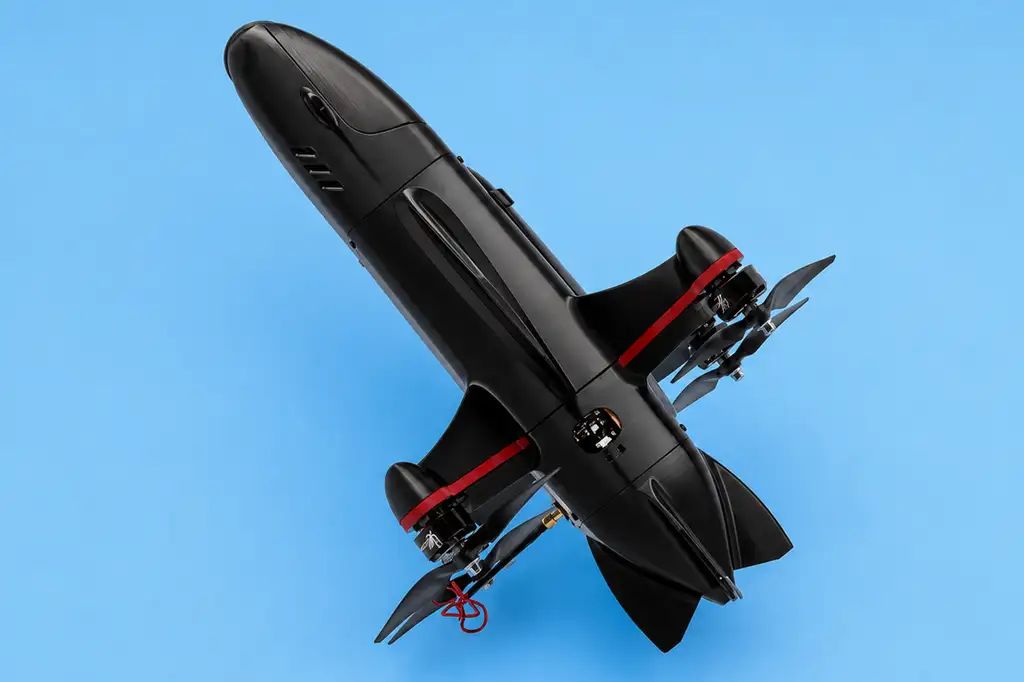
The F-Drones LITAVR+ is a Ukrainian high-speed interceptor unmanned aerial vehicle developed to counter Shahed-type attack drones, including faster jet-powered versions. It is an upgraded development of the earlier LITAVR interceptor and is reported to exceed 400 km/h.
LITAVR+ retains the general form factor of the original LITAVR but uses different motors, electronics, and associated control systems to achieve higher speed. F-Drones also incorporates its own navigation, flight-control, and terminal-guidance technologies.
By August 2026, LITAVR+ had completed factory testing and entered combat trials. F-Drones released footage showing an interception of a jet-powered Shahed-type UAV, while reporting that the system was already available for Ukrainian military orders.
Development
The original LITAVR was developed by F-Drones as an interceptor for hostile unmanned aircraft. Development of that earlier system began in autumn 2024. It was successfully tested and codified during summer 2025, followed by serial production and deliveries to the Ukrainian military in autumn 2025, according to information reported from the Ukrainian Ministry of Defense by Interfax-Ukraine.
The appearance of faster jet-powered Shahed-type attack drones created a requirement for greater interceptor speed. F-Drones responded with LITAVR+, preserving the basic configuration of the existing interceptor while changing its motors and electronics. The company first demonstrated the upgraded version on 22 May 2026 with additional target-identification functions and an automatic target-destruction system.
In August 2026, F-Drones chief executive Stanislav Khutor stated that LITAVR+ could reach more than 400 km/h. Reports from Defender Media, Gordon, and Ukrainian News consistently described the aircraft as an enhanced version intended specifically for high-speed Shahed interception.
Testing
By August 2026, F-Drones stated that LITAVR+ had successfully completed factory testing and was undergoing combat trials. Company-provided footage showed a successful engagement against a jet-powered Shahed-type target. The available reporting therefore supports confirmed flight and interception testing, but does not establish full-scale service introduction of LITAVR+ as a distinct production variant.
Design
LITAVR+ uses the same general form factor as the earlier LITAVR but incorporates different motors and electronics. F-Drones states that the engines, flight controllers, and LARAG software used in its interceptor family are developed by the company.
Navigation and guidance
The interceptor is equipped with a proprietary navigation system designed to operate without GPS. It also uses automatic terminal guidance described as Last Mile or Pixel Lock. In the earlier LITAVR implementation, the system identifies the target and automatically guides the aircraft during the final approach, while the pilot retains control of speed. Reporting on LITAVR+ indicates that the upgraded version retains this terminal-guidance concept.
F-Drones also provides remote-control technology that allows an operator to control the interceptor from a location far from the actual interception area. The company has described this capability as permitting control from virtually anywhere in the world when the required communications infrastructure is available.
Sensors
The LITAVR interceptor family uses an optical system with separate daylight and thermal-imaging cameras. The operator can switch between the two channels during flight. Available sources do not establish whether the LITAVR+ sensor package differs from that of the preceding LITAVR.
Predecessor characteristics
The earlier LITAVR provides useful context for the development of LITAVR+, but its published performance figures should not be treated as confirmed specifications for the upgraded model. The original interceptor was reported with a maximum speed of 350 km/h, flight endurance of up to 15 minutes, an operational radius of 40 km, and a maximum flight altitude of 9,000 m. A Ukrainian unit reportedly achieved a flight of 84 km from the launch point. The earlier model carried a 500 g warhead in the nose and could be supplied either with an empty container for local explosive installation or with a completed warhead.
Program status
As of August 2026, LITAVR+ was in combat testing after successful factory trials. F-Drones stated that the system had already demonstrated successful interception of a jet-powered Shahed-type UAV and was available for order by the Ukrainian military. UA.NEWS likewise reported that the upgraded interceptor had reached the combat-testing phase and had recorded a successful strike.
The available sources do not provide confirmed production quantities, unit assignments, or a formal service-entry date for LITAVR+ as a separate variant.
Variants
- LITAVR: Earlier interceptor UAV developed by F-Drones. It entered serial production and military deliveries in 2025 and has a reported maximum speed of 350 km/h.
- LITAVR+: High-speed upgraded version using different motors and electronics while retaining the predecessor's general form factor. It exceeds 400 km/h and was undergoing combat trials in August 2026.
Specifications (LITAVR+)
General characteristics
- Manufacturer: F-Drones
- Country of origin: Ukraine
- Type: Interceptor unmanned aerial vehicle
- Primary role: Interception of high-speed Shahed-type attack UAVs
- Navigation: Proprietary GPS-independent navigation system
- Terminal guidance: Automatic Last Mile or Pixel Lock target guidance
- Control: Remote pilot control with long-distance operating capability
Performance
- Maximum speed: More than 400 km/h
 Argentina
 Armenia
 Australia
 Austria
 Austria-Hungary
 Belgium
 Brazil
 United Kingdom
 United States
 Brunei
 Bulgaria
 Canada
 Chile
Chile China
China Colonial America
 Colombia
 Confederate States
 Croatia
 Czech
Czech Denmark
 Egypt
Egypt Finland
 France
 Georgia
 Germany
 German Imperial
 Greece
 Holland
 Hungary
 India
India Indonesia
 Iran
Iran Iraq
Iraq Ireland
 Israel
 Italy
Italy Japan
Japan Japan (1940)
 Jordan
 Kingdom of Italy
 Malaysia
 Mexico
 Myanmar
 Nazi Germany
 Netherlands
 New Zealand
 North Korea
 Norway
 Pakistan
 Peru
Peru Philippines
 Poland
 Portugal
 Prussia
 Romania
 Russia
 Saudi Arabia
 Serbia
 Singapore
 Slovakia
 Slovenia
 South Africa
 South Korea
 Soviet Union
 Spain
Spain Sweden
 Switzerland
 Syria
Syria Taiwan
 Thailand
 Turkey
 UAE
UAE Vietnam
 Yugoslavia