



History of Sukhoi Su-70 Okhotnik (fighter)
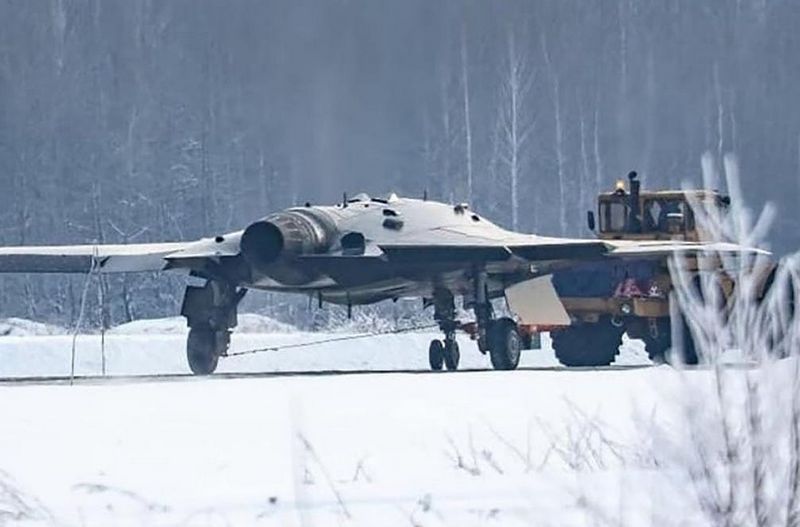
Russia's first entry into the heavy unmanned combat aircraft (UCAV) field appears to be the 6th generation Sukhoi Su-70 "Okhotnik-B" ("Hunter-B"). Images of the completed form surfaced in mid/late January, showing a large drone with a three-wheeled landing gear and full-flying-wing configuration being towed by an agricultural vehicle.
Development of the type is believed to have been ongoing since around 2012, with a launch in mid-2018, followed by ground testing. Okhotnik-B is still in the early stages of development and represents a major step forward in Russia's desire to catch up with the West in UAV/UCAV capabilities.
The Su-70 is in the same class as Northrop Grumman's X-47B, a carrier-based drone with flying wings - and looks very similar. When in service in Russia, these aircraft can serve as unescorted escorts for the new generation of Su-57 fighter jets, also developed by Sukhoi.
A true flying wing design, the Su-70 does away with all vertical planes, keeping all control surfaces on the hybrid wing body shape. This includes common surfaces required for ailerons, flaps, and roll, pitch, etc. maneuvers.
Hybrid wing body shapes are a well-accepted approach to indicating a low-profile design with inherent stealth characteristics. The tricycle landing gear assembly has a typical ground handling configuration: two main legs are attached to one front leg. All of this can be retracted to the bottom of the plane to maintain aerodynamic efficiency at high speeds. Additionally, the front legs feature a dual-wheel arrangement, while the main legs feature large wheels, indicating the support needed for such a large, heavy vehicle. The powerplant used is a Sukhoi turbofan engine buried in the rear of the body and exhausted through a circular port at the rear of the vehicle.
Use a single engine configuration. Engines are drawn through trapezoidal air intakes above and aft of the wing nose (as on the X-47B).
An internal arsenal is also assumed, supporting various operational air-to-surface missiles and precision-guided bombs of the Russian Air Force. Other assumptions can also be made based on existing developments in the West: autonomous capabilities of satellite-based inertial navigation systems (INS), real-time mission/system reporting, protected data links, etc.
The dimensions and performance information on this page are estimates by the author and do not represent official information.
The aircraft was actively tested at the Novosibirsk Aircraft Production Organization (NAPO), which has experience building other Sukhoi types, such as the Su-34 Defender fighter-bomber.
This article will be updated with new information.
Specification
Basic
Production
Roles
- Ground Attack
- Reconnaissance (RECCE)
- X-Plane / Development
- driverless
Dimensions
38.22 ft (11.65 m)
65.62 ft (20 m)
10.17 ft (3.1 m)
Weight
20,000 kg
25,000 kg
Performance
Performance
870 mph (1,400 km/h; 756 knots)
39,370 ft (12,000 m; 7.46 mi)
3,728 miles (6,000 km; 3,240 nautical miles)
Armor
Assumes support for air-to-surface missiles and precision-guided bombs from the two internal weapons bays.
Eliminated up to 4,410 pounds of air-launched/air-dropped munitions.
Changes
S-70 "Okhotnik-B" - the name of the basic series.
 Argentina
 Armenia
 Australia
 Austria
 Austria-Hungary
 Belgium
 Brazil
 United Kingdom
 United States
 Brunei
 Bulgaria
 Canada
 Chile
Chile China
China Colonial America
 Colombia
 Confederate States
 Croatia
 Czech
Czech Denmark
 Egypt
Egypt Finland
 France
 Georgia
 Germany
 German Imperial
 Greece
 Holland
 Hungary
 India
India Indonesia
 Iran
Iran Iraq
Iraq Ireland
 Israel
 Italy
Italy Japan
Japan Japan (1940)
 Jordan
 Kingdom of Italy
 Malaysia
 Mexico
 Myanmar
 Nazi Germany
 Netherlands
 New Zealand
 North Korea
 Norway
 Pakistan
 Peru
Peru Philippines
 Poland
 Portugal
 Prussia
 Romania
 Saudi Arabia
 Serbia
 Singapore
 Slovakia
 Slovenia
 South Africa
 South Korea
 Soviet Union
 Spain
Spain Sweden
 Switzerland
 Syria
Syria Taiwan
 Thailand
 Turkey
 UAE
UAE Ukraine
 Vietnam
 Yugoslavia