
History
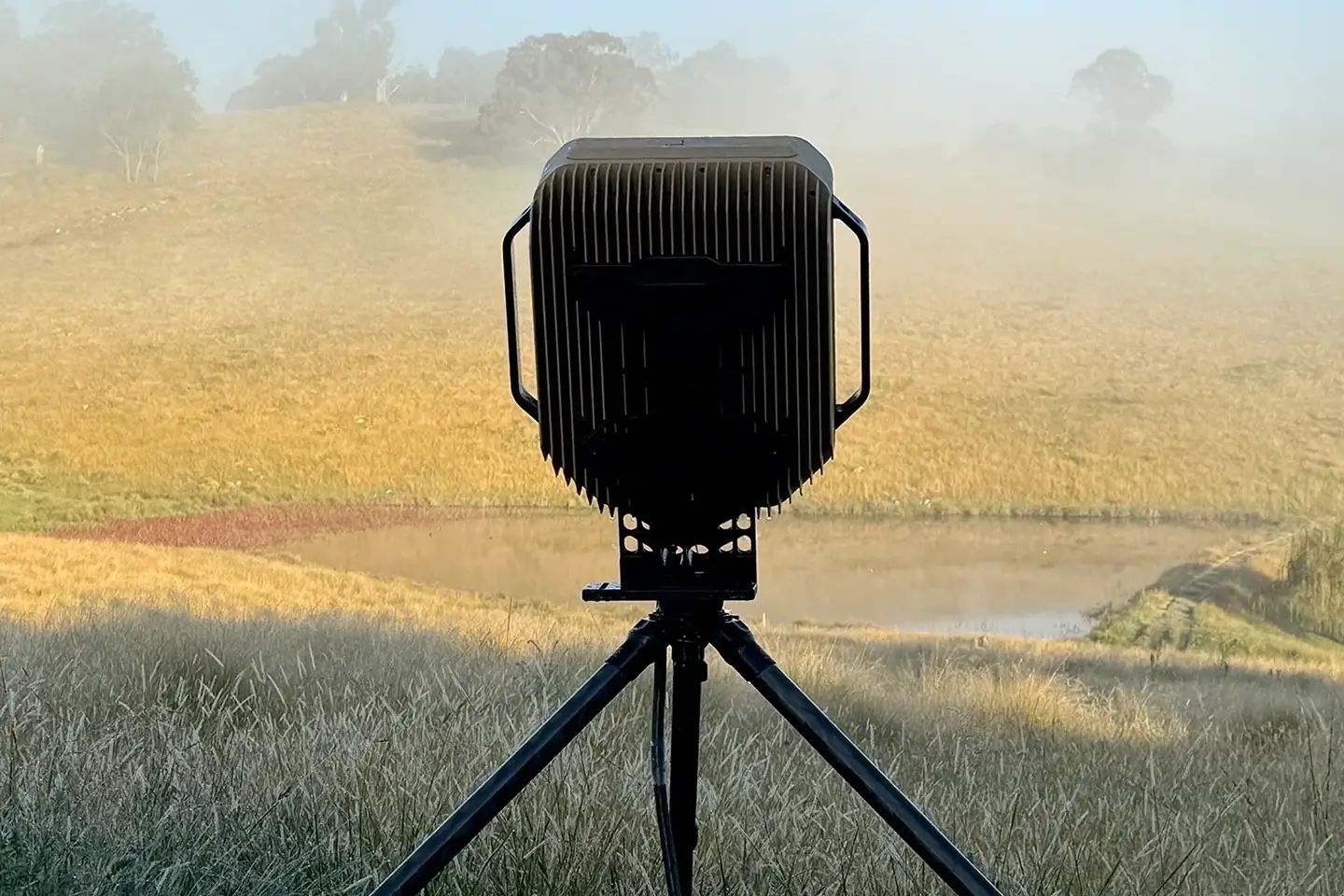
Echodyne MESA is a family of compact, solid-state electronically scanned radars developed in the United States. The platform supports air and surface surveillance for defense, border security, public safety, critical infrastructure protection, and unmanned aircraft operations.
MESA stands for Metamaterials Electronically Scanned Array. Echodyne combines this antenna architecture with software-defined beam control, target processing, and machine-learning classification to provide radar functions without a mechanically rotating antenna.
By June 2025, MESA technology supported the EchoGuard, EchoShield, and EchoFlight product lines. These systems addressed applications ranging from portable counter-unmanned aircraft surveillance to airborne detect-and-avoid operations. An AUVSI overview described operational applications in corrections, critical infrastructure, public safety, event security, and border monitoring.
Production expansion
In July 2026, Echodyne opened an 86,350-square-foot manufacturing facility in Washington State. It included approximately 74,350 square feet of production space and 12,000 square feet of warehousing. End-to-end radar manufacturing began at the site, which was designed for eventual output exceeding 30,000 MESA radars per year. The company reported a planned investment of $40 million in the facility. Details of the expansion appeared in a production report.
ATAK integration
On 28 July 2026, Echodyne announced an Android Team Awareness Kit plugin for the MESA platform. The plugin allows operators to configure and control radars and view their data directly within the ATAK environment. It was intended for organizations already using the Team Awareness Kit ecosystem for command-and-control, mission planning, mapping, and shared situational awareness.
The integration removes the need to operate a separate radar interface during ATAK-based missions. It supports both individual radars and distributed sensor networks, allowing connected users to incorporate radar tracks into a shared operating picture. The plugin became immediately available through the Echodyne customer portal as part of the company's Software & Support package. The release was documented by Military Aerospace.
Design
Electronically scanned antenna
MESA uses a fixed, solid-state electronically scanned array. Its beam is steered electronically rather than by rotating the antenna. Echodyne's metamaterials-based architecture is intended to simplify conventional electronically scanned array construction by avoiding the thousands of phase shifters associated with some traditional designs.
The compact antenna architecture allows MESA technology to be used in portable, fixed-site, vehicle-mounted, maritime, and airborne installations. The exact size, weight, coverage, and detection range depend on the radar model.
Search and tracking
The radar can search its field of view while maintaining tracks on detected objects. Echodyne describes this function as Search While Track. Radar resources can be concentrated on objects of interest while the system continues scanning elsewhere.
The software can form and direct beams in approximately 2,500 directions. Object data can be processed and transmitted ten times per second. High angular accuracy is intended to support precise cueing of cameras, thermal imagers, and other identification or response systems.
Software and classification
MESA is software-defined, allowing processing functions and operating behavior to be updated without replacing the antenna hardware. The platform combines algorithmic processing with data-driven machine-learning methods for target classification. It can monitor objects in air and surface environments, including unmanned aircraft, conventional aircraft, people, and vehicles when supported by the selected radar and installation.
The radar can exchange information with third-party command-and-control systems, video management systems, optical cameras, thermal imagers, and radio-frequency sensors. Echodyne presents the platform as a radar component within layered detection systems rather than as a complete identification or countermeasure system by itself. Additional information is available from the manufacturer's website.
Operational applications
MESA radars are used for counter-unmanned aircraft missions, force protection, border surveillance, intelligence and reconnaissance, and protection of critical infrastructure. As active sensors, the radars do not depend on a target transmitting Remote ID or another radio signal. This permits detection of objects that cannot be found through passive radio-frequency monitoring alone.
Public-safety applications include airspace monitoring for Drone as First Responder programs and beyond-visual-line-of-sight operations. Radar data can help operators identify traffic near an unmanned aircraft route and cue other sensors for confirmation. Ground and air tracking also supports perimeter security at correctional facilities, ports, utilities, campuses, and public events.
The ATAK plugin extends these functions into a mobile geospatial command-and-control environment. Operators can monitor radar information alongside maps, team positions, communications, and mission-planning data. Distributed radars can provide a common set of tracks to multiple connected users.
Variants
- EchoGuard: Compact radar weighing less than 1.36 kg for air and ground surveillance. It can be used in fixed installations or portable security systems.
- EchoShield: Larger radar intended for extended-range surveillance, sensitive-site protection, and mobile sensing. Its enclosure is approximately backpack-sized.
- EchoFlight: Lightweight airborne radar developed for detect-and-avoid functions on unmanned aircraft and advanced air-mobility platforms.
Technical characteristics (MESA platform)
- Radar architecture: Solid-state metamaterials electronically scanned array.
- Antenna movement: Fixed antenna with electronic beam steering.
- Operating functions: Simultaneous search and target tracking.
- Beam directions: Approximately 2,500 software-controlled directions.
- Object-data update rate: Up to ten transmissions per second.
- Surveillance domains: Air and surface, depending on the radar model and installation.
- Integration: Command-and-control software, ATAK, video management systems, cameras, thermal imagers, and radio-frequency sensors.
- Installation types: Fixed, portable, land-mobile, maritime, and airborne configurations across the product family.
 Argentina
 Armenia
 Australia
 Austria
 Austria-Hungary
 Belgium
 Brazil
 United Kingdom
 Brunei
 Bulgaria
 Canada
 Chile
Chile China
China Colonial America
 Colombia
 Confederate States
 Croatia
 Czech
Czech Denmark
 Egypt
Egypt Finland
 France
 Georgia
 Germany
 German Imperial
 Greece
 Holland
 Hungary
 India
India Indonesia
 Iran
Iran Iraq
Iraq Ireland
 Israel
 Italy
Italy Japan
Japan Japan (1940)
 Jordan
 Kingdom of Italy
 Malaysia
 Mexico
 Myanmar
 Nazi Germany
 Netherlands
 New Zealand
 North Korea
 Norway
 Pakistan
 Peru
Peru Philippines
 Poland
 Portugal
 Prussia
 Romania
 Russia
 Saudi Arabia
 Serbia
 Singapore
 Slovakia
 Slovenia
 South Africa
 South Korea
 Soviet Union
 Spain
Spain Sweden
 Switzerland
 Syria
Syria Taiwan
 Thailand
 Turkey
 UAE
UAE Ukraine
 Vietnam
 Yugoslavia