
History
The Turkish Aerospace KAAN P1 is the second flying prototype of Türkiye's KAAN fifth-generation fighter program. It is a single-seat, twin-engine test aircraft intended to evaluate a more representative airframe, integrated mission systems, and combat-aircraft functions than the earlier P0 flight demonstrator.
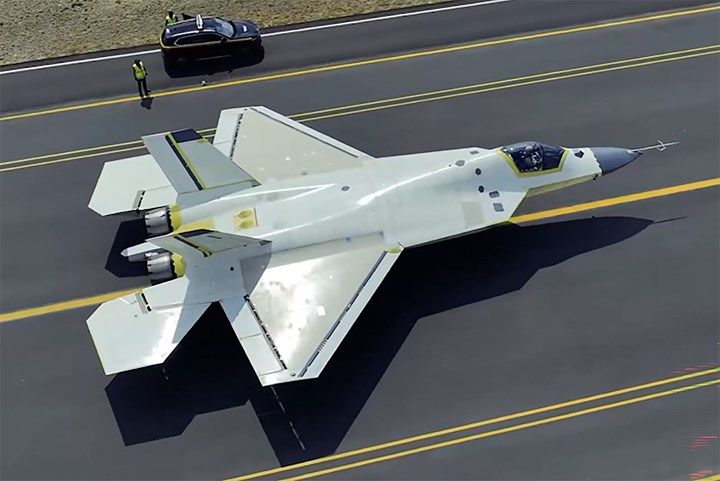
P1 began taxi trials under its own power at Turkish Aerospace facilities in Ankara on 31 July 2026. Images from the trials showed substantial changes to the nose, air intakes, center fuselage, landing gear, and sensor installations. The aircraft remained under development, and its first flight was planned for later in 2026.
The prototype is part of a national program led by Turkish Aerospace to develop a low-observable multirole fighter for the Turkish Air Force. KAAN is intended eventually to replace Türkiye's F-16 fleet while providing national control over aircraft integration, mission software, weapons certification, maintenance, and future modernization.
Program origins
Türkiye approved the development of a national next-generation fighter in December 2010. The original objective was to replace F-16 aircraft expected to leave Turkish service gradually from the 2030s. A conceptual design agreement followed in 2011, and Turkish Aerospace became the principal aircraft designer and manufacturer.
The Presidency of Defence Industries and Turkish Aerospace signed the KAAN development agreement on 5 August 2016. The program was originally known as TF-X and Milli Muharip Uçak, meaning National Combat Aircraft. Turkish Aerospace presented a full-scale mock-up at the Paris Air Show in June 2019.
The program calls for capabilities associated with fifth-generation fighters, including reduced radar and infrared signatures, internal weapon bays, sensor fusion, advanced electronic warfare equipment, high situational awareness, and networked operations. BAE Systems has provided engineering assistance, while Turkish organizations including ASELSAN, TÜBİTAK, TEI, and TAAC contribute mission systems, sensors, propulsion work, landing gear, and other equipment.
P0 flight demonstrator
The first aircraft, subsequently identified as P0, began ground testing in March 2023. It made the KAAN program's first flight on 21 February 2024. The sortie lasted 13 minutes, reached 2,438 m (8,000 ft), and attained 230 knots. A second flight on 6 May 2024 lasted 14 minutes and reached 3,048 m (10,000 ft), again at 230 knots. A twin-engine afterburner ground test followed in December 2024.
P0 primarily demonstrated basic flightworthiness and provided data for flight-control, aerodynamic, structural, and systems development. It flew publicly with its landing gear extended and carried a long air-data boom on the centerline of the nose. Experience from P0 contributed to the more representative P1 and P2 prototypes.
P1 construction and taxi testing
Images of the P1 fuselage appeared publicly in September 2025. Turkish authorities presented P1 and other KAAN test airframes to the press in February 2026. Unlike P0, P1 was described as an aircraft for broader fighter testing, with more flight and avionics equipment incorporated into its configuration.
On 31 July 2026, P1 moved under its own power during taxi trials. Taxi testing allows engineers to examine functions such as engine response, braking, nose-wheel steering, hydraulic operation, electrical generation, cockpit indications, and ground handling before flight. The available public footage did not identify every test point or demonstrate that all mission systems were operational. The trials and visible changes were independently reported by The Aviationist.
At the time of the taxi trials, Turkish officials expected P1 and the third prototype, P2, to begin flight testing during 2026. These dates remained program targets rather than completed milestones.
Design
Airframe
KAAN P1 retains the general arrangement of a large, single-seat fighter with two engines, canted vertical stabilizers, trapezoidal wings, and internal weapons bays. Its external form nevertheless differs visibly from P0. The revisions indicate that P1 is not a duplicate of the first demonstrator but a later engineering configuration incorporating structural, aerodynamic, and systems-integration work.
The forward fuselage has a reworked profile, and the nose appears broader. P1 retains a flight-test air-data boom, but it is mounted away from the nose centerline on the starboard side. This temporary instrument supplies reference measurements during aerodynamic and flight-control testing. Its revised position may also leave the central nose area available for other equipment.
The lateral air intakes begin farther aft than on P0 and have deeper shoulders blended into the fuselage chines. Public views also suggest a broader center fuselage and increased separation between the engines. These changes may provide revised inlet airflow, internal volume, structural space, cooling routes, or room for avionics, fuel, and weapons. Internal duct geometry and radar-signature performance have not been publicly disclosed, so the effect of the changes cannot be quantified.
P1 has a lower and more compact ground stance than P0. Its landing gear appears more representative of the intended aircraft, with revised struts and a potentially wider main-wheel track. The nationally developed retractable tricycle landing gear includes nose-wheel steering, braking, actuators, locks, hydraulic components, control equipment, and position warnings. P1 is expected to support testing of gear retraction, gear-door operation, emergency extension, and handling with the landing gear stowed.
Panels, vents, and fairings around the engine bays and rear fuselage have also been revised. The stabilators have cleaner angular outlines, while the vertical-tail tips and areas near the stabilator roots differ from P0. Some features may remain temporary because P1 is a development aircraft rather than a final production configuration.
Cockpit and flight systems
KAAN has a single-seat cockpit designed to reduce pilot workload through integrated displays, automation, decision support, and sensor fusion. A Tulgar helmet-mounted display was visible inside P1 during its development. The helmet system is intended to present flight and mission information while allowing the pilot to cue sensors and weapons by head movement.
The aircraft's flight-control system supports a configuration designed for high maneuverability. The program also requires integrated monitoring and onboard testing to simplify maintenance and reduce preparation time between missions. The extent to which these functions were active on P1 during its July 2026 taxi trials was not disclosed.
Sensors and electronic warfare
One of P1's most important changes is the inclusion of conformal provisions for electro-optical and electronic-warfare equipment. A faceted installation ahead of the canopy occupies the planned location of ASELSAN's KARAT infrared search-and-track system. An angular fairing below the forward fuselage corresponds to the planned position of the TOYGUN electro-optical targeting system.
An infrared search-and-track sensor can passively detect and track airborne targets by their heat emissions. An electro-optical targeting system can support identification, tracking, and precision attack without requiring a conventional external targeting pod. Their installation within the aircraft's contours can preserve aerodynamic cleanliness and support low-observable design objectives.
The visible housings do not prove that complete operational sensors, processors, cooling systems, or fusion software were installed during the taxi tests. They nevertheless show that the P1 airframe provides space, viewing angles, structural attachment points, power, and thermal provisions for these systems.
Contrasting panels near the leading edges and tips of the canted vertical stabilizers appear consistent with conformal radio-frequency apertures. Such installations could support radar warning, electronic support, communications, or countermeasures. Turkish Aerospace has not published a complete antenna-location diagram for P1, so individual panels cannot yet be assigned confirmed functions.
The wider KAAN mission-system plan includes an active electronically scanned array radar, integrated electronic warfare equipment, secure communications, navigation and identification systems, automatic target recognition, and fusion of information from onboard and external sources. The Turkish Aerospace KAAN program page describes these as program capabilities, not as demonstrated operational performance of P1.
Powerplant
P1 uses two General Electric F110-GE-129 afterburning turbofan engines. The F110 supports the prototype and early production phases, but it remains subject to United States export controls. Türkiye is developing the indigenous TEI TF35000 engine for later KAAN production aircraft. The domestic engine had not powered P1 at the time of its taxi trials.
The twin-engine arrangement provides the thrust required by the aircraft's size and intended performance. It also shapes the rear fuselage, internal ducting, fuel system, cooling arrangements, and space available for internal weapons. Turkish Aerospace publishes a design thrust of approximately 131 kN (29,000 lbf) per engine with afterburner.
Armament provisions
KAAN is designed with internal weapon bays to carry weapons while limiting external radar reflections. P1's wider central body, revised intake positions, and changed landing-gear arrangement provide a more representative configuration for evaluating internal packaging. Public taxi-test material did not confirm an installed operational weapon load.
The wider program is intended to support air-to-air and air-to-ground weapons, including nationally developed missiles and precision-guided munitions. Integration, separation testing, and certification of individual weapons are separate development tasks. A weapon associated with the KAAN program should therefore not be treated as operational on P1 without specific test evidence.
Program status
As of August 2026, KAAN P1 was a development prototype undergoing pre-flight ground testing. It had demonstrated self-powered taxiing but had not yet made a publicly confirmed first flight. The planned 2026 flight-test campaign was expected to examine its revised aerodynamics, landing gear, propulsion integration, flight controls, and progressively installed mission systems.
P2 was being prepared as another advanced prototype. Turkish plans have referred to six prototypes for development and qualification work, including dedicated ground-test airframes. Multiple test aircraft allow structural, flight, avionics, weapons, and systems work to proceed in parallel.
The Turkish Air Force is the intended domestic user of production KAAN aircraft. Development plans have included a Block 0 configuration followed by Block 1 aircraft, with deliveries targeted around the beginning of the 2030s. Indonesia signed an agreement concerning 48 future KAAN fighters in 2025, but neither Indonesia nor the Turkish Air Force operated the P1 prototype.
Variants
- P0: Initial flight demonstrator used to establish basic flightworthiness and collect early aerodynamic and flight-control data. It first flew in February 2024.
- P1: Second flying prototype and the subject of this article. It incorporates revised aerodynamics, more representative landing gear, and provisions for integrated sensors and mission systems. Taxi testing began in July 2026.
- P2: Third prototype developed alongside P1. It is intended to expand the flight and systems test campaign.
- Block 0: Planned initial aircraft configuration for continued development and early production activity.
- Block 1: Planned later configuration associated with initial Turkish Air Force deliveries.
Specifications (KAAN P1)
Turkish Aerospace has not published a separate final specification sheet for P1. The following preliminary figures are the manufacturer's published KAAN program values associated with the configuration represented by the prototype. They are design targets and should not be interpreted as performance already demonstrated by P1.
General characteristics
- Crew: One
- Type: Single-seat, twin-engine fighter development prototype
- Manufacturer: Turkish Aerospace
- Length: 20.3 m (66 ft 7 in)
- Wingspan: 13.4 m (44 ft)
- Height: 5 m (16 ft 5 in)
- Wing area: 71.6 m² (771 sq ft)
- Maximum takeoff weight: 34,750 kg (76,610 lb)
Powerplant
- Engines: Two General Electric F110-GE-129 afterburning turbofans
- Dry thrust: Approximately 76.3 kN (17,155 lbf) per engine
- Afterburning thrust: Approximately 131 kN (29,000 lbf) per engine
Planned performance
- Maximum speed: Mach 1.8 at 12,192 m (40,000 ft)
- Service ceiling: 16,764 m (55,000 ft)
- Design load limits: +9 g to −3.5 g
Equipment and armament provisions
- Sensors: Conformal provisions for infrared search-and-track and electro-optical targeting systems
- Electronic warfare: Distributed conformal apertures and planned integrated electronic-warfare equipment
- Weapons carriage: Internal weapon bays with provisions for additional external stations
- Flight-test equipment: Offset nose-mounted air-data boom
 Argentina
 Armenia
 Australia
 Austria
 Austria-Hungary
 Belgium
 Brazil
 United Kingdom
 United States
 Brunei
 Bulgaria
 Canada
 Chile
Chile China
China Colonial America
 Colombia
 Confederate States
 Croatia
 Czech
Czech Denmark
 Egypt
Egypt Finland
 France
 Georgia
 Germany
 German Imperial
 Greece
 Holland
 Hungary
 India
India Indonesia
 Iran
Iran Iraq
Iraq Ireland
 Israel
 Italy
Italy Japan
Japan Japan (1940)
 Jordan
 Kingdom of Italy
 Malaysia
 Mexico
 Myanmar
 Nazi Germany
 Netherlands
 New Zealand
 North Korea
 Norway
 Pakistan
 Peru
Peru Philippines
 Poland
 Portugal
 Prussia
 Romania
 Russia
 Saudi Arabia
 Serbia
 Singapore
 Slovakia
 Slovenia
 South Africa
 South Korea
 Soviet Union
 Spain
Spain Sweden
 Switzerland
 Syria
Syria Taiwan
 Thailand
 UAE
UAE Ukraine
 Vietnam
 Yugoslavia