
History
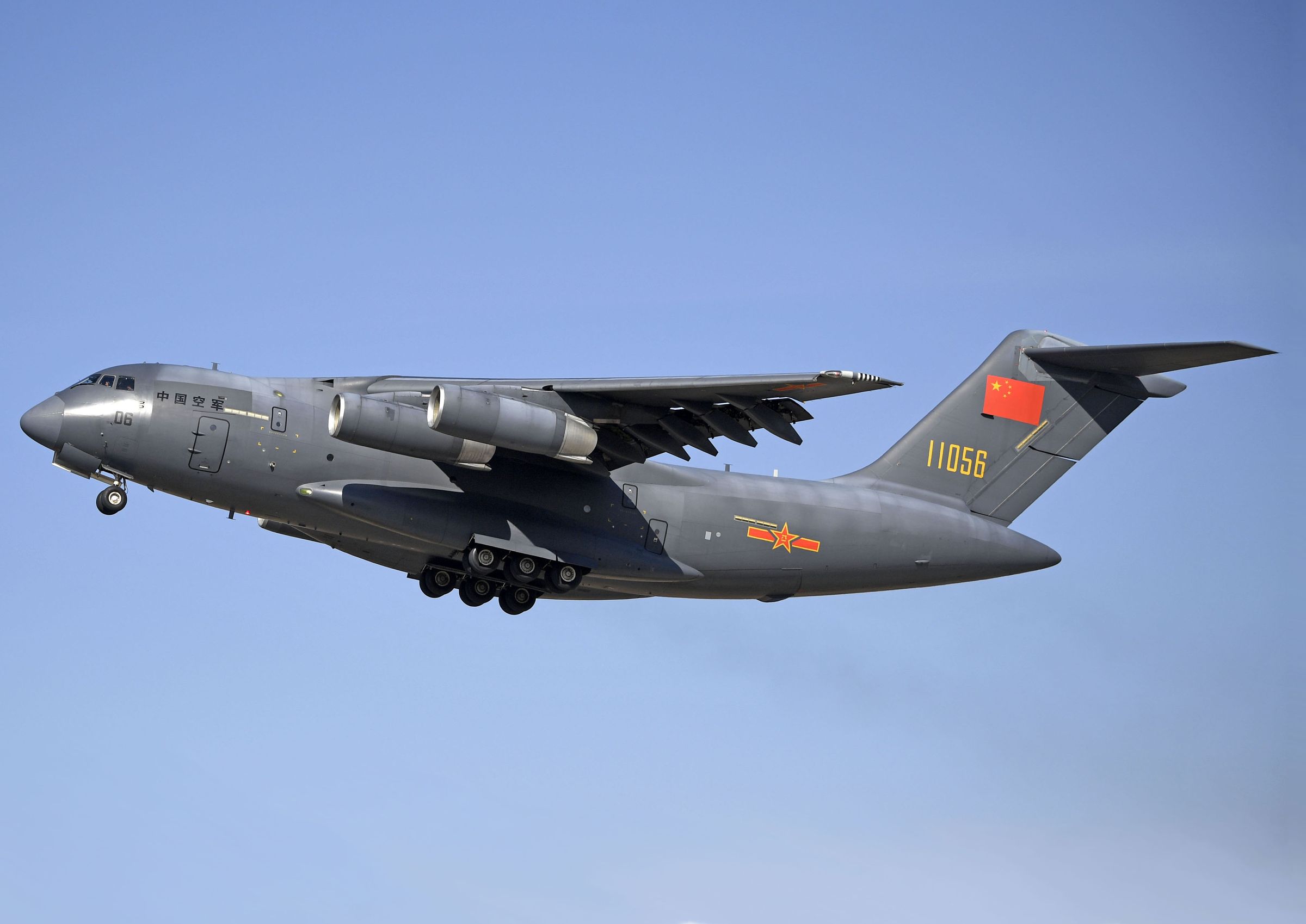
The Xi'an Y-20B Kunpeng is a strategic heavy-lift transport aircraft developed in China for the People's Liberation Army Air Force. It is a later member of the Y-20 family and is distinguished from the earlier Y-20A primarily by its domestically developed WS-20 high-bypass turbofan engines.
The Y-20B retains the Y-20 family's core long-range airlift role while adding a propulsion system intended to reduce dependence on the Russian-origin D-30KP Series II engines used by the Y-20A. Chinese state media has also described the Y-20B as a modular platform that can receive mission equipment for aerial refuelling and potentially other specialized roles.
Official Chinese material identifies the Y-20B separately from the dedicated YY-20A aerial tanker. Claims that a Y-20B can be reconfigured with refuelling pods therefore describe a modular capability of the transport platform rather than a replacement of the YY-20A designation.
Development
The original Y-20 entered service with the PLA Air Force on 6 July 2016. According to the Chinese Ministry of National Defense, the aircraft became China's first domestically developed new-generation large military transport aircraft and subsequently formed the basis of a wider family including the Y-20A, Y-20B and YY-20A.
The earliest clearly supported evidence of physically completed Y-20B aircraft in the available sources dates from November 2024, when five examples were observed at Kaifeng Air Base in satellite imagery. The PLA Air Force formally unveiled three Y-20Bs in September 2025. This makes 2024 the earliest supported year in which the exact Y-20B variant was physically identifiable.
On 22 April 2026, a Y-20B completed its first reported overseas mission when it flew to the Republic of Korea and returned to Shenyang carrying the remains of Chinese People's Volunteers. Chinese official reporting described this as the first overseas mission by a Y-20B powered by a domestically developed engine.
On 27 April 2026, multiple Y-20Bs participated in an elephant-walk training event. AVIC footage released on 30 June 2026 showed ten Y-20Bs together at Kaifeng, compared with the five observed there in November 2024. Janes reported that this indicated a substantial expansion of the visible Y-20B fleet.
In August 2026, Chinese state television described the Y-20B as capable of rapidly changing mission configuration through modular equipment. The reported concept includes fitting aerial-refuelling pods and associated systems, while airborne early-warning and electronic-warfare configurations were described as possible roles for the broader modular platform. The available material does not establish that those specialized configurations are operational.
Design
Airframe and cargo role
The Y-20B uses the basic configuration of the Y-20 heavy transport family, with a high-mounted swept wing, four turbofan engines and a large fuselage designed for personnel and heavy cargo. Published technical summaries give a length of about 47 m, a wingspan of about 50 m and a height of about 15 m.
The aircraft is intended for strategic airlift, including long-distance movement of personnel and heavy equipment. Secondary technical sources attribute a payload capacity of approximately 66,000 to 70,000 kg to the Y-20B. The Y-20 family has also demonstrated heavy-equipment airdrop and airborne-troop operations in PLA Air Force service.
Powerplant
The defining technical change of the Y-20B is its use of four domestically developed WS-20 high-bypass turbofan engines. Janes reports that the WS-20 is rated at approximately 127.5 kN of thrust per engine. The earlier Y-20A uses Russian-origin D-30KP Series II engines rated at 117.7 kN each.
AVIC footage released in 2026 provided a clear view of the WS-20's front fan. Janes described it as having 32 narrow-chord, high-aspect-ratio fan blades connected by snubbers and noted similarities with AECC's AEF1200 high-bypass turbofan design.
Mission equipment
Chinese state media has described the Y-20B as a modular aircraft capable of receiving different mission systems without permanently dedicating every airframe to a single role. The reported tanker configuration uses refuelling pods and associated equipment. Other roles mentioned by officials include airborne early warning and electronic warfare, but the available sources do not confirm operational Y-20B aircraft in those configurations.
Operational history
The PLA Air Force is the confirmed operator of the Y-20B. The variant was publicly associated with Kaifeng Air Base, where aircraft assigned to the 13th Transport Division's 37th Air Regiment have been identified.
The Y-20B's first reported international mission occurred on 22 April 2026 during the repatriation of the remains of Chinese People's Volunteers from the Republic of Korea. The flight demonstrated the overseas use of the WS-20-powered transport variant.
By June 2026, AVIC footage showed ten Y-20Bs participating together in an elephant walk. This provided visible evidence that production and fielding had progressed beyond the small number publicly revealed in 2025.
Variants
- Y-20A: Earlier production transport version powered by Russian-origin D-30KP Series II turbofan engines.
- Y-20B: Strategic transport variant powered by domestically developed WS-20 high-bypass turbofans and described as compatible with modular mission equipment.
- YY-20A: Dedicated aerial-refuelling member of the Y-20 family, officially listed separately from the Y-20B.
Operators
- People's Liberation Army Air Force: Confirmed operator of the Y-20B. Ten aircraft were shown together in AVIC footage released in June 2026, although the total fleet size is not established by the available sources.
Specifications (Y-20B)
General characteristics
- Type: Strategic heavy-lift transport aircraft
- Crew: 3
- Length: approximately 47 m
- Wingspan: approximately 50 m
- Height: approximately 15 m
- Maximum takeoff weight: approximately 220,000 kg
- Payload: approximately 66,000-70,000 kg
- Powerplant: 4 × WS-20 high-bypass turbofan engines
- Thrust: approximately 127.5 kN per engine according to Janes
Performance
Published secondary performance figures are not fully consistent. TheDefenseWatch lists a maximum speed of about 926 km/h, a range of about 7,800 km with payload and a ferry range of up to 10,000 km. A separate Mitchell Institute technical summary for the Y-20 family gives a maximum speed of 432 knots and a range of 2,000-2,800 nautical miles depending on load. Because the latter figures apply to the wider Y-20 family and the available sources do not provide an authoritative official Y-20B performance table, exact Y-20B speed and range figures should be treated as unconfirmed.
 Argentina
 Armenia
 Australia
 Austria
 Austria-Hungary
 Belgium
 Brazil
 United Kingdom
 United States
 Brunei
 Bulgaria
 Canada
 Chile
Chile Colonial America
 Colombia
 Confederate States
 Croatia
 Czech
Czech Denmark
 Egypt
Egypt Finland
 France
 Georgia
 Germany
 German Imperial
 Greece
 Holland
 Hungary
 India
India Indonesia
 Iran
Iran Iraq
Iraq Ireland
 Israel
 Italy
Italy Japan
Japan Japan (1940)
 Jordan
 Kingdom of Italy
 Malaysia
 Mexico
 Myanmar
 Nazi Germany
 Netherlands
 New Zealand
 North Korea
 Norway
 Pakistan
 Peru
Peru Philippines
 Poland
 Portugal
 Prussia
 Romania
 Russia
 Saudi Arabia
 Serbia
 Singapore
 Slovakia
 Slovenia
 South Africa
 South Korea
 Soviet Union
 Spain
Spain Sweden
 Switzerland
 Syria
Syria Taiwan
 Thailand
 Turkey
 UAE
UAE Ukraine
 Vietnam
 Yugoslavia