
History
The Kawasaki XEC-2 is a Japanese experimental stand-off electronic warfare aircraft based on the Kawasaki C-2 transport. It is being developed for the Japan Air Self-Defense Force (JASDF) to support air operations by collecting electronic information and jamming hostile communications, radar, and related functions from outside an adversary's threat envelope.
Japan began development of the stand-off electronic warfare aircraft in fiscal year 2020. The program is intended to rebuild and expand the JASDF's airborne electronic attack and electronic warfare capability after the retirement of older dedicated platforms.
A single XEC-2 prototype had been produced by 2026. It made its first flight in March 2026, entered formal JASDF flight testing in July, and is scheduled to complete the required evaluations in fiscal year 2026 ahead of planned service entry in 2027.
Development
The XEC-2 uses the large C-2 airframe as the basis for a dedicated stand-off electronic warfare platform. Japan's Ministry of Defense has described the mission as support for Japan Self-Defense Forces air operations through effective electromagnetic jamming. The aircraft is intended to detect and collect electronic information and to interfere with hostile communications, radar, and other electromagnetic functions while operating at stand-off range.
The prototype is associated with C-2 serial 68-1203 and was modified by Kawasaki Heavy Industries. Secondary reporting describes it as a conversion of a production C-2 rather than a newly built airframe. The C-2 was selected because its large airframe provides substantial internal volume and capacity for the power, cooling, processing, and operator equipment required by an electronic warfare mission system.
The program follows several earlier Japanese airborne electronic warfare and intelligence aircraft. The JASDF previously operated two YS-11EA aircraft, which Japan's Ministry of Defense said were decommissioned in late 2024. Separate reporting also identifies the EC-1, a C-1-based electronic warfare aircraft, as a predecessor in the same broad mission area. The XEC-2 is intended to provide a modern stand-off capability using the larger C-2 platform.
Flight testing
The JASDF released the first official images of the XEC-2 at Gifu Air Base in March 2026. Taxi trials were reported on 16 March, followed by the first flight on 17 March. The aircraft was formally transferred to the JASDF Air Development and Test Wing at Gifu in June 2026.
Formal testing and evaluation began on 15 July 2026. JASDF footage showed the XEC-2 flying with a Mitsubishi F-2 as a chase aircraft. Public ADS-B data cited by Janes showed the aircraft reaching a maximum barometric altitude of 23,500 ft during the 15 July flight.
The military test campaign is intended to evaluate the modified aircraft's flight performance, mission-system reliability, electromagnetic compatibility, maintenance requirements, operator workload, and operational suitability. Testing must also determine whether the additional fairings and electronic equipment can be operated without unacceptable effects on aircraft safety or performance. Army Recognition reported that the campaign would establish flight restrictions, operating limits, maintenance data, and procedures needed before operational acceptance.
In August 2026, Japan's Ministry of Defense told Janes that the program was progressing as planned. The ministry said flight testing was scheduled to be completed in fiscal year 2026, which extends into early 2027, and that the aircraft was planned to enter JASDF service in 2027 after completion of the required evaluations.
Design
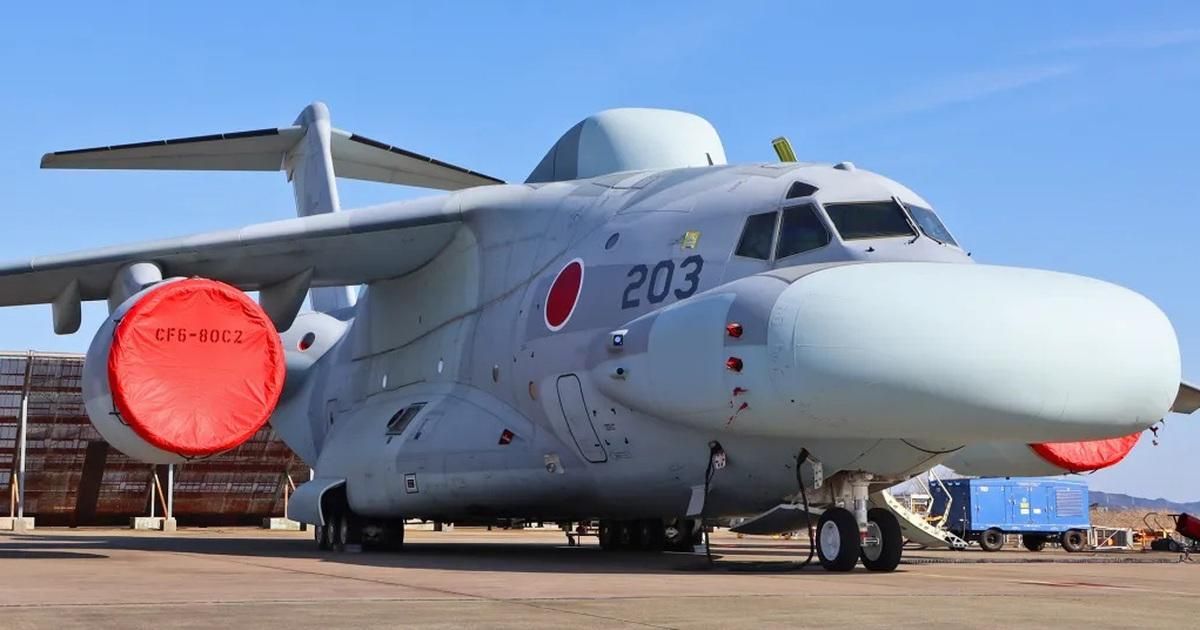
The XEC-2 retains the basic C-2 configuration, including its high-mounted wing, T-tail, rear cargo-ramp layout, and fly-by-wire flight controls, but the transport airframe has been extensively modified for electronic warfare equipment. The most visible change is a large enlarged nose housing. Additional prominent fairings are installed along the upper fuselage and on the rear sides of the aircraft between the wing and tail.
These external housings support a distributed electronic warfare installation rather than a single localized jammer. The arrangement is intended to provide antenna coverage in several sectors for receiving, identifying, and transmitting electromagnetic energy. Internal space is used for electronic receivers, transmitters, processors, operator consoles, power-conditioning equipment, and cooling systems.
Electronic warfare equipment
The XEC-2 is designed for stand-off electronic attack. Its mission is to support Japanese air operations by degrading hostile radar, communications, and other electromagnetic functions while remaining outside the most dangerous engagement zones. The aircraft is also intended to collect electronic information that can support the selection and use of jamming techniques.
The Aviationist reported that the J/ALQ-5 electronic countermeasures system is among the known equipment inherited from the earlier EC-1 lineage. Publicly released images do not disclose the full internal mission-system configuration, and detailed frequencies, transmitter power, antenna performance, and crew-station arrangement have not been released in the supplied sources.
Program status
As of August 2026, one XEC-2 prototype was in flight test with the JASDF Air Development and Test Wing at Gifu Air Base. The Ministry of Defense planned to complete the required evaluations during fiscal year 2026 and to introduce the aircraft into service in 2027 if the test program is completed successfully.
Japan had not publicly confirmed a final production quantity in the most authoritative supplied August 2026 reporting. Some secondary reports, including Defensehere, described a planned four-aircraft EC-2 fleet. However, the Ministry of Defense told Janes in August 2026 only that acquisition of additional XEC-2 aircraft was under consideration and that an update to the JASDF force structure was also being studied.
Variants
- XEC-2: Experimental and flight-test designation for the C-2-based stand-off electronic warfare aircraft. One prototype had been produced and was under JASDF evaluation in 2026.
- EC-2: Designation used in reporting for the planned operational form of the stand-off electronic warfare aircraft after qualification. Service entry is planned for 2027, subject to completion of testing and evaluation.
Operators
- Japan Air Self-Defense Force: One XEC-2 prototype assigned to the Air Development and Test Wing at Gifu Air Base for testing and evaluation as of 2026. Additional aircraft were under consideration.
Specifications (XEC-2 prototype)
General characteristics
- Manufacturer: Kawasaki Heavy Industries
- Base airframe: Kawasaki C-2 military transport aircraft
- Prototype identity: associated with C-2 serial 68-1203
- Configuration: crewed stand-off electronic warfare aircraft with enlarged nose and multiple dorsal and rear-fuselage mission-system fairings
- Flight controls: fly-by-wire, retained from the C-2 airframe
Mission equipment
- Primary role: stand-off electronic attack and electronic warfare support
- Functions: collection of electronic information and jamming of hostile communications, radar, and other electromagnetic functions
- Mission-system installation: distributed receivers, transmitters, processors, operator equipment, power-conditioning equipment, and cooling systems reported within the modified C-2 airframe
Related equipment
- Kawasaki C-2: transport aircraft that provides the base airframe for the XEC-2.
- Kawasaki RC-2: C-2-based signals-intelligence aircraft used for electronic intelligence collection; it is a separate specialized variant from the XEC-2.
- Kawasaki EC-1: earlier C-1-based Japanese electronic warfare aircraft whose mission equipment and experience contributed to the development lineage of the new platform.
- YS-11EA: earlier JASDF airborne electronic attack and electronic warfare aircraft; Japan's Ministry of Defense said the type was decommissioned in late 2024.
 Argentina
 Armenia
 Australia
 Austria
 Austria-Hungary
 Belgium
 Brazil
 United Kingdom
 United States
 Brunei
 Bulgaria
 Canada
 Chile
Chile China
China Colonial America
 Colombia
 Confederate States
 Croatia
 Czech
Czech Denmark
 Egypt
Egypt Finland
 France
 Georgia
 Germany
 German Imperial
 Greece
 Holland
 Hungary
 India
India Indonesia
 Iran
Iran Iraq
Iraq Ireland
 Israel
 Italy
Italy Japan (1940)
 Jordan
 Kingdom of Italy
 Malaysia
 Mexico
 Myanmar
 Nazi Germany
 Netherlands
 New Zealand
 North Korea
 Norway
 Pakistan
 Peru
Peru Philippines
 Poland
 Portugal
 Prussia
 Romania
 Russia
 Saudi Arabia
 Serbia
 Singapore
 Slovakia
 Slovenia
 South Africa
 South Korea
 Soviet Union
 Spain
Spain Sweden
 Switzerland
 Syria
Syria Taiwan
 Thailand
 Turkey
 UAE
UAE Ukraine
 Vietnam
 Yugoslavia