

History
In August 2026, Russian forces were reported to have begun using a previously unidentified kamikaze unmanned aerial vehicle carrying two anti-tank mines. The configuration was documented by Militarnyi, citing Ukrainian defense technology adviser Serhii Flash.
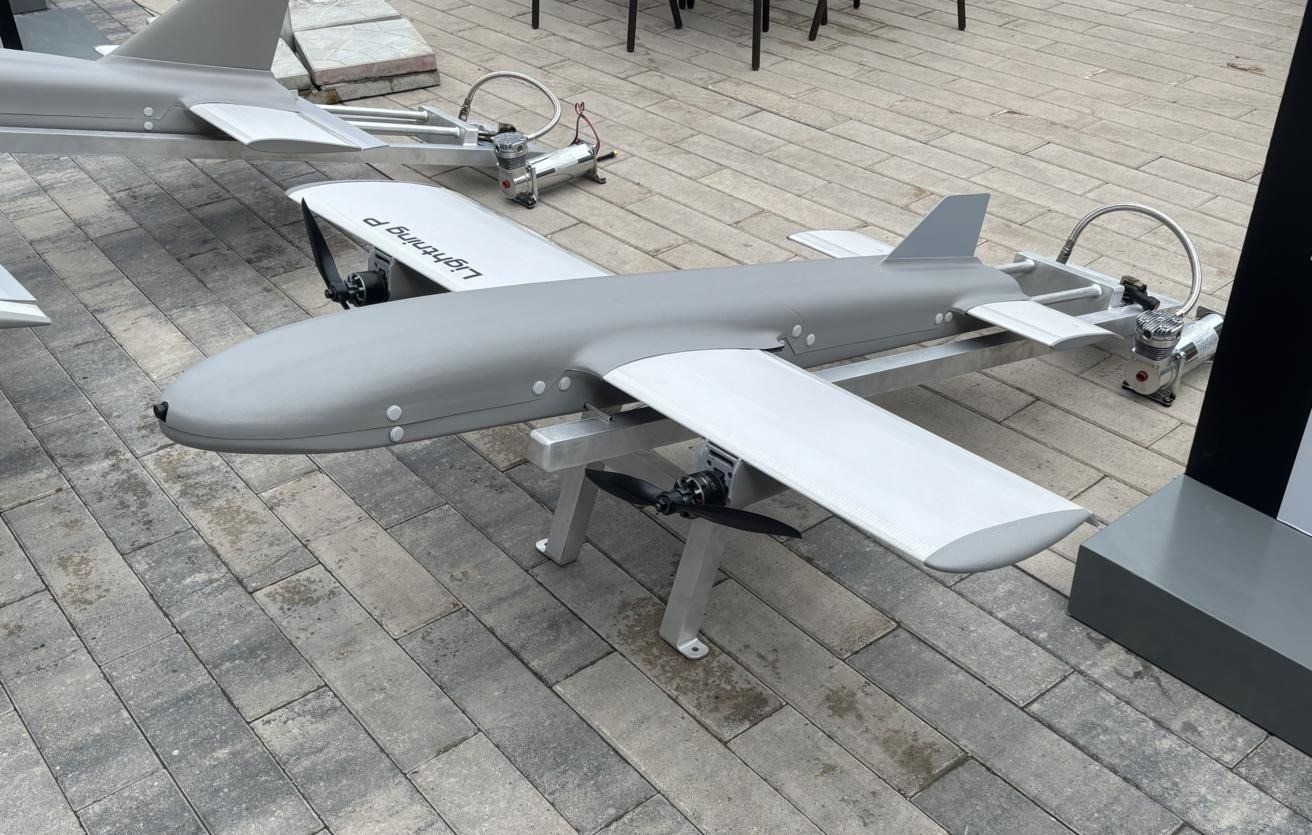
The aircraft visually resembles UAVs of the Russian Molniya family. It has a twin-boom layout, a central equipment section containing the battery, a large wing and tail assembly, and two electric motors. Its nose carries two anti-tank mines assessed as likely TM-62s.
No exact model designation or manufacturer was identified in the available reporting. The aircraft was assessed as a possible development of the Molniya family rather than conclusively identified as a specific Molniya variant.
The two-mine arrangement has precedent within the wider family. Molniya-2 drones had previously been observed carrying TM-62 mines, although the reported aircraft differs sufficiently in overall configuration to have been treated as an unidentified type.
Design
Airframe
The UAV uses a twin-boom airframe with the main equipment and battery compartment positioned centrally. Its wing and empennage are comparatively large. The available assessment suggested that the enlarged aerodynamic surfaces may increase lift, range and gliding time, although no measured performance figures were reported.
An unidentified element is fitted toward the rear of the airframe. It may function as a counterweight for the heavy nose-mounted payload. This interpretation is based on the apparent need to prevent the aircraft's center of mass from moving excessively forward when the mines are installed.
Powerplant
The aircraft has two electric motors of unidentified type. One motor is mounted on each side of the wing. No motor ratings, battery capacity, endurance or speed figures have been reported.
Armament
The observed attack configuration carries two anti-tank mines in the nose. They were assessed as likely TM-62 mines, but the exact mine subtype was not confirmed. The arrangement makes the UAV a one-way attack platform in the reported configuration.
Operational history
Russian forces were reported using the unidentified UAV during the Russian invasion of Ukraine by August 2026. Comments associated with the original report stated that aircraft of this type had already been seen flying toward Snihurivka. Those sightings were not independently confirmed in the supplied reporting.
The evidence available in August 2026 established the existence of the physical configuration and its reported operational use, but did not identify a formal designation, manufacturer, production status or quantity in service.
Specifications (unidentified Molniya-family kamikaze UAV)
General characteristics
- Type: One-way attack unmanned aerial vehicle
- Airframe: Twin-boom configuration with central equipment and battery section
- Propulsion: Two electric motors of unidentified type, one mounted on each side of the wing
- Tail balance: Rear-mounted unidentified element assessed as a possible counterweight
Armament
- Payload: Two nose-mounted anti-tank mines, assessed as likely TM-62
 Argentina
 Armenia
 Australia
 Austria
 Austria-Hungary
 Belgium
 Brazil
 United Kingdom
 United States
 Brunei
 Bulgaria
 Canada
 Chile
Chile China
China Colonial America
 Colombia
 Confederate States
 Croatia
 Czech
Czech Denmark
 Egypt
Egypt Finland
 France
 Georgia
 Germany
 German Imperial
 Greece
 Holland
 Hungary
 India
India Indonesia
 Iran
Iran Iraq
Iraq Ireland
 Israel
 Italy
Italy Japan
Japan Japan (1940)
 Jordan
 Kingdom of Italy
 Malaysia
 Mexico
 Myanmar
 Nazi Germany
 Netherlands
 New Zealand
 North Korea
 Norway
 Pakistan
 Peru
Peru Philippines
 Poland
 Portugal
 Prussia
 Romania
 Saudi Arabia
 Serbia
 Singapore
 Slovakia
 Slovenia
 South Africa
 South Korea
 Soviet Union
 Spain
Spain Sweden
 Switzerland
 Syria
Syria Taiwan
 Thailand
 Turkey
 UAE
UAE Ukraine
 Vietnam
 Yugoslavia