

History
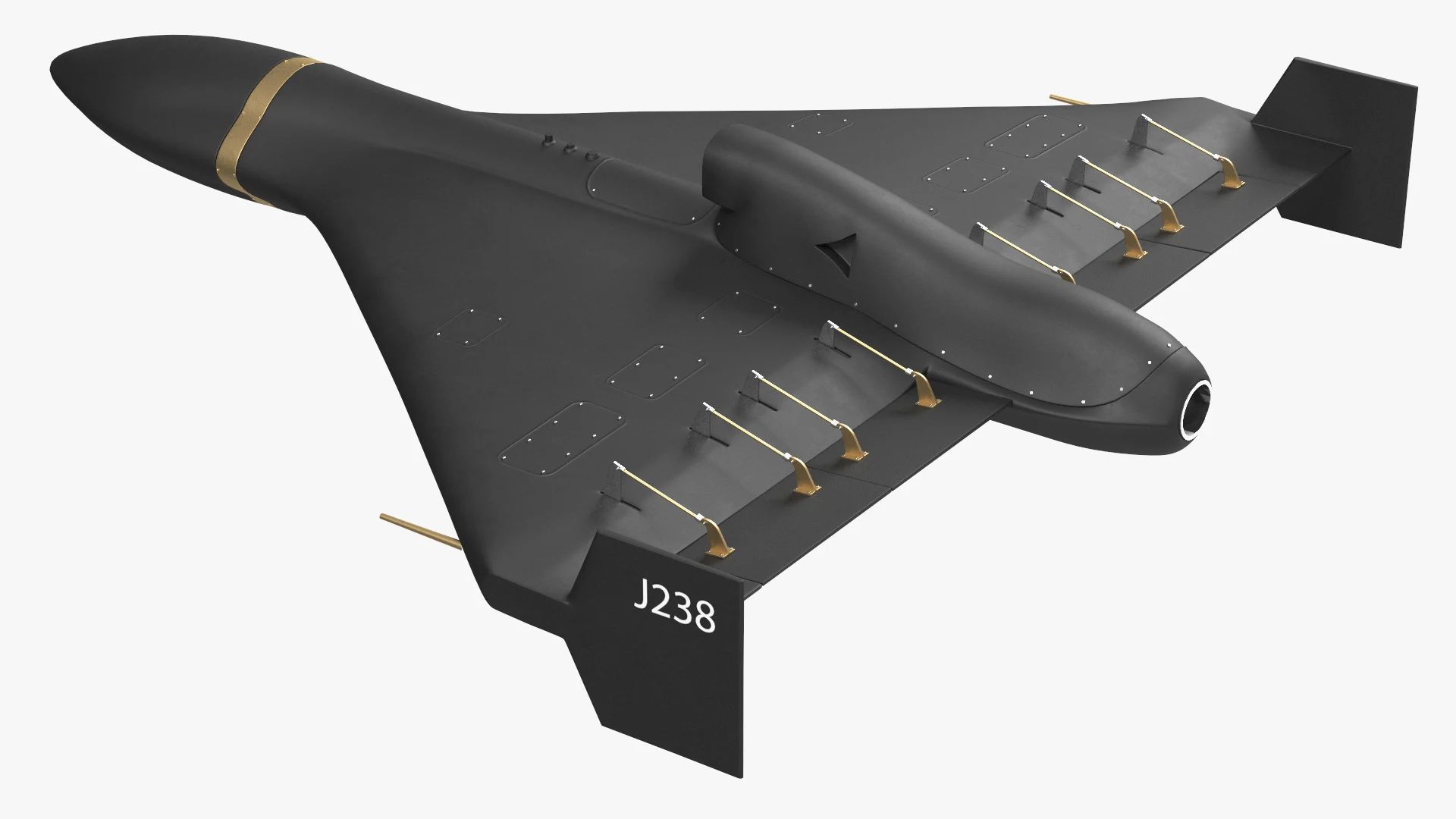
Geran-3 is a Russian jet-powered one-way attack unmanned aerial vehicle developed from the airframe and component base of the piston-powered Geran-2. The principal change was the replacement of the earlier piston engine with a Telefly JT80 turbojet, while the basic airframe was altered only minimally.
The type was reported in Ukraine in 2025 and was photographed by the Defense Intelligence of Ukraine (DIU) on 16 September 2025. By August 2026, DIU told Militarnyi that Russia had stopped producing Geran-3 drones.
Ukrainian intelligence described Geran-3 as a transitional design between Geran-2 and the later Geran-4, allowing jet propulsion and related systems to be introduced before a new airframe was developed specifically around a more powerful jet engine.
Development
Geran-3 retained the general configuration and much of the component base of Geran-2. Instead of redesigning the aircraft around a new propulsion system, the developers fitted the existing airframe with the Telefly JT80 turbojet and made only limited structural changes. This approach produced a faster derivative without changing the overall Geran-2 layout substantially.
Reporting published in 2025 described Geran-3 as a faster development of the Geran family that had appeared in Ukraine that year. Ukrainian military intelligence later released details of the drone's internal systems and foreign-made components.
Production status
On 11 August 2026, DIU informed Militarnyi that Russia had halted Geran-3 production. Other reporting repeated the assessment that Russian forces could continue using previously accumulated Geran-3 stocks after production had ended. Defense Express also described the model as an intermediate step toward Geran-4.
The later Geran-4 uses an airframe adapted specifically for the Telefly LX-WP-160 jet engine. The supplied reporting therefore presents Geran-3 as a short-lived evolutionary stage rather than the final jet-powered form of the Geran family.
Design
Airframe and propulsion
Geran-3 uses the Geran-2 airframe as its basis. According to DIU-linked reporting, the basic structure received only minimal changes for jet propulsion. The Telefly JT80 turbojet replaced the piston engine used on Geran-2.
The JT80 installation gives the drone a reported speed of 300-370 km/h and an operational range of up to 1,000 km. Ukrainian intelligence said the higher-speed flight profile distinguished the type from the propeller-driven Geran-2.
Navigation and onboard electronics
The reported onboard equipment includes a SADRA inertial navigation system, an ADC pressure-measurement unit, a PDU power-distribution unit, and other electronic modules. Satellite navigation is provided by the Kometa-M12 system, which uses a 12-element controlled-reception-pattern antenna array. This arrangement is intended to improve resistance to radio-frequency jamming and other electronic-warfare effects.
Geran-3 was also reported to carry a camera and video-transmission system similar to equipment used on Geran-2 drones. DIU stated that the overall electronic architecture was almost identical to that of gasoline-powered Geran-2 drones.
Foreign components
DIU reported identifying 45 foreign-made components in Geran-3. The published national breakdown listed 22 components from the United States, eight from China, seven from Switzerland, three from Germany, two from the United Kingdom, and one from Japan. Those listed figures total 43, and the supplied reporting does not explain the difference between that subtotal and the stated total of 45.
Some secondary reporting described the drone as containing nearly 50 foreign components. Because the DIU-linked Militarnyi report gives the more specific figure of 45, that figure is used here while noting the published breakdown discrepancy.
Operational history
Geran-3 was reported operating against Ukraine from 2025. Secondary reporting described it as part of Russian one-way attack drone operations and stated that the jet-powered design could reach its highest speeds in areas covered by Ukrainian air defenses and during the terminal phase of flight.
By August 2026, Ukrainian intelligence assessed that ongoing Russian use of Geran-3 came from existing stocks rather than current production. The type remained associated with the Russia-Ukraine war even as development attention shifted to Geran-4.
Operators
- Russia: Russian forces have operated Geran-3 one-way attack UAVs against Ukraine. Ukrainian intelligence reported in August 2026 that production had stopped, with remaining use attributed to previously produced stocks.
Specifications (Geran-3)
General characteristics
- Type: Jet-powered one-way attack unmanned aerial vehicle
- Powerplant: Telefly JT80 turbojet
- Navigation: SADRA inertial navigation system and Kometa-M12 satellite navigation system with a 12-element CRPA antenna array
Performance
- Speed: 300-370 km/h
- Operational range: Up to 1,000 km
Related equipment
- Geran-2: Piston-powered predecessor and the airframe and component basis for Geran-3.
- Geran-4: Later jet-powered development with an airframe specifically adapted for the Telefly LX-WP-160 engine.
 Argentina
 Armenia
 Australia
 Austria
 Austria-Hungary
 Belgium
 Brazil
 United Kingdom
 United States
 Brunei
 Bulgaria
 Canada
 Chile
Chile China
China Colonial America
 Colombia
 Confederate States
 Croatia
 Czech
Czech Denmark
 Egypt
Egypt Finland
 France
 Georgia
 Germany
 German Imperial
 Greece
 Holland
 Hungary
 India
India Indonesia
 Iran
Iran Iraq
Iraq Ireland
 Israel
 Italy
Italy Japan
Japan Japan (1940)
 Jordan
 Kingdom of Italy
 Malaysia
 Mexico
 Myanmar
 Nazi Germany
 Netherlands
 New Zealand
 North Korea
 Norway
 Pakistan
 Peru
Peru Philippines
 Poland
 Portugal
 Prussia
 Romania
 Saudi Arabia
 Serbia
 Singapore
 Slovakia
 Slovenia
 South Africa
 South Korea
 Soviet Union
 Spain
Spain Sweden
 Switzerland
 Syria
Syria Taiwan
 Thailand
 Turkey
 UAE
UAE Ukraine
 Vietnam
 Yugoslavia