
History
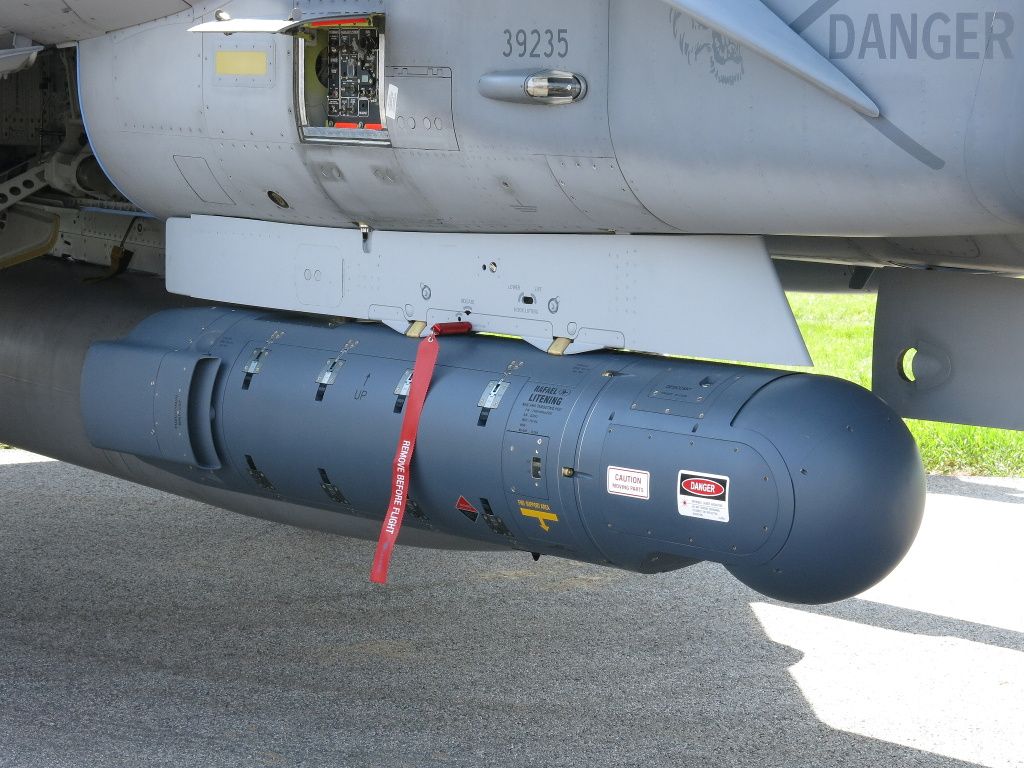
LITENING is a family of externally mounted electro-optical and infrared targeting pods developed for combat aircraft. It combines imaging sensors, laser systems and onboard processing to detect, identify and track targets while supporting precision weapon employment, reconnaissance and surveillance.
The system originated with Rafael Advanced Defense Systems in Israel and later became the subject of a development and marketing partnership with Northrop Grumman in the United States. Its modular architecture has allowed successive sensor, processing and data-link upgrades without replacing the complete pod.
LITENING has been integrated with numerous combat aircraft and has remained in service through multiple generations. In 2026, the U.S. Air Force awarded Northrop Grumman a potential $1.84 billion contract covering continued production, sustainment and modification of U.S. LITENING systems through 31 December 2035.
Development
Rafael developed the first LITENING targeting pod for the Israeli Air Force. A German-language history of the system dates development of the first generation to 1992. In 1995, Northrop Grumman teamed with Rafael for further development and sales of the system. The resulting family was subsequently adapted for a large number of U.S. and international aircraft.
LITENING II was fielded with U.S. Air National Guard and Air Force Reserve Command F-16 aircraft beginning in 1999. It was followed by the LITENING Enhanced Range configuration, which incorporated a higher-resolution third-generation forward-looking infrared sensor. LITENING AT entered U.S. fielding in 2003 and became a standard configuration for U.S. forces. The U.S. Air Force fact sheet describes the system as an infrared and electro-optical targeting and non-traditional intelligence, surveillance and reconnaissance pod.
LITENING G4 began deliveries to U.S. forces in 2008. It introduced improved sensors and image-processing capabilities intended to increase target recognition range and image quality. Later developments included LITENING 5 and Northrop Grumman's LITENING Large Aperture configuration, which expanded spectral coverage, sensor resolution and onboard processing capability.
2026 U.S. Air Force contract
In August 2026, the U.S. Air Force awarded Northrop Grumman Systems Corporation an indefinite-delivery and indefinite-quantity, firm-fixed-price contract with a potential value of $1.84 billion. The contract covers sustainment, production and modifications for the Laser Infrared Targeting and Navigation Comprehensive Advanced Targeting Pod, or LITENING CATP. Fiscal 2026 operations and maintenance funding of $42.9 million was obligated at the time of award.
The contract was issued as a sole-source acquisition through the Precision Attack Contracting Branch at Robins Air Force Base, Georgia. Work is to be performed at Northrop Grumman facilities in Rolling Meadows, Illinois, and the contract supports continued U.S. Air Force operation of LITENING CATP systems through 31 December 2035.
Design
LITENING is carried externally on an aircraft weapon or equipment station. Its stabilized sensor head combines electro-optical and infrared imagery with laser ranging and designation. The system provides wide-field search and narrower-field acquisition and targeting functions, allowing an aircrew to find, identify and follow targets before employing precision-guided weapons.
The LITENING AT configuration described by the U.S. Air Force includes a high-resolution mid-wave third-generation forward-looking infrared sensor and a CCD television camera for visible-spectrum imagery. An on-gimbal inertial navigation sensor supports line-of-sight stabilization and automatic boresighting. A laser designator supports laser-guided weapons, while a laser rangefinder provides precise target-coordinate information.
The pod also incorporates a laser spot tracker and laser marker. Compatible video data-link equipment can distribute imagery for coordination with other air and ground forces. Automatic target tracking allows stabilized tracking during tactical flight and weapon-delivery maneuvers.
Modular architecture
Modularity is a central feature of the LITENING family. Line-replaceable components, built-in diagnostic functions and upgradeable electronics allow sensors, processors and data links to be replaced or improved as requirements change. The Air Force states that automated built-in testing allows a flight-line maintainer to isolate and replace a line-replaceable unit without intermediate-level maintenance.
Northrop Grumman's current LITENING product description identifies digital high-definition color video, multiple infrared bands, picture-in-picture imagery, two-way plug-and-play data links, laser imaging sensors and an advanced laser designator among the family's technologies.
Later sensor configurations
LITENING G4 introduced higher-resolution electro-optical and infrared sensors, improved target-recognition functions and enhanced digital processing. LITENING 5 represents a later Rafael development with high-resolution multi-spectral sensors and expanded air-to-air and air-to-ground functions.
Rafael describes LITENING 5 as combining mid-wave and short-wave infrared sensors, a high-clarity forward-looking infrared channel, a large-aperture high-definition color sensor and laser systems. The manufacturer's LITENING 5 overview also describes air-to-air search and tracking, image matching, laser rangefinding and operation in degraded navigation environments.
Northrop Grumman's LITENING Large Aperture configuration uses a three-aperture arrangement supporting larger daylight, mid-wave infrared, short-wave infrared and long-wave infrared sensors. It also incorporates more powerful graphics processing and image-processing algorithms intended to improve image clarity and reduce pilot workload.
Operational history
LITENING has been used on a wide range of U.S. and international combat aircraft. U.S. applications have included the A-10, B-52H, F-15E and several F-16 blocks. Other versions of the pod have been integrated with aircraft including the AV-8B, F/A-18, Eurofighter Typhoon, Saab JAS 39 Gripen, AMX, HAL Tejas, Mirage 2000, MiG-29 and Su-30MKI.
The system supports day and night precision targeting, target identification, laser designation, target-coordinate generation, reconnaissance and surveillance. Its combination of infrared and visible-spectrum sensors allows crews to use the pod for both weapon employment and non-traditional intelligence, surveillance and reconnaissance tasks.
LITENING has been adopted by air forces in Europe, Asia, the Middle East, Africa and the Americas. Rafael states that later members of the family have accumulated extensive operational use across many aircraft types, while Northrop Grumman continues to support U.S. and partner-nation fleets.
Variants
- LITENING I: Original Rafael-developed generation for the Israeli Air Force. Development is reported from 1992.
- LITENING II: Improved version fielded with U.S. Air National Guard and Air Force Reserve Command F-16 aircraft beginning in 1999.
- LITENING ER: Enhanced Range configuration incorporating a higher-resolution third-generation forward-looking infrared sensor to improve detection range.
- LITENING AT: Advanced Targeting version fielded by U.S. forces from 2003, with improved target detection, recognition and coordinate-generation capability.
- LITENING SE: Sensor Enhancement configuration with laser ranging and designation, recording functions and a digital two-way data link.
- LITENING III: Later targeting and reconnaissance configuration used on several international aircraft types, including versions of the Typhoon, AMX and Tejas.
- LITENING G4: Generation introduced to U.S. forces from 2008 with higher-resolution sensors and improved target-recognition and image-processing capabilities.
- LITENING 5: Rafael-developed later generation with multi-spectral electro-optical and infrared sensors and expanded air-to-air and air-to-ground functions.
- LITENING Large Aperture: Northrop Grumman's advanced configuration using enlarged apertures, broader spectral coverage, upgraded processing and high-definition sensors.
Operators
- United States: LITENING variants have been operated by the U.S. Air Force and by U.S. naval aviation and Marine Corps units on aircraft including the A-10, B-52H, F-15E, F-16, AV-8B and F/A-18.
- Israel: The Israeli Air Force was the original customer for the Rafael-developed LITENING system and has operated later variants on combat aircraft.
- European operators: Variants have been used by air forces including those of the Czech Republic, Denmark, Finland, Germany, Hungary, Italy, the Netherlands, Portugal, Spain, Sweden and the United Kingdom.
- Other international operators: LITENING variants have also been associated with military aircraft operated by countries including Argentina, Brazil, Chile, Colombia, Greece, India, Kazakhstan, Singapore, South Africa, Thailand and Venezuela.
Specifications (LITENING AT)
General characteristics
- Primary function: Infrared and electro-optical targeting; non-traditional intelligence, reconnaissance and surveillance.
- Prime contractor: Northrop Grumman Corporation.
- Length: 2.20 m (87 in).
- Diameter: 0.406 m (16 in).
- Weight: 200 kg (440 lb).
- Sensors: Infrared detector, CCD television camera, laser rangefinder and laser designator.
- U.S. Air Force aircraft: A-10A/A+/C, B-52H, F-15E and F-16 Block 25/30/32/40/42/50/52.
- U.S. deployment date: February 2000.
- Reported unit cost: $1.4 million, according to the U.S. Air Force fact sheet current as of August 2015.
Related equipment
- Lockheed Martin Sniper: Another externally mounted precision targeting pod used on combat aircraft.
- AN/AAQ-40 Electro-Optical Targeting System: An internally integrated electro-optical targeting system used by the F-35 family.
 Argentina
 Armenia
 Australia
 Austria
 Austria-Hungary
 Belgium
 Brazil
 United Kingdom
 United States
 Brunei
 Bulgaria
 Canada
 Chile
Chile China
China Colonial America
 Colombia
 Confederate States
 Croatia
 Czech
Czech Denmark
 Egypt
Egypt Finland
 France
 Georgia
 Germany
 German Imperial
 Greece
 Holland
 Hungary
 India
India Indonesia
 Iran
Iran Iraq
Iraq Ireland
 Italy
Italy Japan
Japan Japan (1940)
 Jordan
 Kingdom of Italy
 Malaysia
 Mexico
 Myanmar
 Nazi Germany
 Netherlands
 New Zealand
 North Korea
 Norway
 Pakistan
 Peru
Peru Philippines
 Poland
 Portugal
 Prussia
 Romania
 Russia
 Saudi Arabia
 Serbia
 Singapore
 Slovakia
 Slovenia
 South Africa
 South Korea
 Soviet Union
 Spain
Spain Sweden
 Switzerland
 Syria
Syria Taiwan
 Thailand
 Turkey
 UAE
UAE Ukraine
 Vietnam
 Yugoslavia