
History
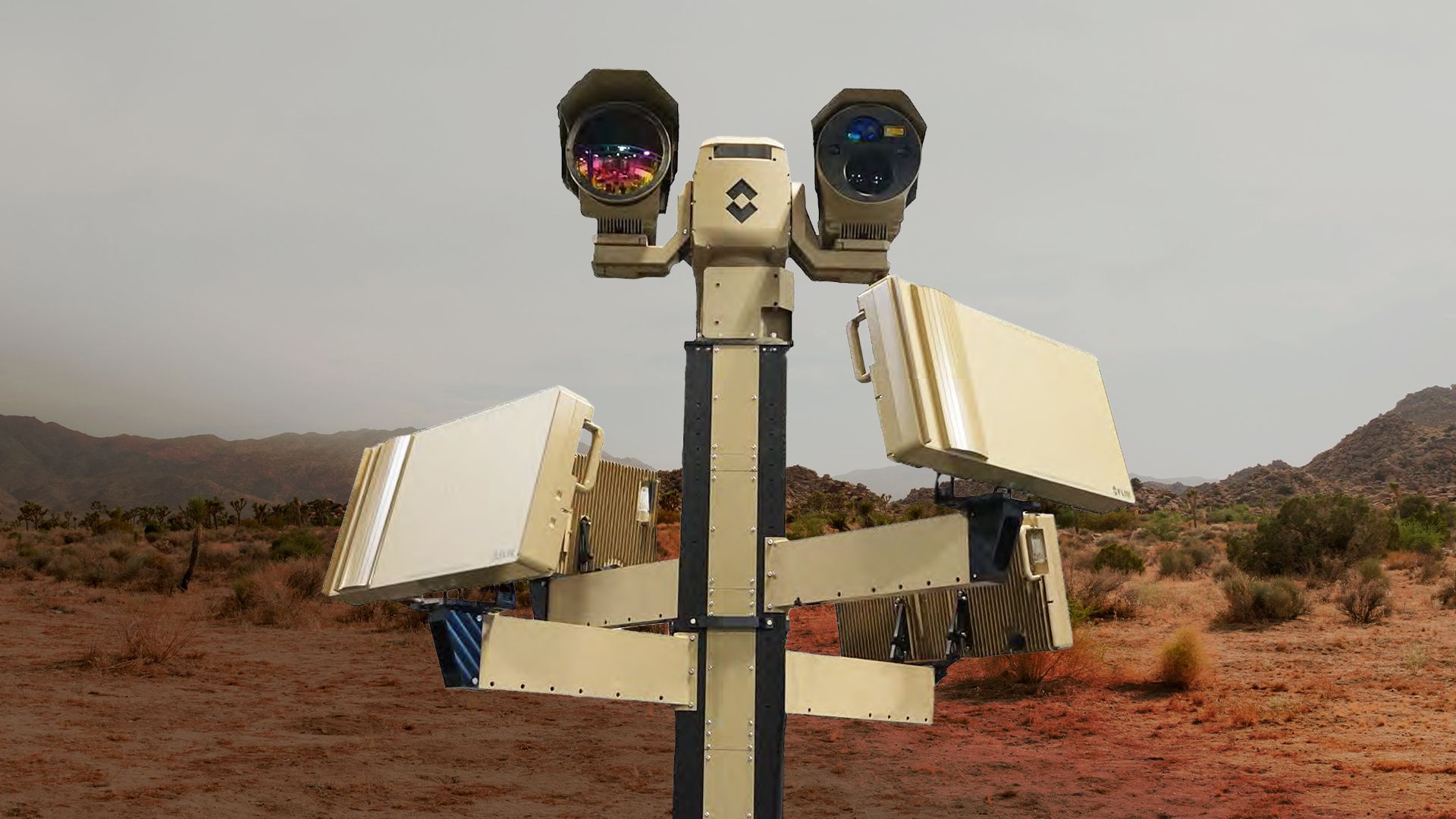
The AeroVironment Titan Multi-Sensor, or Titan MS, is an artificial-intelligence-assisted counter-unmanned aircraft system designed primarily for fixed-site protection. It combines radio-frequency detection, radar, optical sensors, and software to detect, classify, track, and help defeat unmanned threats.
Titan MS is the largest and most capable system in AeroVironment's Titan counter-UAS family. The company describes it as a multi-mission system suitable for fixed installations in land, maritime, and air-domain security environments.
In 2026, the system was selected to support the Joint Interagency Task Force 401 Domestic Shield Program, which is intended to protect United States military installations and critical infrastructure from unmanned aircraft.
The wider Titan family was selected as a counter-UAS Program of Record capability for an undisclosed United States Department of Defense customer in 2022. AeroVironment subsequently expanded the family with systems intended for fixed, mobile, vehicle-mounted, and dismounted applications. The manufacturer presented Titan MS as its large fixed-site configuration, combining several complementary sensor types instead of relying only on radio-frequency detection.
In July 2026, AeroVironment received an initial task order valued at $80.5 million to deliver Titan MS systems for Air Force Global Strike Command. The order was issued under a three-year, $500 million sole-source indefinite-delivery, indefinite-quantity contract supporting the Domestic Shield Program.
On 29 July 2026, Teledyne FLIR Defense announced that AeroVironment had ordered Argus XL platforms for integration into Titan MS. The Teledyne FLIR announcement identified Argus XL as a source of radar, visible-light and thermal imaging, command-and-control software, and core detection functions within the Titan MS architecture. Contemporary reports from Army Recognition and The Defense Post also described Argus XL as the system's principal multi-sensor detection element.
Design
System architecture
Titan MS uses an open, multi-sensor architecture. It fuses information from radio-frequency sensors, radar, electro-optical cameras, and infrared imagers into a common operational picture. Artificial-intelligence and machine-learning algorithms assist with detecting, classifying, tracking, and reporting unmanned-system threats.
The architecture is intended to address both radio-controlled aircraft and autonomous drones. Radio-frequency sensors can detect or locate control and communications emissions, while radar and imaging sensors provide detection and identification options for targets that do not produce a useful radio-frequency signal.
Titan MS can also track human and vehicle movement around a protected location. Recorded video, archived sensor data, and analytics support after-action review and the refinement of security procedures.
Argus XL sensor platform
Argus XL is a fixed-site surveillance platform equipped for air-domain awareness and counter-UAS missions. Its integrated radar, electro-optical camera, thermal imager, and command-and-control software provide continuous day-and-night surveillance. The system is designed to track multiple aerial targets at different distances and operate in demanding weather conditions.
The Argus XL architecture supports hemispherical coverage around a protected site. It is intended to detect aerial targets that include small and micro unmanned aircraft with limited radar or thermal signatures.
Third-party radio-frequency sensors and defeat systems can be connected through the open architecture. Depending on the selected configuration, these external systems can include electronic-warfare equipment, radio-frequency jammers, or kinetic effectors. Titan MS is therefore a sensor-fusion and command system rather than a single predefined weapon.
Command and control
Sensor information is presented through a unified operator interface to shorten the process of detecting, classifying, and responding to a threat. The system can maintain situational awareness while tracking several aerial objects and can preserve collected information for later analysis.
The available sources do not identify the specific radar model, detection ranges, crew requirement, power demand, deployment time, vehicle chassis, or standard defeat effector for the 2026 Titan MS configuration.
Program status
JIATF 401 selected Titan MS to provide layered counter-UAS protection for domestic military installations and critical infrastructure. The 2026 procurement covers systems intended for United States Air Force commands, including Air Force Global Strike Command. Publicly available information confirms the contract and sensor order but does not state how many Titan MS systems were ordered or when each installation will become operational.
Integration of Argus XL broadens the detection layer available to Titan MS. Its combination of radar, visible-light imaging, thermal imaging, and optional third-party radio-frequency sensors is intended to maintain surveillance against targets with different signatures and flight profiles. The architecture can then connect detections to an appropriate electronic or kinetic response selected for the protected site.
Specifications (Titan MS with Argus XL)
General characteristics
- Type: Fixed-site, multi-sensor counter-unmanned aircraft system
- Manufacturer and integrator: AeroVironment
- Primary sensor-platform supplier: Teledyne FLIR Defense
- Primary sensor platform: Argus XL
- Intended environments: Fixed installations supporting land, maritime, and air-domain security
- Target classes: Radio-controlled and autonomous unmanned aircraft, including small and micro drones
Sensors and software
- Detection methods: Radio-frequency sensing, radar, visible-light imaging, and thermal imaging
- Processing: Multi-sensor fusion with artificial-intelligence and machine-learning algorithms
- Coverage: Hemispherical aerial-target detection around a protected site
- Operating period: Continuous day-and-night surveillance
- Tracking: Simultaneous tracking of multiple aerial threats
- Data functions: Recorded video, sensor-data archiving, analytics, and after-action review
- Architecture: Open architecture supporting third-party sensors and defeat technologies
Countermeasure integration
- Electronic options: Integration with radio-frequency jammers and other electronic-warfare systems
- Kinetic options: Integration with compatible third-party kinetic effectors
- Response model: Configurable layered response based on the threat and applicable rules of engagement
Related equipment
- Titan 4: Compact radio-frequency counter-UAS system designed for fixed-site, mobile, or dismounted employment.
- Titan EO/IR: Portable multi-sensor system combining Titan radio-frequency capabilities with mid-wave infrared sensors.
- Titan-SV LOB: Fixed-site or vehicle-mounted detection and tracking system that provides azimuth, elevation, and three-dimensional tracking for compatible small unmanned aircraft.
- Titan-SV MOSA/SOSA: Open-standard sensor-card development intended to integrate Titan-SV passive detection into compatible multi-mission systems.
A description of these systems and their relationship to Titan MS appears in the Titan family announcement.
 Argentina
 Armenia
 Australia
 Austria
 Austria-Hungary
 Belgium
 Brazil
 United Kingdom
 Brunei
 Bulgaria
 Canada
 Chile
Chile China
China Colonial America
 Colombia
 Confederate States
 Croatia
 Czech
Czech Denmark
 Egypt
Egypt Finland
 France
 Georgia
 Germany
 German Imperial
 Greece
 Holland
 Hungary
 India
India Indonesia
 Iran
Iran Iraq
Iraq Ireland
 Israel
 Italy
Italy Japan
Japan Japan (1940)
 Jordan
 Kingdom of Italy
 Malaysia
 Mexico
 Myanmar
 Nazi Germany
 Netherlands
 New Zealand
 North Korea
 Norway
 Pakistan
 Peru
Peru Philippines
 Poland
 Portugal
 Prussia
 Romania
 Russia
 Saudi Arabia
 Serbia
 Singapore
 Slovakia
 Slovenia
 South Africa
 South Korea
 Soviet Union
 Spain
Spain Sweden
 Switzerland
 Syria
Syria Taiwan
 Thailand
 Turkey
 UAE
UAE Ukraine
 Vietnam
 Yugoslavia