
History
Archer Midnight is an American piloted electric vertical take-off and landing aircraft developed by Archer Aviation for short urban and regional journeys. The aircraft combines vertical lift with wing-borne cruise and is designed to carry one pilot and four passengers. It is also being studied for government and military missions including personnel transport, logistics, and casualty evacuation.
Midnight evolved from Archer's two-seat Maker demonstrator, which was used to validate the company's electric propulsion, flight-control, and twelve-propeller configuration. Archer publicly unveiled the production-intent Midnight design in November 2022 after completing a preliminary design review.
The first Midnight aircraft was assembled in May 2023. It received a Federal Aviation Administration Special Airworthiness Certificate in August of that year, allowing flight testing to begin. The aircraft subsequently progressed through remotely piloted and piloted tests while Archer continued work toward civil type certification.
Development
Archer designed Midnight primarily for repeated short flights of approximately 32 km (20 mi), with rapid charging between sectors. Its planned operating model emphasises trips between urban centres and airports, where vertical take-off can reduce the need for long runways and wing-borne cruise can improve efficiency compared with hovering for the entire flight.
The company has also worked with the United States Department of Defense through the AFWERX program. Military studies have focused on roles where lower acoustic signature, distributed electric propulsion, and reduced maintenance could supplement conventional helicopters. These activities did not make the baseline Midnight an armed aircraft.
In October 2025, Korean Air and Archer announced an agreement to commercialise Midnight in South Korea, including the potential purchase of up to 100 aircraft for several applications. In 2026, the companies confirmed work on a possible military conversion. Korean Air was assigned the leading role in conversion and systems integration, while Archer would provide technical cooperation and certification support.
Military conversion
The proposed South Korean military version is intended to support government future-mobility objectives and could be considered for a Defense Acquisition Program Administration rapid-demonstration initiative. The partners planned to define their technical responsibilities and localise modification capabilities in stages.
No military prototype configuration, weapons, sensors, protection system, or firm procurement order had been announced as of August 2026. The agreement should therefore be understood as conversion and evaluation work, not evidence that a military Midnight has entered production or service.
Design
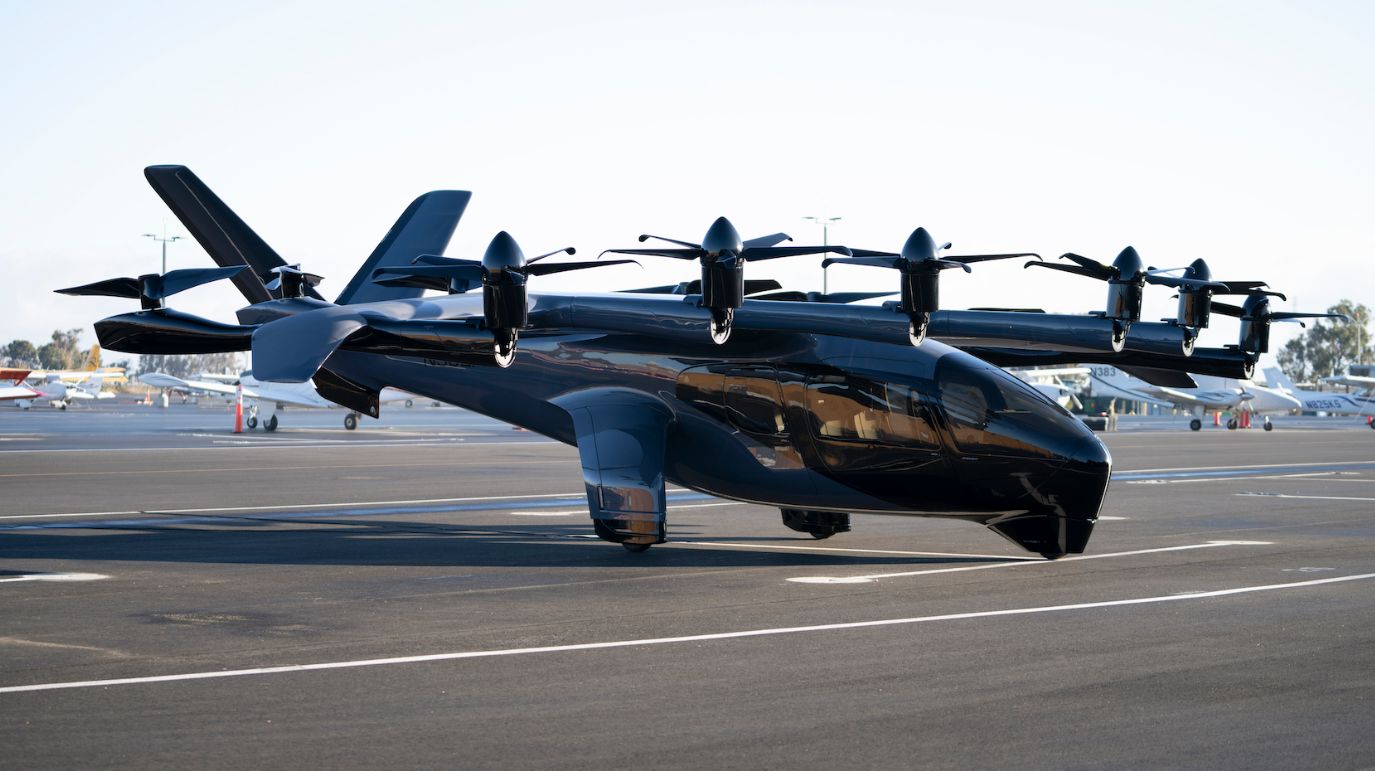
Midnight is a high-wing aircraft with a streamlined fuselage, V-tail, and fixed tricycle landing gear. It uses distributed electric propulsion and twelve propellers mounted along the wing. Six forward propellers tilt between vertical-lift and forward-flight positions, while six rear propellers provide lift during vertical take-off and landing and stop during cruise.
After take-off, the tilting propellers rotate forward and the wing increasingly supports the aircraft's weight. Wing-borne flight requires less power than continuous rotor-borne lift, allowing Midnight to travel farther than a multicopter using comparable battery technology.
Propulsion and energy
Independent electric motors drive the propellers. Archer presents the distributed arrangement as a way to avoid a single critical propulsion failure and to reduce the number of mechanically complex components found in turbine helicopters. Actual certification requirements and demonstrated failure tolerance remain subject to regulatory testing.
The aircraft is intended to perform repeated 32 km sectors with approximately ten minutes of charging between flights. Its stated maximum range is about 161 km (100 mi), while operational range will depend on payload, reserves, weather, battery condition, and mission profile.
Cabin and payload
The cabin is arranged for a pilot and four passengers. Archer states an expected useful payload above 454 kg (1,000 lb). A military or government conversion could replace passenger accommodation with mission equipment, cargo, or medical provisions, but detailed layouts have not been released.
Flight controls and noise
Flight-control computers coordinate motor speed, propeller tilt, and control surfaces through the transition between vertical and horizontal flight. Distributed propulsion reduces the need for the mechanical transmission and rotor-control systems of a conventional helicopter.
Archer designed the aircraft for low community noise. During forward flight, the propeller axes align more closely with the airflow and the aircraft uses multiple smaller propellers with lower tip speeds. The company has projected about 45 dBA at ground level during cruise near 610 m (2,000 ft), although measured noise depends on flight condition and observation point.
Program status
Midnight remained in development and certification as of August 2026. Flight testing had included a piloted journey of approximately 89 km (55 mi) in 31 minutes and operation at an altitude of 3,048 m (10,000 ft). These demonstrations supported performance development but did not constitute unrestricted commercial certification.
Plans for South Korean commercial introduction and military adaptation were prospective. The agreement allowed for up to 100 aircraft, but potential quantity is not the same as a completed firm delivery. Entry into service depends on certification, production maturity, customer contracts, and national approval.
Variants
- Midnight civil configuration — production-intent piloted eVTOL designed for one pilot and four passengers.
- United States government demonstrators — aircraft used to examine transport, logistics, rescue, and other public-sector applications through cooperation with the Department of Defense.
- Proposed Korean military conversion — planned localisation and systems-integration project led by Korean Air with technical support from Archer.
Operators
No regular operational operator had been confirmed as of August 2026. Archer operated development aircraft, while agreements in the United States and South Korea covered testing, prospective acquisition, and future commercial or government use.
Specifications (Archer Midnight production-intent aircraft)
General characteristics
- Crew: One pilot.
- Capacity: Four passengers.
- Payload: More than 454 kg (1,000 lb), expected.
- Configuration: High-wing electric vertical take-off and landing aircraft with V-tail.
- Landing gear: Fixed tricycle arrangement.
- Propellers: Twelve electric propellers, including six tilting cruise-and-lift propellers and six lift-only propellers.
Performance
- Maximum speed: Approximately 241 km/h (150 mph), stated target.
- Maximum range: Approximately 161 km (100 mi), stated target.
- Optimised mission: Repeated sectors of approximately 32 km (20 mi).
- Turnaround charging: Approximately 10 minutes between short sectors, planned.
Related equipment
- Archer Maker — earlier demonstrator used to validate technology and the twelve-propeller configuration.
- Archer Thunder — separate hybrid-electric military tiltrotor concept.
- Archer Halo — proposed uncrewed tiltrotor for cargo and public-service applications.
 Argentina
 Armenia
 Australia
 Austria
 Austria-Hungary
 Belgium
 Brazil
 United Kingdom
 Brunei
 Bulgaria
 Canada
 Chile
Chile China
China Colonial America
 Colombia
 Confederate States
 Croatia
 Czech
Czech Denmark
 Egypt
Egypt Finland
 France
 Georgia
 Germany
 German Imperial
 Greece
 Holland
 Hungary
 India
India Indonesia
 Iran
Iran Iraq
Iraq Ireland
 Israel
 Italy
Italy Japan
Japan Japan (1940)
 Jordan
 Kingdom of Italy
 Malaysia
 Mexico
 Myanmar
 Nazi Germany
 Netherlands
 New Zealand
 North Korea
 Norway
 Pakistan
 Peru
Peru Philippines
 Poland
 Portugal
 Prussia
 Romania
 Russia
 Saudi Arabia
 Serbia
 Singapore
 Slovakia
 Slovenia
 South Africa
 South Korea
 Soviet Union
 Spain
Spain Sweden
 Switzerland
 Syria
Syria Taiwan
 Thailand
 Turkey
 UAE
UAE Ukraine
 Vietnam
 Yugoslavia