
History
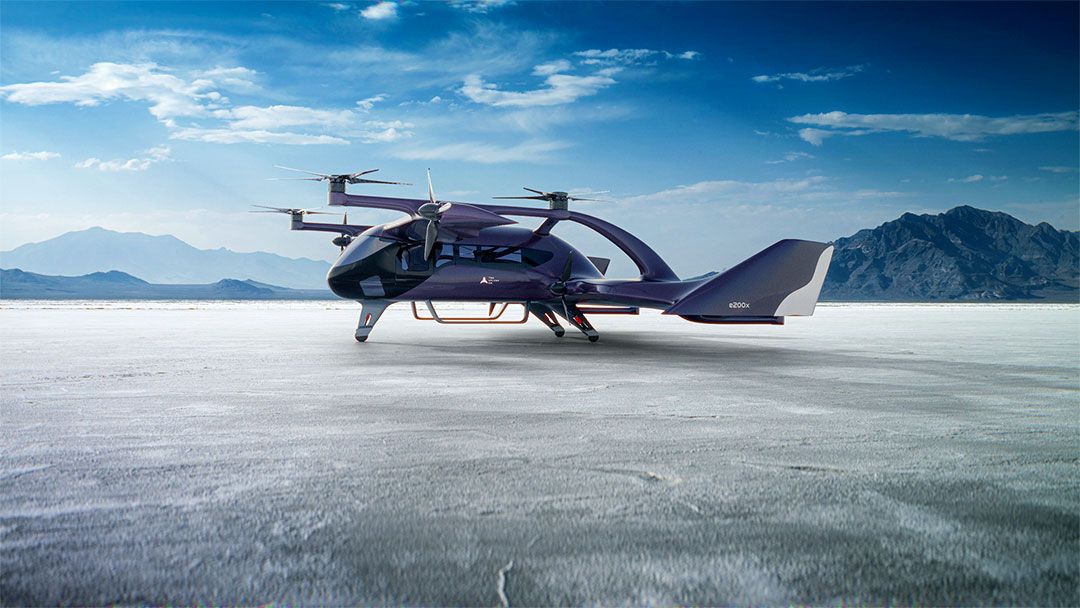
The ePlane Company e200X is an electric vertical-takeoff-and-landing aircraft under development in India. It is intended for passenger transport, emergency medical missions, and urban cargo operations.
The compact winged aircraft combines dedicated vertical-lift propulsion with separate propulsion for forward flight. Its modular design allows the same basic airframe to support several mission configurations.
The first full-scale prototype, designated PT-01, was completed in 2026. Ground testing is planned before full-scale flight trials targeted for mid-2027.
Development
The ePlane Company was founded in 2019 and was incubated at the Indian Institute of Technology Madras. The company operates as Ubifly Technologies Private Limited. Its patented Synergistic Lift concept was filed in 2019 and subsequently granted protection in more than 30 countries.
Development progressed through a one-fifth-scale demonstrator called ATVA and the e50 heavy-lift drone, which has a payload capacity of 50 kilograms. The company reported that these earlier platforms accumulated more than 10,000 kilometers of test flights and provided scaling data for the full-size aircraft.
India's Directorate General of Civil Aviation granted the company Design Organisation Approval in 2023. This approval supported its work toward type certification but did not constitute certification of the aircraft itself.
The company completed assembly of PT-01 in June 2026 and unveiled it publicly in July at its production facility in Chennai. The prototype brought the major aircraft systems together in a full-scale carbon-fiber-composite airframe. According to the prototype unveiling report, PT-01 is scheduled to undergo ground tests before flight trials begin.
The company has targeted mid-2027 for flight testing within the certification program. Commercial operation remains dependent on successful testing, type certification, production preparation, and operating approvals.
Electrical-system partnership
In July 2026, SASMOS HET Technologies and The ePlane Company announced a memorandum of understanding at the Farnborough International Airshow. SASMOS will support development and industrialization of the e200X electrical wiring interconnection system, or EWIS.
The work covers wiring-harness architecture, engineering, design for manufacturability, prototype evaluation, and certification readiness. EWIS distributes electrical power and data among propulsion, avionics, flight controls, and other aircraft systems. Its weight, reliability, thermal behavior, installation, and maintainability are particularly important in an electric aircraft.
The agreement also establishes a framework for possible cooperation on other electrical and interconnection systems as the program advances toward industrialization and serial production. The EWIS development report states that prototype evaluations will help refine the design for manufacturing and later certification activities.
Design
Airframe and layout
The e200X is a winged eVTOL aircraft built from carbon-fiber composite. It occupies an approximately 8-by-11-meter footprint and belongs to the 2,200-kilogram maximum gross weight class. The company designed this compact footprint to permit operations from existing helipads and suitable open spaces rather than requiring purpose-built vertiports.
The Synergistic Lift architecture uses separate propulsion units for vertical lift and forward cruise. Its rotors remain fixed instead of tilting between flight modes. The passenger configuration accommodates one pilot and two passengers, while other configurations are planned for cargo and emergency medical missions.
Electric propulsion
The aircraft uses an 800-volt distributed electric propulsion architecture. Each motor is independently connected to the battery system, an arrangement intended to remove single electrical points of failure. The high-voltage architecture is also intended to limit wiring mass, support thermal management, and permit faster charging.
The independent propulsion arrangement requires the EWIS to carry power and data between multiple motors, batteries, flight controls, avionics, and monitoring equipment. SASMOS is expected to help convert this architecture into wiring harnesses suitable for repeatable production and certification.
Avionics and digital systems
The e200X incorporates Nvidia's IGX Thor computing platform for sensor fusion using camera, lidar, and radar inputs. Hensoldt supplies navigation and situational-awareness equipment. Tata Consultancy Services developed software for battery management and predictive fleet analysis.
The ePlane Company also used Nvidia Omniverse to create a digital twin for virtual validation before physical testing. Digital analysis does not replace ground and flight trials, but it allows engineers to evaluate system integration and design changes before testing the complete aircraft.
Mission configurations
The modular platform is intended to support passenger transport, urban cargo carriage, and emergency medical response. Publicly reported figures describe a pilot plus two passengers or a payload of up to 200 kilograms. Detailed equipment for the proposed cargo and medical configurations has not been published.
Program status
PT-01 had entered the ground-test phase by July 2026 and had not yet begun full-scale flight trials. Testing is expected to examine structural integrity, propulsion, electrical systems, controls, and overall reliability before the aircraft proceeds through the Indian type-certification process.
The manufacturer reports commitments for more than 800 aircraft, including significant interest in emergency medical transport. These commitments are not evidence of operational service, and no certified production operators have been announced in the supplied sources.
The aircraft is being prepared for production through a growing Indian supplier network covering electrical systems, avionics, composites, fasteners, and interiors. The SASMOS agreement is part of this industrialization effort. A separate partnership account confirms that the electrical work extends from prototype evaluation to certification readiness and potential serial manufacture.
Specifications (e200X PT-01)
General characteristics
- Type: Electric vertical-takeoff-and-landing aircraft
- Crew: One pilot
- Capacity: Two passengers or up to 200 kg of payload
- Footprint: Approximately 8 m by 11 m
- Maximum gross weight class: 2,200 kg
- Structure: Carbon-fiber composite
- Electrical architecture: 800 V
- Propulsion arrangement: Distributed electric propulsion with separate fixed propulsion units for vertical lift and forward flight
Performance
- Operational range: 110 km
 Argentina
 Armenia
 Australia
 Austria
 Austria-Hungary
 Belgium
 Brazil
 United Kingdom
 United States
 Brunei
 Bulgaria
 Canada
 Chile
Chile China
China Colonial America
 Colombia
 Confederate States
 Croatia
 Czech
Czech Denmark
 Egypt
Egypt Finland
 France
 Georgia
 Germany
 German Imperial
 Greece
 Holland
 Hungary
 Indonesia
 Iran
Iran Iraq
Iraq Ireland
 Israel
 Italy
Italy Japan
Japan Japan (1940)
 Jordan
 Kingdom of Italy
 Malaysia
 Mexico
 Myanmar
 Nazi Germany
 Netherlands
 New Zealand
 North Korea
 Norway
 Pakistan
 Peru
Peru Philippines
 Poland
 Portugal
 Prussia
 Romania
 Russia
 Saudi Arabia
 Serbia
 Singapore
 Slovakia
 Slovenia
 South Africa
 South Korea
 Soviet Union
 Spain
Spain Sweden
 Switzerland
 Syria
Syria Taiwan
 Thailand
 Turkey
 UAE
UAE Ukraine
 Vietnam
 Yugoslavia