
History
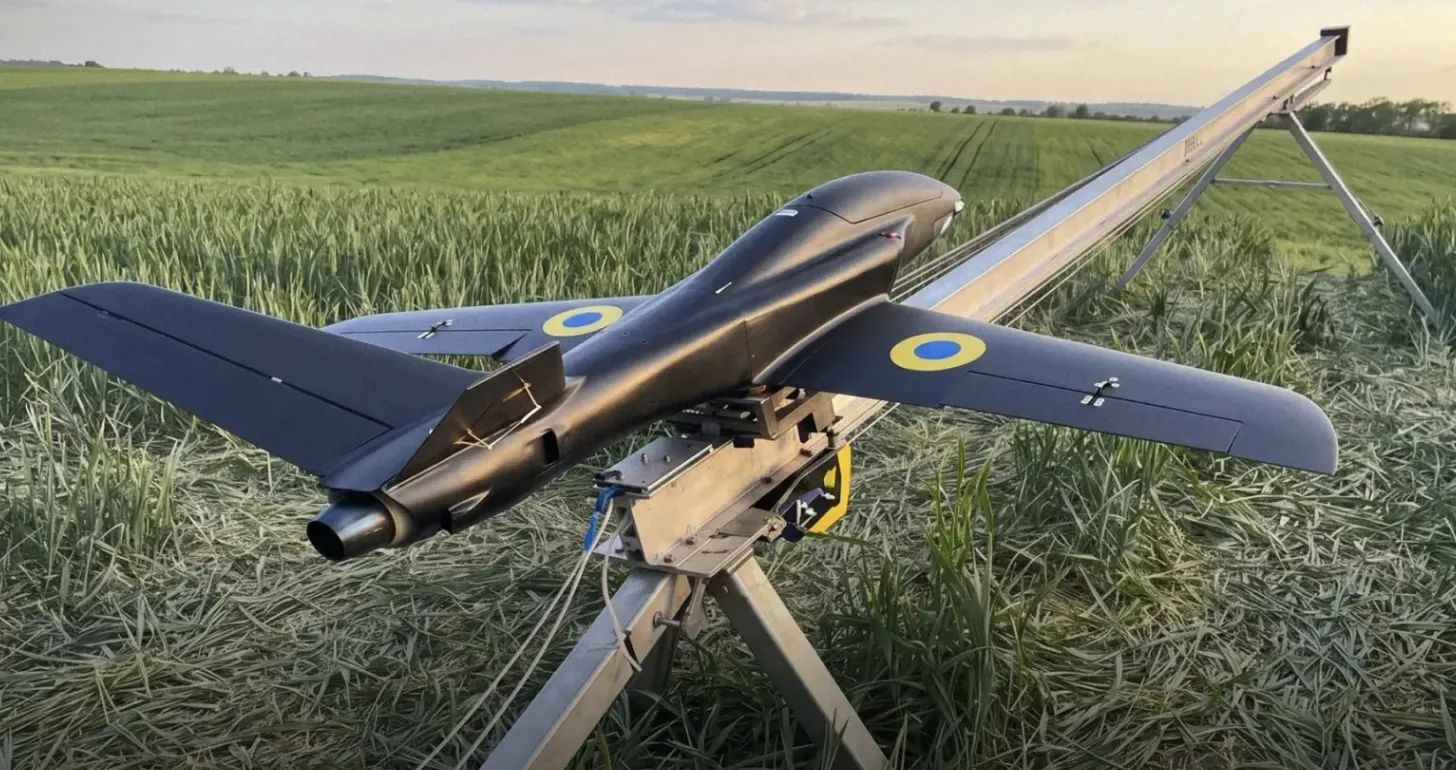
Alexa Spatium is a Ukrainian unmanned jet-powered interceptor developed to engage fast aerial threats, including jet-powered one-way attack drones. Ukraine's Ministry of Defence described it in August 2026 as the country's first domestically developed unmanned interceptor specifically intended for this role.
The system was developed and manufactured by Ukrainian engineers, although the manufacturer has not been publicly identified. Its primary stated targets include the Russian Geran-3, Geran-4 and Geran-5 loitering munitions and the Shahed-131, while the interceptor can also be used against reconnaissance UAVs and helicopters.
In August 2026, the Ministry of Defence announced that Alexa Spatium had completed the required testing and had been authorised for use by the Ukrainian Defense Forces. The development was reported by Militarnyi, LIGA.net and Defence Industry Europe.
Development and testing
According to the Ukrainian Ministry of Defence information cited by Defence Industry Europe, Alexa Spatium met the tactical and technical characteristics declared by its manufacturer during testing. The interceptor was developed for rapid response to aerial threats and for deployment with limited preparation of the operating position.
The system was designed around a highly mobile launch concept. Its components can be transported on a pickup truck, while the UAV is launched from a mobile catapult. Preparation and launch can be performed remotely, reducing the need for personnel to remain at the launch position.
Design
Airframe and propulsion
Alexa Spatium has approximate overall dimensions of 1.5 by 1.7 metres. Its airframe is made from lightweight composite materials. The design is intended to provide the manoeuvrability required for sharp turns while maintaining controllability.
The aircraft is powered by a turbojet engine. Published descriptions attribute a high operating ceiling, substantial combat radius and operation from low to medium altitudes to the propulsion and aerodynamic configuration, but no numerical ceiling, range or speed figures for Alexa Spatium have been disclosed in the supplied material.
The interceptor is described as combining a high maximum speed with a sufficiently low minimum speed to reduce fuel consumption when high speed is not required. It can be prepared and launched from its mobile catapult within several minutes.
Guidance and sensors
Alexa Spatium can fly toward pre-programmed coordinates or operate under direct guidance. Television and infrared search-and-sighting systems are used for target detection and engagement. The aircraft also incorporates control and video-transmission systems.
The system is highly automated and supports remote preparation and commissioning. If an aircraft does not complete its mission, it can return to the launch area for recovery and subsequent reuse rather than necessarily being expended.
Warheads
Alexa Spatium can be equipped with different warhead types. The disclosed options are high-explosive fragmentation, shaped-charge and thermobaric warheads. The Ministry of Defence stated that the available warhead capacity allows the interceptor to engage a range of aerial targets.
Operational history
In August 2026, Ukraine announced that Alexa Spatium had been authorised for use by the Defense Forces. Public reporting described the aircraft as the first Ukrainian unmanned jet interceptor specifically developed to counter jet-powered drones. No confirmed individual combat engagements or interception results for Alexa Spatium were provided in the supplied material.
The system entered the Ukrainian inventory during a period of expanding domestic counter-UAS development. Defence Industry Europe reported that Ukraine's Ministry of Defence had codified and authorised 413 unmanned aircraft systems for Defense Forces use since the beginning of 2026, with almost all of them domestically manufactured.
Specifications (Alexa Spatium)
General characteristics
- Type: Unmanned jet-powered interceptor
- Overall dimensions: approximately 1.5 × 1.7 m
- Airframe: lightweight composite construction
- Propulsion: turbojet engine
- Launch method: mobile catapult
- Transport: complete system can be carried on a pickup truck
Flight and control
- Operating altitude: low to medium altitudes, with a high operating ceiling stated by the developer
- Navigation and guidance: pre-programmed coordinates or direct guidance
- Targeting sensors: television and infrared search-and-sighting systems
- Data systems: control and video-transmission systems
- Recovery: capable of returning to the launch area after an uncompleted mission for possible reuse
Armament
- Warhead options: high-explosive fragmentation, shaped-charge or thermobaric
 Argentina
 Armenia
 Australia
 Austria
 Austria-Hungary
 Belgium
 Brazil
 United Kingdom
 United States
 Brunei
 Bulgaria
 Canada
 Chile
Chile China
China Colonial America
 Colombia
 Confederate States
 Croatia
 Czech
Czech Denmark
 Egypt
Egypt Finland
 France
 Georgia
 Germany
 German Imperial
 Greece
 Holland
 Hungary
 India
India Indonesia
 Iran
Iran Iraq
Iraq Ireland
 Israel
 Italy
Italy Japan
Japan Japan (1940)
 Jordan
 Kingdom of Italy
 Malaysia
 Mexico
 Myanmar
 Nazi Germany
 Netherlands
 New Zealand
 North Korea
 Norway
 Pakistan
 Peru
Peru Philippines
 Poland
 Portugal
 Prussia
 Romania
 Russia
 Saudi Arabia
 Serbia
 Singapore
 Slovakia
 Slovenia
 South Africa
 South Korea
 Soviet Union
 Spain
Spain Sweden
 Switzerland
 Syria
Syria Taiwan
 Thailand
 Turkey
 UAE
UAE Vietnam
 Yugoslavia