
History
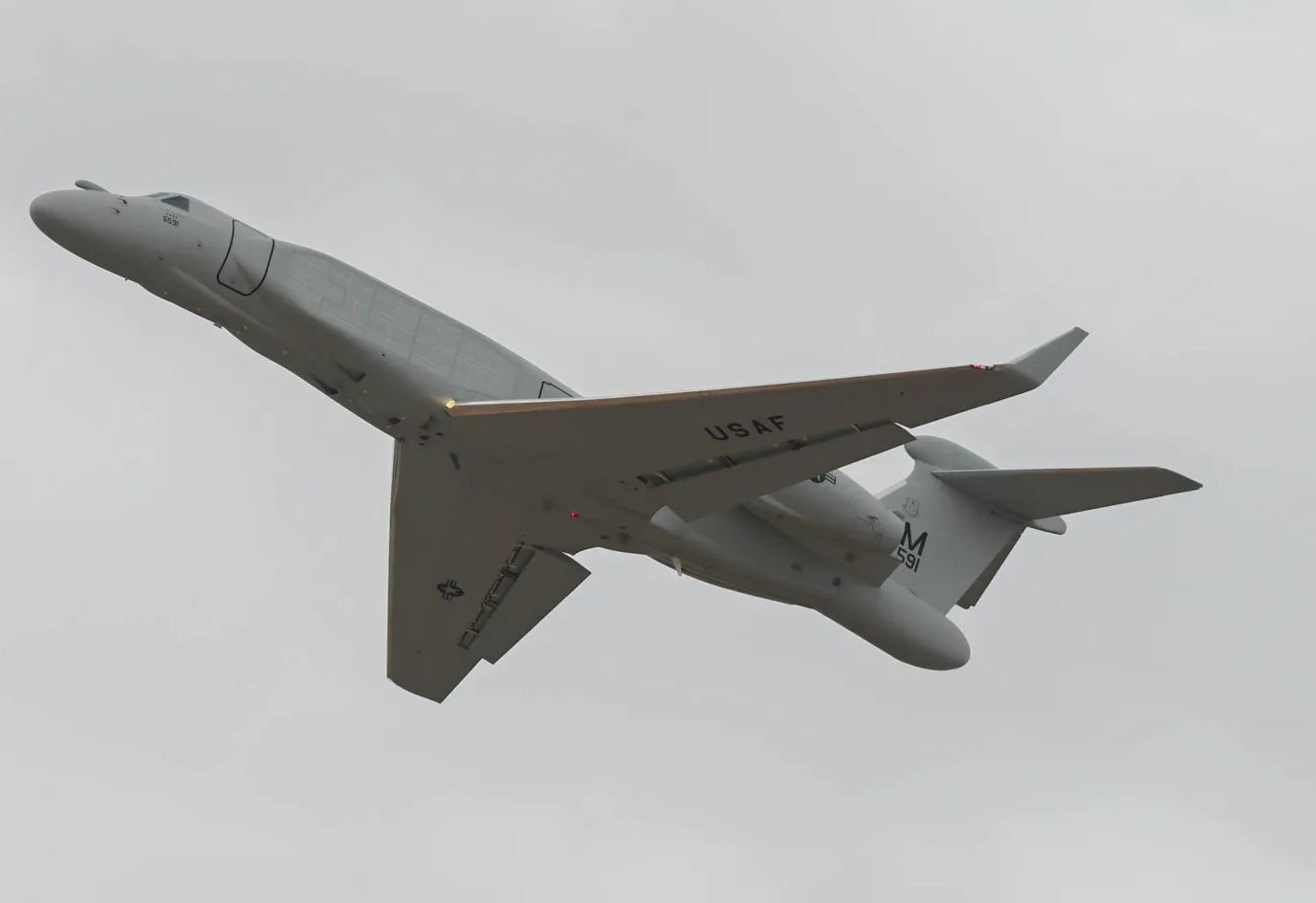
The L3Harris EA-37B Compass Call is a United States Air Force airborne electromagnetic attack aircraft based on the Gulfstream G550 business jet. It is being introduced to replace the EC-130H Compass Call while retaining and modernizing the Compass Call electronic attack mission.
The aircraft is designed to degrade, deny and disrupt hostile communications, command-and-control networks, radars and other elements of the electromagnetic spectrum. Its greater speed, altitude and range compared with the EC-130H allow the mission system to operate from greater stand-off distances.
L3Harris Technologies integrates the aircraft and BAE Systems supplies the principal electronic attack mission equipment. Much of the initial capability was re-hosted from the EC-130H, while later baselines introduce a more open and software-defined architecture for faster insertion of new electronic warfare techniques.
Development
On September 7, 2017, the U.S. Air Force awarded L3 Technologies, now L3Harris Technologies, a contract to replace the EC-130H in the tactical electronic attack role using a Gulfstream G550-based aircraft. The re-hosting approach was intended to transfer much of the established Compass Call mission equipment to a faster and higher-flying platform.
On October 23, 2018, Secretary of the Air Force Heather Wilson approved Air Combat Command's request to replace the EC-130H aircraft of the 55th Electronic Combat Group with the new aircraft. The basing decision memorandum followed on November 15, 2018. The official Air Combat Command fact sheet identifies rising sustainment costs for the EC-130H and emerging threats in multiple theaters as reasons for moving the mission to the G550 platform.
Air & Space Forces Magazine reports that the first flight occurred on August 25, 2021. An early test aircraft subsequently appeared at Davis-Monthan Air Force Base in August 2022. The first aircraft for Baseline 3 development and operational testing was delivered on September 12, 2023, according to Air & Space Forces Magazine.
The aircraft was originally designated EC-37B. Air Combat Command formally changed the designation to EA-37B on November 14, 2023 to emphasize its electronic attack role.
Training and testing
On August 23, 2024, the first aircraft intended for operational training arrived at Davis-Monthan Air Force Base. The 43rd Electronic Combat Squadron flew the EA-37B's first official mission training sortie on May 2, 2025. Air & Space Forces Magazine reports that initial operational testing was completed in July 2025, while further developmental and operational work continued into fiscal year 2026.
Baseline development has progressed beyond the initial transfer of EC-130H equipment. The first aircraft use Baseline 3 equipment, while SABER, the Small Adaptive Bank of Electronic Resources, serves as an intermediate step toward Baseline 4. Baseline 4 is intended to introduce a fully open software-defined radio architecture and System-Wide Open Reconfigurable Dynamic Architecture, or SWORD-A, to make future capability changes easier to integrate.
Design
Airframe
The EA-37B uses a Gulfstream G550-derived airframe adapted for the Compass Call mission. Its external appearance includes large conformal fairings along the sides of the fuselage, derived from the Gulfstream Conformal Airborne Early Warning configuration. L3Harris works with Gulfstream on the structural conversion before integrating the electronic attack equipment.
The G550 platform provides a substantial performance increase over the EC-130H. L3Harris representatives described the EA-37B as capable of Mach 0.82 and operations above 40,000 feet, compared with approximately 300 mph and 20,000 feet for the EC-130H. The higher operating altitude also increases line-of-sight distance to radio-frequency emitters and communications systems.
Electronic attack system
The Compass Call mission is focused on disrupting an adversary's ability to communicate, coordinate sensors and weapons, and maintain command and control. The aircraft is intended for counter-C5ISRT operations involving command, control, communications, computers, cyber, intelligence, surveillance, reconnaissance and targeting networks. It can also support suppression of enemy air defenses by interfering with communications and electronic systems used to coordinate integrated air-defense networks.
According to interviews with L3Harris and BAE Systems executives published by TWZ, the aircraft is intended to employ multiple electronic attack techniques simultaneously rather than act as a simple broad-spectrum jammer. The mission system is software-defined, allowing new techniques to be introduced as threats evolve.
BAE Systems produces and tests the primary mission equipment before it is integrated into the aircraft by L3Harris. The original configuration transferred a large portion of the EC-130H Compass Call capability, with program descriptions indicating that nearly 70 percent of the mission equipment remained unchanged during the initial re-hosting effort.
The aircraft can detect and exploit electromagnetic emitters as part of its mission. The available source material also describes an intelligence, surveillance and reconnaissance function based on detecting, tracking and geolocating emitters. Some processing is performed aboard the aircraft, while information can also be shared with other networked platforms.
Crew
The EA-37B carries two pilots and a mission crew of up to seven people, for a maximum crew of nine. Mission personnel can include a mission crew commander and weapons system officer, both electronic warfare officers, as well as cryptologic personnel, linguists, an acquisition operator and an airborne maintenance technician. The exact crew composition varies with the mission.
Powerplant
The aircraft is powered by two Rolls-Royce BR700-710 C4-11 turbofan engines. Air Combat Command lists thrust at 68.4 kN, or 15,385 pounds-force, for each engine.
Operational history
The EA-37B began overseas activity while the U.S. Air Force was still transitioning from the EC-130H. An EA-37B visited Ramstein Air Base in Germany on January 26, 2026 during the type's first European road show.
During the early phase of Operation Epic Fury, EA-37Bs were deployed to RAF Mildenhall in the United Kingdom. According to the supplied July 2026 source, U.S. Central Command announced on April 1, 2026 that the aircraft had been used in combat as part of that operation.
On July 23, 2026, two EA-37B aircraft arrived at RAF Fairford in the United Kingdom from the United States. Their arrival occurred during a wider movement of U.S. military aircraft through Europe and the Middle East. The available source does not establish the specific mission assigned to those two aircraft or confirm that their arrival was connected to any subsequent operation.
Program status
The U.S. Air Force has been replacing its remaining EC-130H Compass Call aircraft with the EA-37B. The 2023 Air Combat Command fact sheet stated that the service planned to procure up to 10 EA-37Bs and assign them to Air Combat Command for operation by the 55th Electronic Combat Group. A July 2026 source also described a 10-aircraft procurement plan.
More recent Air & Space Forces Magazine reporting states that Congress added two aircraft in fiscal year 2026, which would return the planned fleet to 12 aircraft. Because the official Air Combat Command fact sheet and other supplied reporting still describe a 10-aircraft program, the final fleet size should be regarded as dependent on subsequent procurement decisions.
The Air Combat Command fact sheet listed initial operating capability for fiscal year 2026. Later reporting indicated that Baseline 4 development and other testing work continued during that period.
Operators
- United States Air Force: Operated by the 55th Electronic Combat Group under Air Combat Command. The group includes the 41st and 43rd Electronic Combat Squadrons, the 42nd Electronic Combat Squadron as a formal training unit, the 755th Operations Support Squadron and the 755th Aircraft Maintenance Squadron.
Specifications (EA-37B Compass Call)
Published secondary specifications differ on several figures. The values below follow the official Air Combat Command fact sheet where it provides a figure, including the 41,276 kg maximum takeoff weight and 8,167 km range.
General characteristics
- Crew: Two pilots and up to seven mission crew members
- Length: 29.4 m (96 ft 5 in)
- Wingspan: 28.5 m (93 ft 6 in)
- Height: 7.9 m (25 ft 10 in)
- Weight: 21,908 kg (48,300 lb)
- Maximum takeoff weight: 41,276 kg (91,000 lb)
- Fuel capacity: 18,733 kg (41,300 lb)
- Powerplant: 2 × Rolls-Royce BR700-710 C4-11 turbofans
- Thrust: 68.4 kN (15,385 lbf) each
Performance
- Maximum speed: Mach 0.82
- Range: 8,167 km (4,410 nmi)
- Service ceiling: 13.7 km (45,000 ft)
Mission equipment
- Primary function: Airborne electromagnetic attack
- Mission role: Disruption and denial of hostile communications, command-and-control networks, radar and other electromagnetic systems
- Architecture: Progressive transition toward open, software-defined mission-system baselines for rapid insertion of new electronic warfare techniques
Related equipment
- EC-130H Compass Call: The Lockheed C-130-based Compass Call aircraft whose electronic attack mission and substantial portions of its mission equipment are being transferred to the EA-37B.
- Gulfstream G550: The business-jet platform from which the EA-37B airframe is derived.
 Argentina
 Armenia
 Australia
 Austria
 Austria-Hungary
 Belgium
 Brazil
 United Kingdom
 Brunei
 Bulgaria
 Canada
 Chile
Chile China
China Colonial America
 Colombia
 Confederate States
 Croatia
 Czech
Czech Denmark
 Egypt
Egypt Finland
 France
 Georgia
 Germany
 German Imperial
 Greece
 Holland
 Hungary
 India
India Indonesia
 Iran
Iran Iraq
Iraq Ireland
 Israel
 Italy
Italy Japan
Japan Japan (1940)
 Jordan
 Kingdom of Italy
 Malaysia
 Mexico
 Myanmar
 Nazi Germany
 Netherlands
 New Zealand
 North Korea
 Norway
 Pakistan
 Peru
Peru Philippines
 Poland
 Portugal
 Prussia
 Romania
 Russia
 Saudi Arabia
 Serbia
 Singapore
 Slovakia
 Slovenia
 South Africa
 South Korea
 Soviet Union
 Spain
Spain Sweden
 Switzerland
 Syria
Syria Taiwan
 Thailand
 Turkey
 UAE
UAE Ukraine
 Vietnam
 Yugoslavia