
History
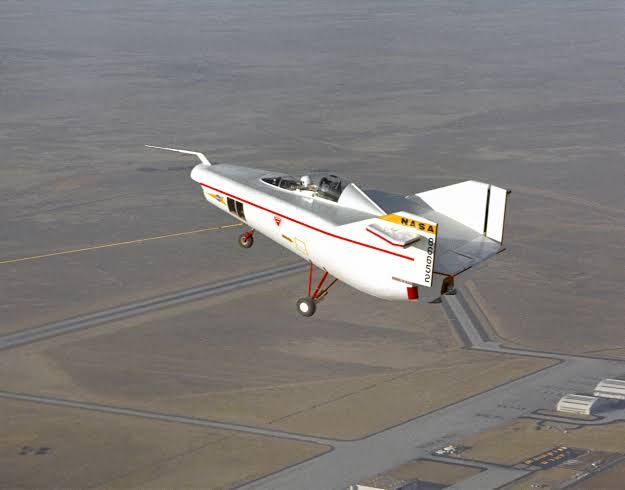
The NASA M2-F1 was a lightweight, unpowered lifting-body research aircraft developed to test whether a wingless vehicle could be controlled during atmospheric flight and landed horizontally. Instead of conventional wings, the aircraft generated lift primarily from the shape of its fuselage.
The project was conceived as an experimental alternative to capsule spacecraft that returned under parachutes. NASA engineers investigated whether a lifting body could provide greater control during descent and permit an aircraft-style runway landing after atmospheric reentry.
The M2-F1 became the first crewed vehicle in NASA's lifting-body flight research program. Its successful tests supported later development of heavier lifting bodies and contributed aerodynamic and handling data relevant to subsequent spacecraft research.
Development
The lifting-body concept was studied at NASA's Ames Research Center. NASA Flight Research Center engineer R. Dale Reed promoted the idea and tested small lifting-body models before center director Paul Bikle approved discretionary funding for a lightweight research vehicle. According to NASA, the designation M2-F1 referred to a manned flight version of the concept.
The aircraft was deliberately inexpensive and simple. Sailplane builder Gus Briegleb constructed the wooden fuselage, while NASA personnel produced the internal steel-tube framework and completed other parts of the vehicle. NASA's historical account states that the M2-F1 was built in about four months and that the cost was kept to approximately $30,000.
Because the M2-F1 had no engine, NASA initially used a modified 1963 Pontiac convertible as a tow vehicle. The car was modified for higher speed so that the research aircraft could be pulled across the dry lakebed fast enough to become airborne.
Ground-tow testing
The first car-tow attempts took place on March 1, 1963, with NASA research pilot Milton O. "Milt" Thompson at the controls. The aircraft bounced between its main landing-gear wheels and could not lift off successfully. NASA subsequently sent the vehicle to Ames for wind-tunnel testing and modified the control system using the resulting data.
Testing resumed on April 5, 1963. Thompson was able to lift the M2-F1 from the lakebed while it remained attached to the tow car. Further runs during the spring and summer increased speed and altitude and demonstrated that the vehicle could make short glides after release from the tow line.
First free flight
The M2-F1 completed its first free flight on August 16, 1963. A C-47 tow aircraft carried it to about 1,585 m (5,200 ft) above the lakebed before Thompson released the tow line. The aircraft then entered a steep glide and landed safely after a flight lasting less than two minutes. NASA reported an average descent rate of about 1,220 m/min (4,000 ft/min) during this first free flight.
The successful flight demonstrated that a low lift-to-drag, wingless lifting body could be controlled and landed. It provided the basis for continued flight testing and for the development of larger metal lifting-body research vehicles.
Design
The M2-F1 was an unpowered, single-seat lifting-body aircraft. Its broad fuselage generated aerodynamic lift, allowing the vehicle to fly without conventional wings. The configuration was based on a half-cone lifting-body shape and was intended to investigate the handling qualities of vehicles that could descend steeply and transition to a controlled landing.
Structure
The aircraft used a wooden outer shell supported by an internal steel-tube structure. This lightweight construction allowed NASA to build and modify the prototype without the cost of a conventional aerospace development program. The completed vehicle weighed approximately 454 kg (1,000 lb) empty.
Controls and landing equipment
The M2-F1 used mechanical flight controls. Early ground testing revealed control problems, and wind-tunnel testing at Ames led to changes in how the pilot's control inputs operated the aerodynamic surfaces. The aircraft used a tricycle landing-gear arrangement.
For the air-tow program, the aircraft was equipped with an ejection seat. Small rockets were also installed in the tail as an emergency means of briefly extending the landing flare if required.
Flight testing
Following the first free flight, the M2-F1 continued to make air-towed research flights as NASA expanded its understanding of lifting-body handling and landing techniques. Typical glide flights lasted about two minutes and involved steep descent profiles followed by a flare before touchdown.
Several pilots eventually flew the aircraft, including Milt Thompson, Bruce Peterson, Chuck Yeager, Donald Sorlie, Donald Mallick, Jerauld Gentry, and Bill Dana. Additional pilots participated in ground-tow testing.
NASA states that by the time the M2-F1 was retired in August 1966, it had completed 77 air-towed flights and approximately 400 car-towed flights. The program demonstrated the controllability of the lifting-body configuration and provided experience for subsequent research vehicles.
Program significance
The M2-F1 was followed by heavier lifting-body aircraft including the M2-F2, M2-F3, HL-10, X-24A, and X-24B. These vehicles expanded the research to higher speeds and altitudes and produced additional information about low lift-to-drag flight, atmospheric descent, and horizontal landing.
NASA's Wingless Flight history describes the M2-F1 as the vehicle that helped open the way for the broader lifting-body program. Although the lifting-body configuration itself was not selected for the Space Shuttle, NASA states that experience and data from the lifting-body research were applicable to the Shuttle's development and its unpowered atmospheric landing profile.
Specifications (NASA M2-F1)
General characteristics
- Crew: 1
- Length: 6.1 m (20 ft)
- Height: 2.90 m (9 ft 6 in)
- Empty weight: 454 kg (1,000 lb)
- Gross weight: 536 kg (1,182 lb)
- Maximum takeoff weight: 567 kg (1,250 lb)
Performance
- Never-exceed speed: 240 km/h (150 mph; 130 kn)
- Aerotow speed: approximately 161 km/h (100 mph; 87 kn)
- Typical rate of sink: approximately 1,100 m/min (3,600 ft/min)
Related equipment
- NASA M2-F2: A heavier metal lifting-body research aircraft whose configuration followed the M2-F1 research.
- NASA M2-F3: A later development of the M2-series lifting-body program.
- NASA HL-10: A crewed lifting-body research aircraft used in the subsequent NASA program.
- Martin Marietta X-24A and X-24B: U.S. Air Force lifting-body research aircraft that extended testing to higher-performance flight conditions.
 Argentina
 Armenia
 Australia
 Austria
 Austria-Hungary
 Belgium
 Brazil
 United Kingdom
 Brunei
 Bulgaria
 Canada
 Chile
Chile China
China Colonial America
 Colombia
 Confederate States
 Croatia
 Czech
Czech Denmark
 Egypt
Egypt Finland
 France
 Georgia
 Germany
 German Imperial
 Greece
 Holland
 Hungary
 India
India Indonesia
 Iran
Iran Iraq
Iraq Ireland
 Israel
 Italy
Italy Japan
Japan Japan (1940)
 Jordan
 Kingdom of Italy
 Malaysia
 Mexico
 Myanmar
 Nazi Germany
 Netherlands
 New Zealand
 North Korea
 Norway
 Pakistan
 Peru
Peru Philippines
 Poland
 Portugal
 Prussia
 Romania
 Russia
 Saudi Arabia
 Serbia
 Singapore
 Slovakia
 Slovenia
 South Africa
 South Korea
 Soviet Union
 Spain
Spain Sweden
 Switzerland
 Syria
Syria Taiwan
 Thailand
 Turkey
 UAE
UAE Ukraine
 Vietnam
 Yugoslavia