
History
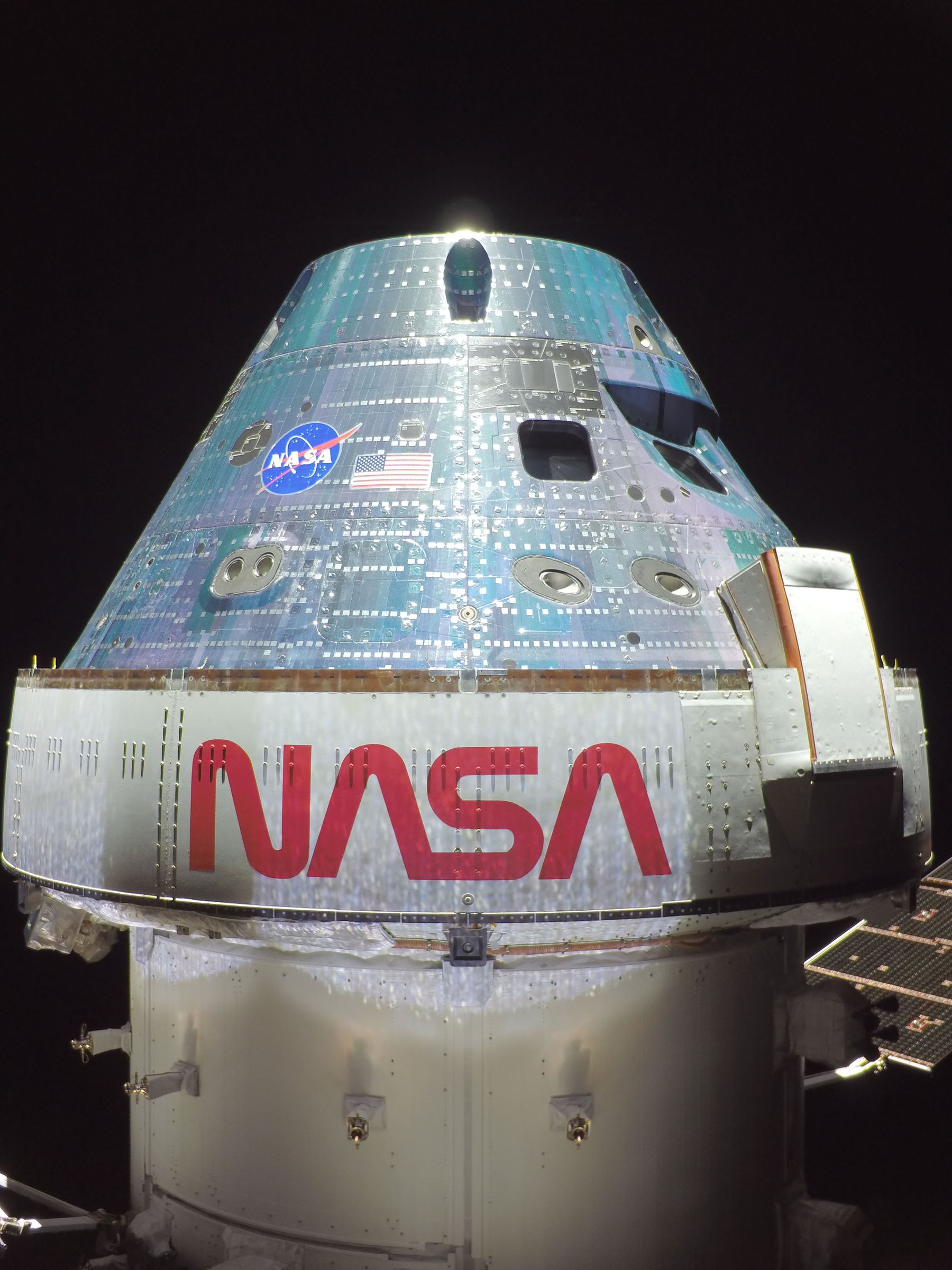
Orion is a partially reusable crewed spacecraft developed for NASA's human exploration missions beyond low Earth orbit. The system combines a Lockheed Martin crew module with a European Service Module supplied by the European Space Agency and manufactured by Airbus Defence and Space. Orion is designed to carry four astronauts, operate independently for missions lasting up to 21 days, and return its crew to Earth by atmospheric re-entry and ocean recovery.
The spacecraft originated in NASA's Crew Exploration Vehicle program during the 2000s. Lockheed Martin was selected as the prime contractor in 2006, when Orion formed part of the Constellation program. After Constellation was cancelled in 2010, NASA retained and redesigned Orion for deep-space exploration. The Space Launch System became its primary launch vehicle, and a service module derived from Europe's Automated Transfer Vehicle replaced the earlier service-module concept.
An uncrewed Orion test vehicle made the Exploration Flight Test 1 mission on 5 December 2014. The flight tested launch, high-energy atmospheric re-entry, parachutes, recovery procedures, avionics, and the crew-module heat shield. The later Artemis I mission provided an uncrewed test of the integrated Orion and European Service Module around the Moon.
Development
Orion was built around the requirement to support crews beyond low Earth orbit, where rapid return to Earth is not always possible. Its development therefore placed emphasis on radiation protection, life support, autonomous navigation, fault tolerance, high-speed re-entry, and the ability to sustain a crew during lunar missions.
The partnership with ESA divided the principal spacecraft elements between American and European industry. Lockheed Martin produces the crew module, while Airbus Defence and Space builds the European Service Module. The service module supplies propulsion, electrical power, thermal control, water, oxygen, and other resources until it separates from the crew module before re-entry.
Flight testing
Artemis II was the first crewed Orion mission and the first crewed journey beyond low Earth orbit since the Apollo era. The spacecraft assigned to the mission was Orion CM-003, named Integrity, paired with ESM-2. During the mission, the crew evaluated habitability, life-support performance, operations, and manual handling.
Manual piloting demonstrations used the separated Space Launch System upper stage as a visual reference. Crew members operated rotational and translational hand controllers while using windows, cameras, and cockpit displays to judge relative position. One demonstration tested two thruster modes, six-degree-of-freedom and three-degree-of-freedom control. The exercise collected handling data for contingency operations and future proximity and docking tasks.
Design
Orion consists of a conical crew module, a cylindrical European Service Module, a crew-module adapter, and a launch abort system used during ascent. The crew module is the only major element that returns to Earth. It contains the pressure vessel, crew stations, avionics, navigation equipment, life-support systems, parachutes, and thermal protection needed for lunar-return velocity.
Crew module
The crew module accommodates four astronauts. Its pressurised volume is approximately 19.56 cubic metres, of which about 8.9 cubic metres is habitable. Glass-cockpit displays and hand controllers allow astronauts to supervise automated flight and manually control orientation and translation when required.
Ablative thermal protection shields the capsule during atmospheric entry. After deceleration, a parachute system lowers the crew module for an ocean splashdown. Recovery forces then secure the capsule and extract the crew.
European Service Module
The European Service Module carries solar arrays and produces up to approximately 11 kilowatts of electrical power. It contains tanks and distribution equipment for propellant, water, oxygen, and nitrogen. Thermal-control hardware removes heat from the crew module and spacecraft systems.
For Artemis II, the propulsion system comprised one main engine, eight auxiliary engines, and 24 reaction-control thrusters arranged in six pods. The main engine provided major velocity changes, the auxiliary engines supported trajectory corrections and offered backup capability, and the smaller thrusters controlled orientation and fine translation. The service module is discarded before the crew module enters Earth's atmosphere.
Guidance and control
Orion normally flies under computer control, but the crew can intervene using rotational and translational hand controllers. The rotational controller commands pitch, yaw, and roll. The translational controller moves the spacecraft forward, backward, and laterally. Multiple displays present vehicle status and navigation information, while a cursor-control device provides access to display functions.
Operational history
Exploration Flight Test 1 in 2014 was Orion's first spaceflight. Artemis I later carried an uncrewed production configuration around the Moon and back, testing the integrated spacecraft in deep space. Artemis II followed as the first crewed flight and used Orion Integrity for a lunar flyby. Results from its life-support, habitability, thermal-protection, and manual-control tests were passed to later Artemis missions.
Orion is intended to support continuing Artemis missions, including flights that work with lunar landers and other elements of the Moon-to-Mars architecture. Mission assignments and schedules remain subject to NASA program decisions, testing, and funding.
Variants
- Orion EFT-1 — uncrewed crew-module test vehicle flown in 2014 without a production European Service Module.
- Orion Artemis I — uncrewed deep-space test configuration with the first operational European Service Module.
- Orion Integrity — CM-003 and ESM-2 spacecraft used for the crewed Artemis II lunar flyby.
- Later Artemis spacecraft — production vehicles under construction for subsequent crewed missions.
Operators
- United States — NASA operates Orion for crewed exploration beyond low Earth orbit.
Specifications (Orion MPCV with European Service Module)
General characteristics
- Crew: Four.
- Launch mass: Approximately 33,446 kg (73,735 lb) including crew module, service module, and launch abort system.
- Crew-module mass: Approximately 10,400 kg (22,900 lb).
- Crew-module length: Approximately 3.3 m (11 ft).
- Crew-module diameter: Approximately 5.03 m (16.5 ft).
- Pressurised volume: Approximately 19.56 m³ (690.6 cu ft).
- Habitable volume: Approximately 8.9 m³ (316 cu ft).
- Independent mission duration: Up to approximately 21 days.
- Electrical power: Up to approximately 11 kW from European Service Module solar arrays.
Propulsion and control
- Main propulsion: One European Service Module main engine.
- Auxiliary propulsion: Eight auxiliary engines.
- Reaction control: 24 small thrusters arranged in six pods.
- Manual controls: Rotational and translational hand controllers.
Related equipment
- Space Launch System — NASA launch vehicle used to send Orion on Artemis missions.
- European Automated Transfer Vehicle — spacecraft whose technology contributed to the European Service Module.
- Apollo command and service module — earlier American crewed lunar spacecraft with a broadly comparable crew-return role.
 Argentina
 Armenia
 Australia
 Austria
 Austria-Hungary
 Belgium
 Brazil
 United Kingdom
 Brunei
 Bulgaria
 Canada
 Chile
Chile China
China Colonial America
 Colombia
 Confederate States
 Croatia
 Czech
Czech Denmark
 Egypt
Egypt Finland
 France
 Georgia
 Germany
 German Imperial
 Greece
 Holland
 Hungary
 India
India Indonesia
 Iran
Iran Iraq
Iraq Ireland
 Israel
 Italy
Italy Japan
Japan Japan (1940)
 Jordan
 Kingdom of Italy
 Malaysia
 Mexico
 Myanmar
 Nazi Germany
 Netherlands
 New Zealand
 North Korea
 Norway
 Pakistan
 Peru
Peru Philippines
 Poland
 Portugal
 Prussia
 Romania
 Russia
 Saudi Arabia
 Serbia
 Singapore
 Slovakia
 Slovenia
 South Africa
 South Korea
 Soviet Union
 Spain
Spain Sweden
 Switzerland
 Syria
Syria Taiwan
 Thailand
 Turkey
 UAE
UAE Ukraine
 Vietnam
 Yugoslavia