
History
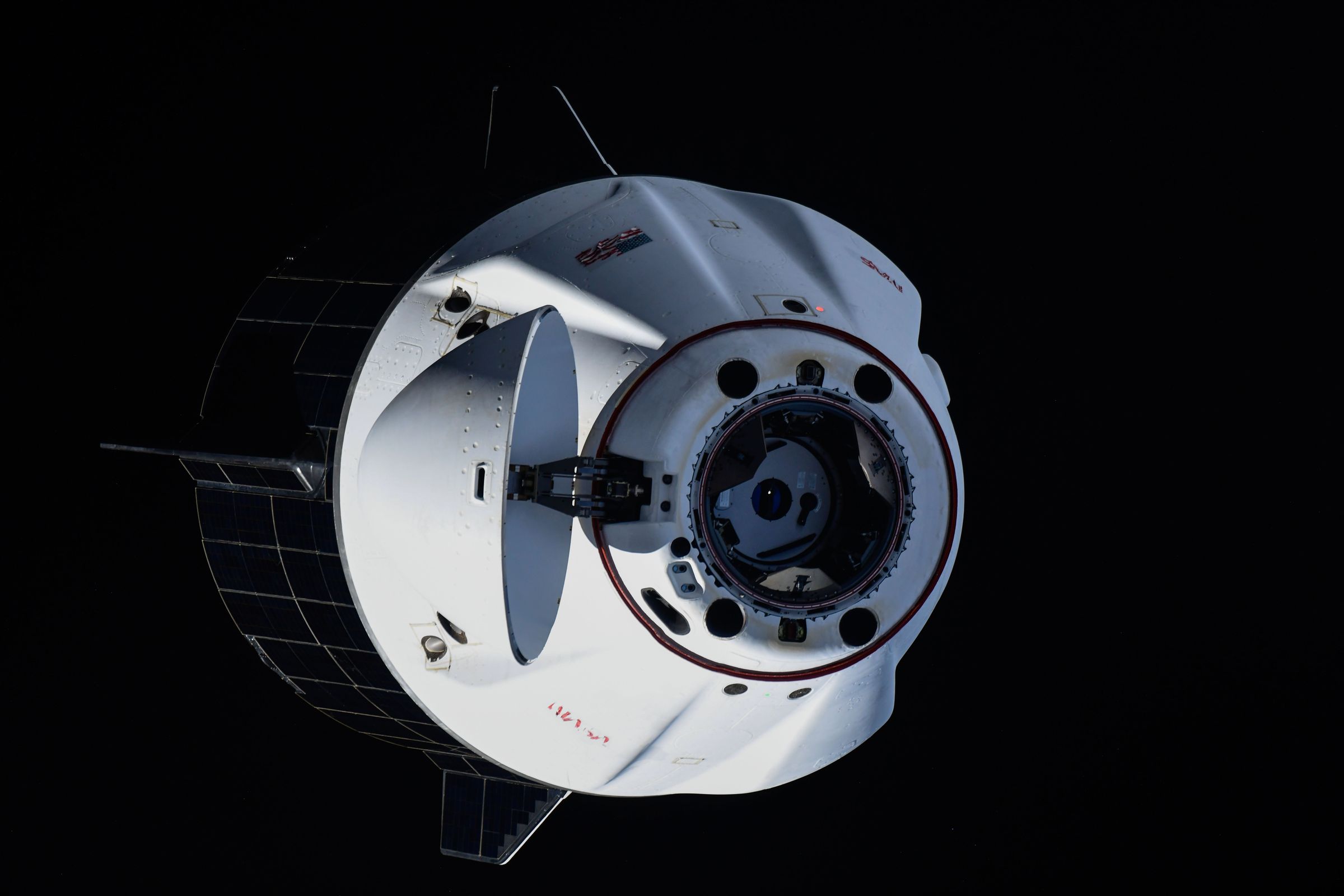
SpaceX Crew Dragon is a reusable crewed spacecraft developed in the United States for transport between Earth and low orbit. It is the crew-carrying version of the Dragon 2 family and was created primarily for NASA's Commercial Crew Program. The vehicle also supports private missions to low Earth orbit and the International Space Station.
Development
Crew Dragon evolved from SpaceX's first-generation Dragon cargo vehicle. NASA selected SpaceX in 2014 to complete development and certification of a commercial crew transportation system. The new spacecraft incorporated life-support equipment, seats and displays for astronauts, autonomous docking, and an integrated launch escape system.
The uncrewed Demo-1 spacecraft reached the International Space Station in March 2019. A ground-test vehicle was lost during a SuperDraco firing test in April 2019, leading to an investigation and changes to the propulsion system. SpaceX then conducted an in-flight abort demonstration in January 2020.
Flight testing
The Demo-2 mission launched astronauts Douglas Hurley and Robert Behnken on 30 May 2020. It was the first crewed orbital flight launched from the United States since the Space Shuttle's final mission in 2011 and the first crewed flight of a privately developed orbital spacecraft. Demo-2 docked with the International Space Station and returned by parachute-assisted ocean splashdown in August 2020.
Operational service
NASA certification enabled regular Commercial Crew rotation missions to the International Space Station. Crew Dragon has also flown private astronaut missions, including independent orbital flights and commercially organized visits to the station. SpaceX operates a fleet of named capsules and refurbishes them between missions.
The operational life of each capsule is governed by certification, inspection results, component limits, and mission requirements. SpaceX has stated that the fleet retains substantial service life, but the company has not committed publicly to an indefinite production or retirement date.
Design
Crew Dragon consists of a reusable pressurized capsule and an expendable trunk. The capsule carries the crew, avionics, life-support equipment, maneuvering thrusters, heat shield, and parachutes. The trunk provides structural support during launch, solar power, thermal-control radiators, and space for unpressurized payload.
Cabin and controls
The pressurized cabin has a published volume of 9.3 cubic metres. Normal NASA missions carry four people, although the basic vehicle was designed with accommodation for as many as seven. The crew uses touchscreen displays supported by physical controls for critical functions. The spacecraft can launch, rendezvous, dock, depart, and return largely autonomously, while the crew and ground controllers retain command capability.
Propulsion and escape system
Sixteen Draco thrusters provide attitude control and orbital maneuvering. Eight more powerful SuperDraco engines are integrated into the capsule in four pods for launch escape. The escape system can pull the capsule away from a failing launch vehicle during critical portions of ascent and avoids the separate jettisonable escape tower used by many earlier spacecraft.
Docking
Crew Dragon uses a nose-mounted docking mechanism compatible with the International Docking System Standard. A hinged nose cone protects the mechanism during launch and atmospheric entry. Automated rendezvous sensors and flight software guide the vehicle to the station, where it docks directly rather than being captured by a robotic arm.
Launch and recovery
The spacecraft launches on a Falcon 9 Block 5 rocket. Before atmospheric entry, the trunk is discarded. The capsule uses its heat shield to survive reentry and descends under four main parachutes to an ocean splashdown. Recovery ships retrieve the capsule and support medical checks and crew egress.
Operational history
Crew Dragon became NASA's principal United States crew transport to the International Space Station after Demo-2. Operational missions typically remain docked for several months and serve as an emergency return vehicle for their crews. The program restored a domestic US capability for routine crew launch and reduced reliance on purchased Soyuz seats.
Private missions have demonstrated uses beyond NASA crew rotation. These flights have included free-flying orbital missions and visits to the International Space Station. Mission duration, crew composition, orbit, and equipment vary, but all use the same basic capsule and Falcon 9 launch architecture.
Variants
- Crew Dragon — crewed Dragon 2 variant with life support, seats, displays, docking equipment, and SuperDraco launch-escape engines.
- Cargo Dragon — uncrewed Dragon 2 variant for cargo delivery and return; it is related to Crew Dragon but is not a crew-carrying configuration.
Operators
- United States — SpaceX operates the spacecraft for NASA Commercial Crew missions and private customers.
Specifications (Crew Dragon)
General characteristics
- Crew: four in normal NASA service; vehicle capacity up to seven
- Height: 8.1 m with trunk
- Diameter: 4 m
- Pressurized volume: 9.3 cubic metres
- Trunk volume: 37 cubic metres
- Launch vehicle: Falcon 9 Block 5
- Propulsion: 16 Draco maneuvering thrusters
- Launch escape: eight SuperDraco engines
Performance
- Operating region: low Earth orbit
- Free-flight design duration: approximately 10 days
- Docked mission duration: up to approximately 210 days, subject to mission certification
Related equipment
- SpaceX Dragon 1 — first-generation cargo spacecraft from which Dragon 2 was developed.
- Boeing CST-100 Starliner — another spacecraft developed under NASA's Commercial Crew Program.
 Argentina
 Armenia
 Australia
 Austria
 Austria-Hungary
 Belgium
 Brazil
 United Kingdom
 Brunei
 Bulgaria
 Canada
 Chile
Chile China
China Colonial America
 Colombia
 Confederate States
 Croatia
 Czech
Czech Denmark
 Egypt
Egypt Finland
 France
 Georgia
 Germany
 German Imperial
 Greece
 Holland
 Hungary
 India
India Indonesia
 Iran
Iran Iraq
Iraq Ireland
 Israel
 Italy
Italy Japan
Japan Japan (1940)
 Jordan
 Kingdom of Italy
 Malaysia
 Mexico
 Myanmar
 Nazi Germany
 Netherlands
 New Zealand
 North Korea
 Norway
 Pakistan
 Peru
Peru Philippines
 Poland
 Portugal
 Prussia
 Romania
 Russia
 Saudi Arabia
 Serbia
 Singapore
 Slovakia
 Slovenia
 South Africa
 South Korea
 Soviet Union
 Spain
Spain Sweden
 Switzerland
 Syria
Syria Taiwan
 Thailand
 Turkey
 UAE
UAE Ukraine
 Vietnam
 Yugoslavia