
History
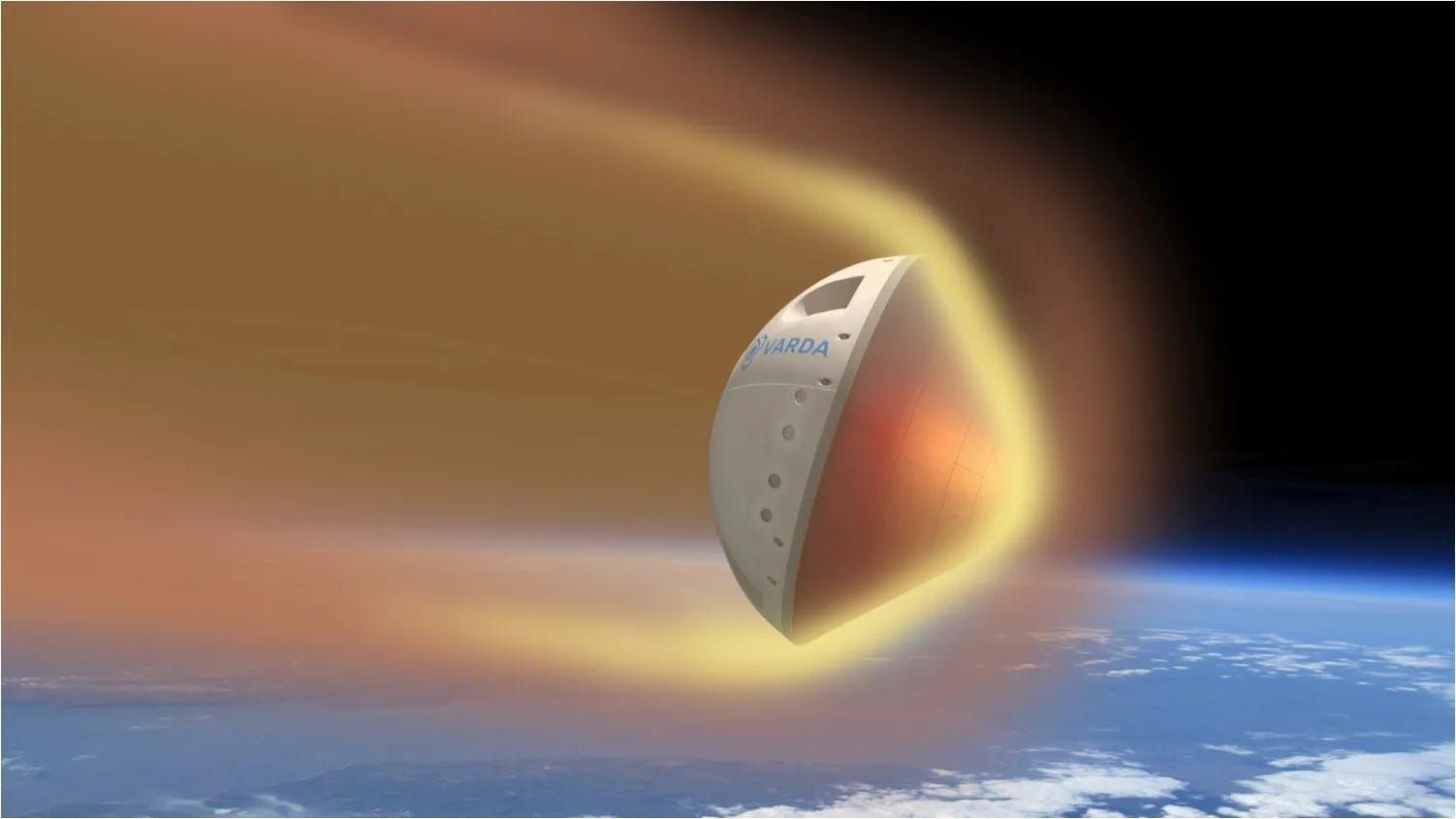
SpaceX Starfall is an uncrewed reentry capsule designed to return cargo from orbit or near-orbital trajectories. Its intended applications include microgravity manufacturing, scientific research, pharmaceutical work, and rapid cargo delivery.
The low-profile spacecraft can carry up to 1,000 kg of return payload. It is designed for launch aboard Falcon 9, while carriage by Starship is planned as part of a larger system that could deploy multiple capsules.
In August 2026, a Redwire subsidiary working in space biotechnology and pharmaceutical applications agreed to place research payloads aboard a dedicated Starfall mission. The mission remained planned at the time of the announcement.
Development and authorization
The Starfall initiative was publicly reported in July 2025 as a SpaceX project associated with orbital manufacturing. The concept combines launch services with a dedicated system for returning products manufactured or studied in microgravity.
In May 2026, the United States Federal Aviation Administration approved environmental plans for two prototype reentry tests. The authorized recovery area was in international waters in the Pacific Ocean, approximately 1,300 km west of the coasts of California and Mexico. The approval and vehicle configuration were described in reports about the Starfall program and its reentry tests.
Starfall Demo
The first Starfall demonstration vehicle launched aboard a Falcon 9 on 23 June 2026. Its payload included a space-exposure experiment containing brewing, distilling, and wine yeast strains. The capsule was recovered after splashdown and brought to the Port of Long Beach on 25 June for inspection. Details of the demonstration and recovery were recorded in a contemporary Starfall program account.
Design
Starfall has a circular, disk-shaped configuration rather than the conical form commonly used for crewed capsules. The vehicle measures approximately 3.1 m in diameter and 0.75 m in height. Its low-profile structure contains a rectangular payload volume measuring approximately 2.5 × 1.5 × 0.5 m.
The spacecraft has a mass of approximately 2,100 kg without its payload. Reported structural details describe a 1,400 kg aluminium upper section and a 700 kg carbon-fibre heat shield. With the maximum payload installed, total mass is approximately 3,100 kg.
Guidance and attitude control
The capsule uses cold-gas thrusters for orientation and attitude control. Nitrogen tanks for the system are housed within the heat-shield structure. Available descriptions do not identify an independent chemical propulsion system for deorbiting. The required reentry trajectory is therefore established by the launch vehicle or an external propulsion stage.
Prototype vehicles were also intended to test integrated Starlink communications equipment. The purpose of this equipment was to evaluate data transmission during atmospheric reentry, including the period when ionized gas around a spacecraft can interrupt conventional radio links.
Reentry and recovery
A carbon-fibre thermal-protection structure shields the capsule during atmospheric entry. The descent system uses a pilot chute, a drogue parachute, and a main parachute. Shortly before splashdown, the approximately 700 kg heat shield is jettisoned. Maritime recovery vessels retrieve the capsule and associated components from the ocean.
Initial missions follow predetermined reentry paths to Pacific recovery zones. This approach allows SpaceX to evaluate atmospheric entry, parachute deployment, splashdown, communications, and recovery procedures before expanding the system's proposed applications.
Program status
Starfall completed its first demonstration launch and recovery in June 2026. The program remains associated with prototype testing and the development of commercial cargo-return services. Proposed applications include returning pharmaceuticals, protein crystals, advanced materials, semiconductors, and other products manufactured or studied in microgravity.
The dedicated mission announced with a Redwire subsidiary is planned to carry microgravity research payloads related to biotechnology and pharmaceutical applications. The available announcement does not provide its launch date or payload manifest.
SpaceX has also presented Starfall as a possible system for rapid terrestrial cargo delivery. This application remains a proposed capability and should not be confused with the demonstrated orbital-return mission.
Specifications (Starfall demonstration configuration)
General characteristics
- Type: Uncrewed reentry capsule
- Manufacturer: SpaceX
- Country of origin: United States
- Diameter: 3.1 m (10.2 ft)
- Height: 0.75 m (2.5 ft)
- Vehicle mass without payload: Approximately 2,100 kg (4,630 lb)
- Maximum payload: 1,000 kg (2,205 lb)
- Maximum total mass: Approximately 3,100 kg
- Payload volume dimensions: Approximately 2.5 × 1.5 × 0.5 m
- Launch vehicle: Falcon 9; Starship planned
Control and recovery
- Attitude control: Nitrogen-fed cold-gas thrusters
- Thermal protection: Jettisonable carbon-fibre heat shield
- Descent system: Pilot chute, drogue parachute, and single main parachute
- Landing method: Ocean splashdown followed by maritime recovery
 Argentina
 Armenia
 Australia
 Austria
 Austria-Hungary
 Belgium
 Brazil
 United Kingdom
 Brunei
 Bulgaria
 Canada
 Chile
Chile China
China Colonial America
 Colombia
 Confederate States
 Croatia
 Czech
Czech Denmark
 Egypt
Egypt Finland
 France
 Georgia
 Germany
 German Imperial
 Greece
 Holland
 Hungary
 India
India Indonesia
 Iran
Iran Iraq
Iraq Ireland
 Israel
 Italy
Italy Japan
Japan Japan (1940)
 Jordan
 Kingdom of Italy
 Malaysia
 Mexico
 Myanmar
 Nazi Germany
 Netherlands
 New Zealand
 North Korea
 Norway
 Pakistan
 Peru
Peru Philippines
 Poland
 Portugal
 Prussia
 Romania
 Russia
 Saudi Arabia
 Serbia
 Singapore
 Slovakia
 Slovenia
 South Africa
 South Korea
 Soviet Union
 Spain
Spain Sweden
 Switzerland
 Syria
Syria Taiwan
 Thailand
 Turkey
 UAE
UAE Ukraine
 Vietnam
 Yugoslavia