
History
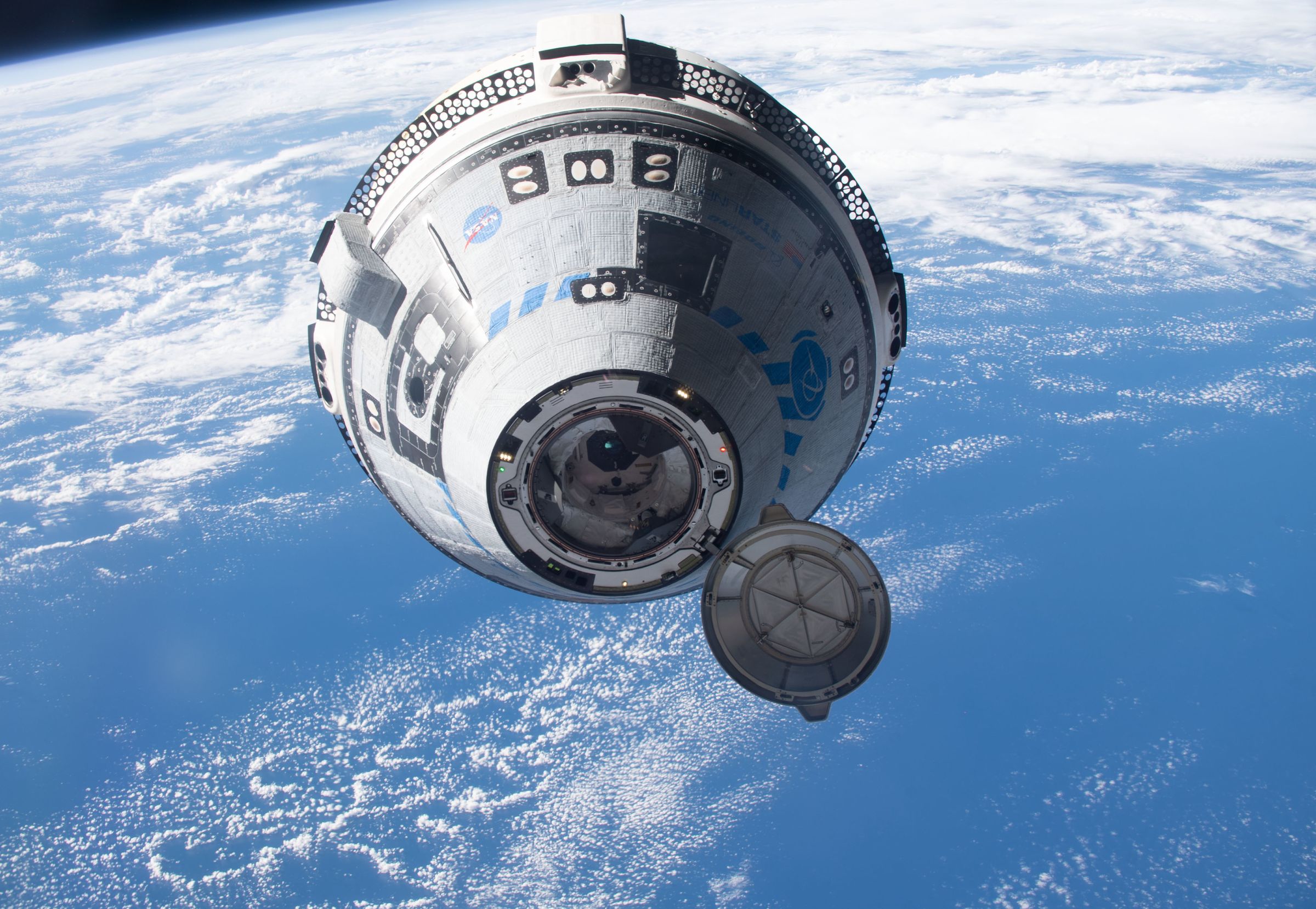
The Boeing CST-100 Starliner is a reusable crew capsule developed with NASA through the Commercial Crew Program. It is intended to transport astronauts and cargo between Earth and destinations in low Earth orbit, primarily the International Space Station.
The spacecraft combines a reusable crew module with an expendable service module. It can carry as many as seven people, although NASA missions are designed for up to four astronauts and time-critical research or other cargo.
Starliner completed uncrewed orbital flights in 2019 and 2022 and its first crewed flight in 2024. Technical problems during these missions delayed certification for regular crew-rotation service. Boeing and NASA subsequently began preparing an additional uncrewed cargo and certification flight.
Development
Boeing publicly introduced the CST-100 concept in June 2010. CST means Crew Space Transportation, while 100 refers to the Kármán line at an altitude of approximately 100 km, commonly treated as the boundary of space. The design drew on Boeing experience from the Apollo, Space Shuttle, International Space Station and Orbital Express programs.
NASA supported development through several phases of its Commercial Crew initiative. Boeing received $18 million during the initial Commercial Crew Development phase and $92.3 million through CCDev2. In September 2014, NASA awarded Boeing a Commercial Crew Transportation Capability contract with a maximum value of $4.2 billion. The contract covered completion, testing and certification of the spacecraft, followed by crew-transport missions to the International Space Station.
Boeing adopted the Starliner name in September 2015. The original program schedule anticipated operational service during the second half of the 2010s, but mass reduction, aerodynamic work, software requirements, propulsion-system problems and other technical issues repeatedly delayed the flight-test program.
A Starliner test vehicle conducted a pad-abort demonstration at White Sands Missile Range in November 2019. Its four launch-abort engines carried the crew module away from the test stand, demonstrating the system intended to separate the capsule from a failing launch vehicle.
Orbital Flight Test
The first uncrewed Orbital Flight Test launched on an Atlas V N22 rocket on 20 December 2019. An incorrect mission-elapsed-time value caused the spacecraft to execute orbital-control commands at the wrong time and consume excessive propellant. Starliner entered orbit but could not rendezvous with the International Space Station. Controllers also discovered a separate software problem that could have caused the crew module and service module to collide during separation. The capsule returned to Earth and landed at White Sands two days after launch.
NASA and Boeing conducted an extensive investigation and developed dozens of corrective actions. Boeing elected to repeat the uncrewed flight at its own expense. The second attempt was delayed in 2021 after valves in the service-module propulsion system became stuck. Investigators linked the condition to corrosion produced when atmospheric moisture interacted with nitrogen tetroxide oxidizer and aluminium components.
Orbital Flight Test 2
Orbital Flight Test 2 launched on 19 May 2022. Two Orbital Maneuvering and Attitude Control thrusters stopped operating during orbital insertion, but other thrusters allowed the spacecraft to continue. Additional reaction-control thrusters experienced problems during the approach to the station.
Starliner nevertheless reached the International Space Station and completed its first docking. The mission transported more than 360 kg of combined NASA and Boeing cargo to the station. The capsule undocked and landed at White Sands on 25 May. Although the flight demonstrated the complete launch, docking, re-entry and landing sequence, the recorded propulsion and thermal-control anomalies required further analysis.
Crew Flight Test
The Crew Flight Test launched on 5 June 2024 with NASA astronauts Barry Wilmore and Sunita Williams aboard the Calypso crew module. This was Starliner's first flight with people. During its approach to the International Space Station, several aft-facing reaction-control thrusters stopped producing the expected thrust. The service module also developed multiple helium leaks. Controllers recovered enough thruster capability for the spacecraft to dock on 6 June.
NASA and Boeing conducted ground and orbital tests while the spacecraft remained at the station. NASA eventually concluded that uncertainty about the propulsion system created too much risk for a crewed return. Starliner therefore undocked without Wilmore and Williams and landed at White Sands on 7 September 2024. The astronauts later returned aboard a SpaceX Crew Dragon in March 2025.
Subsequent investigation associated the propulsion degradation with excessive heating inside the service-module thruster enclosures, vapor formation in the oxidizer and deformation of valve seals. The investigation also examined the helium leaks and a crew-module orientation thruster that failed during re-entry. A report released in February 2026 classified the Crew Flight Test as a Type A mishap and identified technical, qualification and organizational deficiencies requiring correction.
Design
Configuration and accommodation
Starliner consists of a conical reusable crew module and a cylindrical expendable service module. The combined spacecraft is approximately 5 m high and 4.6 m in diameter. Boeing uses a weldless, spun-formed pressure structure for the capsule.
The cabin can accommodate as many as seven people or a combination of crew and cargo. NASA service missions are configured for up to four agency-sponsored astronauts, leaving capacity for research equipment and supplies. Boeing designed each crew module for as many as ten flights, with a targeted turnaround period of six months.
The spacecraft uses the NASA Docking System to connect with the International Space Station. Rendezvous, approach and docking can be performed automatically, while manual flight controls provide a backup capability. Wireless networking and tablet-based crew interfaces are incorporated into the cabin.
Propulsion
The service module contains 28 reaction-control-system thrusters, each rated at 378 N, and 20 Orbital Maneuvering and Attitude Control thrusters, each rated at approximately 6.67 kN. The smaller thrusters control orientation and conduct precise translation manoeuvres. The more powerful OMAC units perform larger orbital changes, including orbital insertion and the deorbit burn.
Four RS-88-derived launch-abort engines provide approximately 178 kN of thrust each. During an emergency they are intended to push the crew module away from the launch vehicle. The abort engines are installed in the service module, which is discarded before atmospheric entry.
The crew module has 12 reaction-control thrusters rated at approximately 445 N each. These units control its orientation after separation from the service module and during the entry and landing sequence.
Electrical power and thermal protection
Solar cells are installed on the aft surface of the service module and provide more than 2.9 kW of electrical power. Batteries support the spacecraft during mission phases when solar power is unavailable. The crew module uses Boeing Lightweight Ablator material as its atmospheric-entry heat shield.
A protective cover closes over the docking system before atmospheric entry. The cover shields the docking hardware while the capsule passes through the atmosphere and allows this equipment to remain with the reusable crew module.
Landing system
Unlike American crew capsules designed principally for ocean recovery, Starliner normally returns to a dry landing site in the western United States. Three main parachutes reduce its descent speed. The heat shield is released before touchdown, allowing six airbags beneath the capsule to inflate and absorb the landing impact.
Primary recovery areas include sites at White Sands Missile Range in New Mexico, Dugway Proving Ground in Utah and Willcox Playa in Arizona. Edwards Air Force Base in California can serve as a contingency site.
Launch system
Completed Starliner orbital flights have used the United Launch Alliance Atlas V N22. In this designation, the first N indicates that the rocket carries no payload fairing, 2 identifies two solid rocket boosters and the second 2 identifies the dual-engine Centaur upper stage. The launch profile places Starliner on a suborbital trajectory, after which the spacecraft uses its own propulsion to enter orbit.
Starliner was designed with compatibility for several launch vehicles. The remaining NASA flights were assigned to Atlas V rockets reserved before the end of Atlas production. Vulcan Centaur has been identified as a possible later launch vehicle, but it would require work and certification for human spaceflight before carrying a crewed Starliner.
Program status
NASA has not certified Starliner for regular crew-rotation missions. After the 2024 Crew Flight Test, NASA and Boeing agreed that the next spacecraft would fly without astronauts. The planned Starliner-1 mission is intended to carry cargo to the International Space Station while providing additional flight data for certification.
As of July 2026, Boeing and NASA were still evaluating technical work and available International Space Station launch opportunities. No firm launch date had been announced. A later return to crewed flight depends on resolving the propulsion-system deficiencies and completing NASA's certification requirements.
Boeing continued to describe NASA as the program's principal customer and maintained that Starliner was intended to support future crew and cargo missions. Technical information and program updates are available from the Boeing Starliner program, while the eoPortal mission record documents the spacecraft's development and early flights.
Flight vehicles and missions
- Spacecraft 1: Test article used for the successful pad-abort demonstration at White Sands in November 2019.
- Spacecraft 3 Calypso: Reusable crew module flown on the first Orbital Flight Test in December 2019 and the Crew Flight Test in June 2024.
- Spacecraft 2: Crew module used for Orbital Flight Test 2 in May 2022 and assigned to the planned uncrewed Starliner-1 cargo and certification mission.
Operator and customer
- Boeing: Owns and operates the Starliner spacecraft and is responsible for spacecraft production, integration, mission planning, crew training and recovery support.
- NASA: Anchor customer through the Commercial Crew Program. NASA oversees certification and intends to use Starliner for transportation to and from the International Space Station after the system meets its requirements.
Specifications (CST-100 Starliner)
General characteristics
- Type: Reusable low-Earth-orbit crew and cargo capsule
- Manufacturer: Boeing
- Height: 5 m, crew and service modules combined
- Diameter: 4.6 m
- Combined mass: 6,663 kg
- Maximum crew capacity: Seven
- NASA mission crew: Up to four
- Docking system: NASA Docking System
- Reusable element: Crew module, designed for up to ten flights
- Expendable element: Service module
- Launch vehicle used: Atlas V N22
- Nominal destination: International Space Station in low Earth orbit
Propulsion and power
- Service-module reaction control: 28 thrusters producing 378 N each
- Orbital manoeuvring: 20 OMAC thrusters producing approximately 6.67 kN each
- Crew-module reaction control: 12 thrusters producing approximately 445 N each
- Launch-abort propulsion: Four engines producing approximately 178 kN each
- Solar-array output: More than 2.9 kW
Recovery
- Landing method: Ground landing using three main parachutes and six airbags
- Primary recovery region: Western United States
 Argentina
 Armenia
 Australia
 Austria
 Austria-Hungary
 Belgium
 Brazil
 United Kingdom
 Brunei
 Bulgaria
 Canada
 Chile
Chile China
China Colonial America
 Colombia
 Confederate States
 Croatia
 Czech
Czech Denmark
 Egypt
Egypt Finland
 France
 Georgia
 Germany
 German Imperial
 Greece
 Holland
 Hungary
 India
India Indonesia
 Iran
Iran Iraq
Iraq Ireland
 Israel
 Italy
Italy Japan
Japan Japan (1940)
 Jordan
 Kingdom of Italy
 Malaysia
 Mexico
 Myanmar
 Nazi Germany
 Netherlands
 New Zealand
 North Korea
 Norway
 Pakistan
 Peru
Peru Philippines
 Poland
 Portugal
 Prussia
 Romania
 Russia
 Saudi Arabia
 Serbia
 Singapore
 Slovakia
 Slovenia
 South Africa
 South Korea
 Soviet Union
 Spain
Spain Sweden
 Switzerland
 Syria
Syria Taiwan
 Thailand
 Turkey
 UAE
UAE Ukraine
 Vietnam
 Yugoslavia