

History
The Sukhoi S-71M Monochrome is a Russian air-launched cruise missile and loitering-munition design developed for carriage by low-observable combat aircraft. Sources describe it as the autonomous-targeting member of the S-71 family and as a modification of the S-71K Kovyor.
The S-71M is reported to combine reduced-observability shaping, folding wings, low-altitude flight, and onboard electro-optical guidance. Ukrainian specialists examining missile wreckage in 2026 identified an NVIDIA Jetson Orin computer module, which Ukrainian military intelligence said may indicate the use of artificial-intelligence technologies in the missile's guidance system.
Public information about the S-71M remains incomplete and sometimes contradictory. Reported range, warhead mass, production status, and classification differ between sources, so technical figures below are presented as reported rather than definitive.
Development
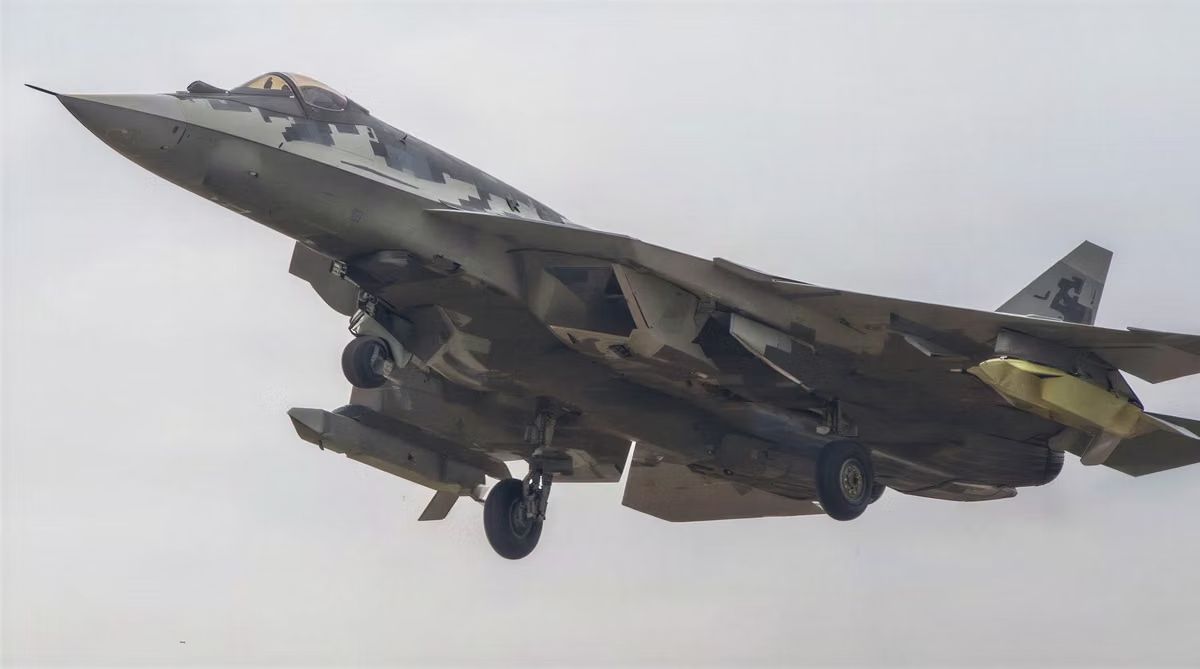
The S-71M is associated with JSC United Aircraft Corporation and Sukhoi. It was developed as part of the wider S-71 family, with the Monochrome version described as an adaptation of the S-71K Kovyor intended for internal carriage by aircraft such as the Su-57 fighter and S-70 Okhotnik unmanned combat aircraft.
Redstar.gr reports that the S-71M made its first flight on 18 April 2023. This is the earliest physical milestone identified in the supplied material.
The subsequent program status is less clear. Autonomous Weapons Watch lists the system as approved for mass production in 2025, while Redstar.gr describes the S-71M as remaining in factory testing in 2026. The available material therefore does not establish a precise production quantity or service-entry date.
Identification in Ukraine
In August 2026, Ukraine's Main Directorate of Intelligence reported finding an NVIDIA Jetson Orin module in wreckage identified as an S-71M Monochrome. The recovered processor carried the TE980M-A1 marking. Reporting by The Register and Tom's Hardware independently described the Ukrainian finding.
Tom's Hardware identified the component as resembling an NVIDIA Jetson Orin NX 8 GB or 16 GB system-on-module. Such modules are designed to perform substantial computing and machine-vision workloads locally rather than depending on a continuous cloud connection. NVIDIA stated that Jetson Orin products are consumer-grade devices, are not designed for military use, and are not officially available in Russia.
The discovery of an AI-capable processor does not by itself establish exactly which algorithms the S-71M runs. Ukrainian intelligence stated that the component may indicate the use of artificial-intelligence technologies. Other supplied reporting describes the missile as capable of autonomous target search and engagement using optical sensors and onboard processing.
Design
Airframe
The S-71M is reported to have a trapezoidal fuselage cross-section, a folding swept wing, and a V-shaped all-moving tail. These features are consistent with the stated requirement for compact carriage inside internal weapon bays. Redstar.gr reports a length of 4.00 m, a maximum wingspan of 3.43 m, a width of 0.35 m, and a height of 0.55 m.
The missile is described as compatible with the internal weapon bays of the Su-57 and S-70 Okhotnik. It has also been depicted on an external aircraft weapon station. The supplied sources describe reduced observability as a central feature of the design.
Powerplant
Redstar.gr reports a single modified TRDD-50 small turbofan engine installed in the rear of the vehicle. The source gives normal thrust in the range of 175 to 220 kgf and a maximum figure of 450 kgf. The TRDD-50 family is also associated with several other Russian cruise-missile designs.
Navigation and targeting
The reported navigation suite combines a digital inertial navigation system with GLONASS/GPS correction and a radar altimeter for low-altitude flight. Redstar.gr also describes an electro-optical correlation sensor and the possible use of bispectral infrared sensing.
The Monochrome version is distinguished in the supplied material by its reported ability to search for targets in an assigned area. Autonomous Weapons Watch states that the S-71M can search for, detect, and engage moving targets using electro-optical sensors and onboard targeting data. It also reports an operating mode in which a human operator can validate targets, as well as a fully autonomous mode.
Tom's Hardware reports that an electro-optical perception system in the missile may use a Chinese-made Honpho TS130C-01 module together with the NVIDIA Jetson Orin computer. In such an architecture, the Jetson could process images locally and provide target-recognition information to the missile's guidance system. The precise division of functions between the recovered computer and other flight-control hardware has not been publicly established.
Warhead
Open sources disagree about the S-71M warhead. The Ukrainian source material states that, if the Monochrome retains the same relevant parameters as the S-71K, it could use a 250 kg OFAB-250-270 high-explosive fragmentation bomb as its payload. Redstar.gr instead reports warhead options weighing approximately 100 to 150 kg, including high-explosive fragmentation and penetrating types.
A separate August 2026 report by TSN describes the warhead as weighing about 250 kg. Because the supplied sources do not resolve this discrepancy, no single warhead mass can be treated as confirmed for the S-71M.
Operational history
By August 2026, Ukrainian military intelligence had examined wreckage identified as belonging to an S-71M Monochrome. The recovered NVIDIA processor provides physical evidence that at least one S-71M reached a stage at which complete missiles were being flown or employed.
Ukrainian and international reporting in August 2026 described the S-71M in connection with Russian attacks against Ukraine. The supplied material does not establish how many missiles had been produced or used, the specific missions in which individual missiles were employed, or the combat effectiveness of the reported autonomous-targeting functions.
Variants
- S-71K Kovyor: Related S-71 cruise-missile version from which the S-71M is described as being derived. The supplied Ukrainian material uses the S-71K as a reference when discussing possible S-71M range and payload characteristics.
- S-71M Monochrome: Reduced-observability version intended for air launch and reported to include autonomous target-search capabilities, electro-optical sensing, and onboard high-performance computing.
Specifications (S-71M Monochrome)
General characteristics
- Type: Air-launched cruise missile and loitering munition
- Developer: JSC UAC Sukhoi, as reported in the supplied sources
- First flight: 18 April 2023, as reported by Redstar.gr
- Length: 4.00 m
- Wingspan: 3.43 m maximum
- Width: 0.35 m
- Height: 0.55 m
- Reported maximum mass: 650–700 kg
- Powerplant: One TRDD-50 turbofan
- Reported thrust: 175–220 kgf, with a reported maximum of 450 kgf
- Reported carrier aircraft: Su-57 fighter and S-70 Okhotnik unmanned combat aircraft
Performance
- Reported range: Approximately 200–350 km; other supplied reporting gives up to 300 km when assuming parameters similar to the S-71K
- Reported service ceiling: 8,000 m
- Reported low-altitude flight: 20–75 m above terrain and 5–15 m above water
Guidance
- Navigation: Digital inertial navigation with reported GLONASS/GPS correction
- Altitude sensing: Radar altimeter
- Terminal sensing: Reported electro-optical correlation system, with possible infrared sensing
- Onboard computing: NVIDIA Jetson Orin module identified in recovered missile wreckage
- Targeting: Reported autonomous target search, detection, and engagement capability with an operator-in-the-loop option
 Argentina
 Armenia
 Australia
 Austria
 Austria-Hungary
 Belgium
 Brazil
 United Kingdom
 United States
 Brunei
 Bulgaria
 Canada
 Chile
Chile China
China Colonial America
 Colombia
 Confederate States
 Croatia
 Czech
Czech Denmark
 Egypt
Egypt Finland
 France
 Georgia
 Germany
 German Imperial
 Greece
 Holland
 Hungary
 India
India Indonesia
 Iran
Iran Iraq
Iraq Ireland
 Israel
 Italy
Italy Japan
Japan Japan (1940)
 Jordan
 Kingdom of Italy
 Malaysia
 Mexico
 Myanmar
 Nazi Germany
 Netherlands
 New Zealand
 North Korea
 Norway
 Pakistan
 Peru
Peru Philippines
 Poland
 Portugal
 Prussia
 Romania
 Saudi Arabia
 Serbia
 Singapore
 Slovakia
 Slovenia
 South Africa
 South Korea
 Soviet Union
 Spain
Spain Sweden
 Switzerland
 Syria
Syria Taiwan
 Thailand
 Turkey
 UAE
UAE Ukraine
 Vietnam
 Yugoslavia