
History
The Raytheon MS-110 is an externally carried multispectral reconnaissance system designed for long-range, wide-area imagery collection by military aircraft. It combines visible and infrared sensing with dedicated imagery-processing software and a high-speed data link for day-and-night intelligence collection.
The MS-110 was developed as a next-generation reconnaissance system compatible with the established DB-110 operational architecture and ground-support equipment. Its multispectral design is intended to improve target discrimination, change detection, and the recognition of objects that may be difficult to distinguish in conventional grayscale imagery.
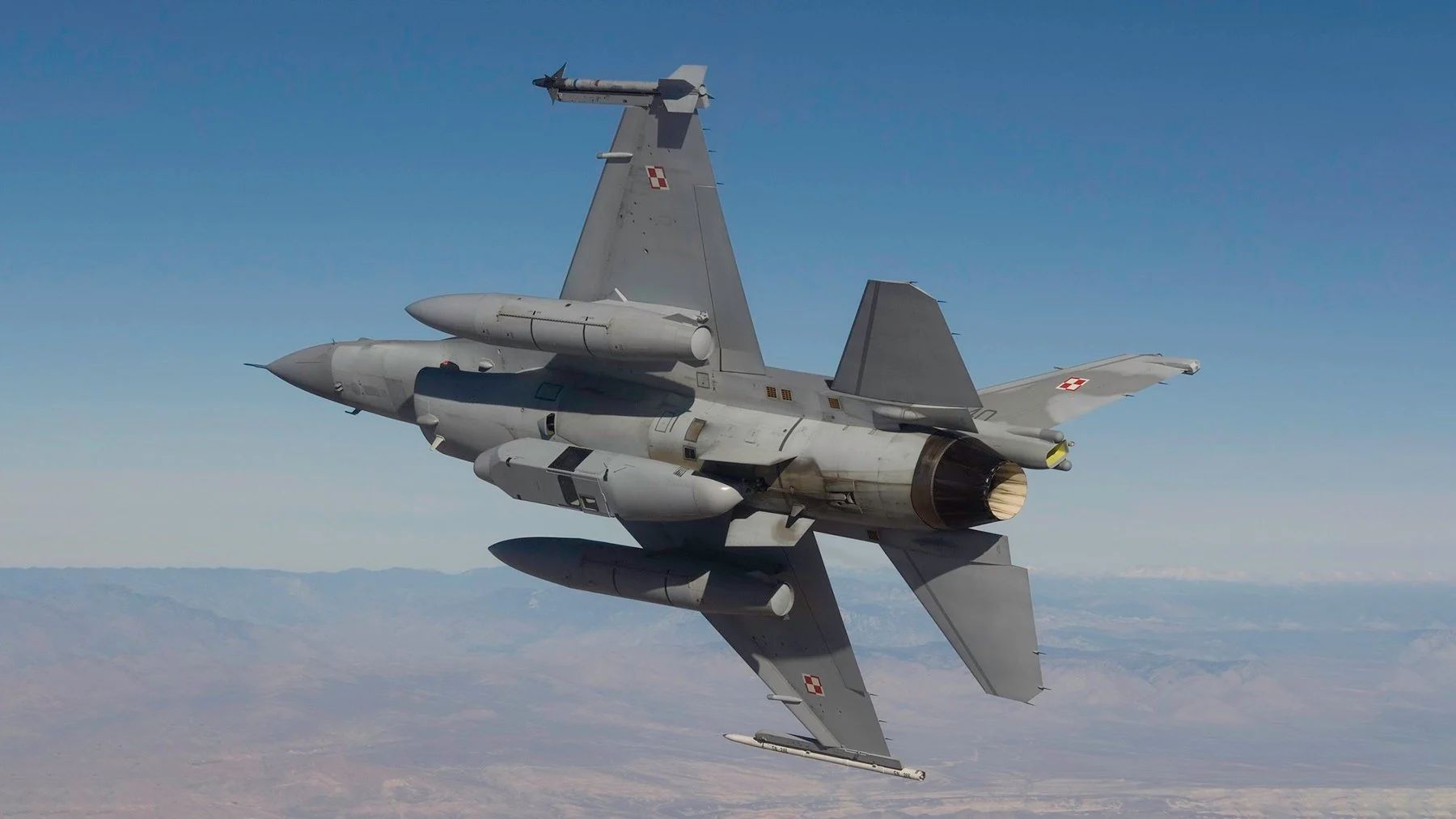
By 2026, the system had entered international procurement and aircraft-integration programs. Taiwan was flight-testing the MS-110 on F-16V fighters, while Poland had ordered seven systems with delivery and integration scheduled for completion by August 2031.
Development and international procurement
The MS-110 builds on the DB-110 reconnaissance concept while adding multispectral collection and associated exploitation software. The system is designed to support long stand-off reconnaissance and to provide high-resolution imagery over large areas. Raytheon describes its processing architecture as intended to shorten the interval between collection, analysis, and operational use of reconnaissance data.
In 2020, Taiwan requested six MS-110 reconnaissance pods through a proposed U.S. Foreign Military Sale. The request also covered three transportable ground stations and one fixed ground station. The pods were subsequently delivered to the Taiwanese Air Force, followed by personnel training and aircraft-integration work.
On August 26, 2026, a Taiwanese Air Force F-16V was publicly observed carrying an MS-110 during a flight test from Chiashan Air Force Base in Hualien. The event provided publicly reported evidence of practical integration of the pod with Taiwan's operational fighter fleet. According to officials cited in the reporting, the system has an effective reconnaissance range exceeding 80 nautical miles, approximately 148 km, and can collect about 26,000 square kilometres of high-resolution imagery per hour. These figures were reported in connection with Taiwan's evaluation of the system rather than as universal performance guarantees for every installation. Additional information on the Taiwanese flight-test program was published by Army Recognition.
Poland also selected the MS-110. Raytheon announced an order for seven systems, with deliveries and integration scheduled to be completed by August 2031. Reporting on the procurement described Poland as the first NATO country to acquire the MS-110 and the fourth customer nation globally. Details of the Polish procurement and published system specifications were reported by Calibre Defence.
Design
Multispectral sensor
The MS-110 uses multispectral imaging to observe the same ground area in several portions of the electromagnetic spectrum. Reported sensor channels include blue, green, red, near-infrared, short-wave infrared, and two mid-wave infrared channels designated MWIR1 and MWIR2. The channels provide common ground coverage so that information from different spectral regions can be compared or combined.
This method can reveal differences that are less apparent in conventional visible-light or single-band imagery. The intended applications include target discrimination, change detection, recognition of camouflaged or concealed objects, and analysis of material or environmental differences across an observed scene. The system is intended for both day and night operation and can provide useful imagery in conditions such as haze or smoke. It remains an electro-optical and infrared reconnaissance system rather than a synthetic-aperture radar, so radar reconnaissance remains a complementary capability under conditions that restrict optical sensing.
Published technical information describes the sensor as a line-scanning time-delay-integration system. In this arrangement, imagery is built progressively as the aircraft moves over the observed area. Multiple detector exposures can be integrated to improve the usable signal and image quality during high-speed or low-light collection.
Collection modes and field of regard
The MS-110 supports spot, wide-area, and persistent imaging modes. Its published maximum field of regard is ±90 degrees in roll and ±20 degrees in pitch. These viewing limits allow the sensor to observe areas displaced from the aircraft's immediate flight path and support stand-off reconnaissance.
Imagery processing and data distribution
The system incorporates software designed specifically to exploit multispectral imagery. Data from different spectral channels can be compared to support target identification and detection of changes between reconnaissance passes. Raytheon also associates the system with improved imagery quality measured using the NATO Image Interpretability Rating Scale.
A high-speed near-real-time data link allows collected imagery to be transmitted for analysis without relying exclusively on post-flight retrieval. This architecture is intended to reduce the time between sensor collection and the availability of intelligence to ground personnel and operational staffs.
Aircraft integration
The MS-110 is designed for installation on several aircraft types. Reported compatible platforms include the F-16, F-15, F/A-18, Gripen, C-130, maritime-patrol and special-mission aircraft, and medium-altitude long-endurance unmanned aircraft such as the MQ-9. Compatibility with a platform does not mean that every listed aircraft type is an operational MS-110 carrier.
The system was designed to integrate with the established DB-110 concept of operations and architecture while retaining common ground-support equipment. This can reduce the amount of supporting infrastructure that must be replaced when transitioning from earlier reconnaissance systems.
Program status
As of August 2026, Taiwan was conducting flight testing of the MS-110 on the F-16V after receiving six systems and conducting personnel training. The August 26 flight from Chiashan Air Force Base demonstrated aircraft carriage and integration testing. Reporting also indicated that the pod could potentially be used with Taiwan's MQ-9B aircraft, but this was described as a future possibility rather than a confirmed operational installation.
Poland had ordered seven MS-110 systems. Delivery and integration were scheduled for completion by August 2031. The available sources do not identify the final Polish host aircraft, although the MS-110 is compatible with several fighter and unmanned-aircraft types.
Operators
- Taiwan: Six MS-110 reconnaissance pods were acquired. Flight testing on the F-16V was publicly reported in August 2026.
- Poland: Seven MS-110 systems ordered, with delivery and integration scheduled for completion by August 2031.
Specifications (MS-110)
General characteristics
- Length: 138.43 cm (54.5 in)
- Diameter: 66.55 cm (26.2 in)
- Sensor weight: 156.94 kg (346 lb)
- Power requirement: 340 W
- Sensor type: Line-scanning time-delay-integration multispectral imaging system
Sensor and collection
- Spectral coverage: Blue, green, red, near-infrared, short-wave infrared, MWIR1, and MWIR2 channels reported
- Collection modes: Spot, wide area, and persistent imaging
- Maximum field of regard: ±90 degrees roll and ±20 degrees pitch
- Reported Taiwan reconnaissance range: More than 80 nautical miles, approximately 148 km
- Reported Taiwan area collection rate: Approximately 26,000 km² of high-resolution imagery per hour
 Argentina
 Armenia
 Australia
 Austria
 Austria-Hungary
 Belgium
 Brazil
 United Kingdom
 Brunei
 Bulgaria
 Canada
 Chile
Chile China
China Colonial America
 Colombia
 Confederate States
 Croatia
 Czech
Czech Denmark
 Egypt
Egypt Finland
 France
 Georgia
 Germany
 German Imperial
 Greece
 Holland
 Hungary
 India
India Indonesia
 Iran
Iran Iraq
Iraq Ireland
 Israel
 Italy
Italy Japan
Japan Japan (1940)
 Jordan
 Kingdom of Italy
 Malaysia
 Mexico
 Myanmar
 Nazi Germany
 Netherlands
 New Zealand
 North Korea
 Norway
 Pakistan
 Peru
Peru Philippines
 Poland
 Portugal
 Prussia
 Romania
 Russia
 Saudi Arabia
 Serbia
 Singapore
 Slovakia
 Slovenia
 South Africa
 South Korea
 Soviet Union
 Spain
Spain Sweden
 Switzerland
 Syria
Syria Taiwan
 Thailand
 Turkey
 UAE
UAE Ukraine
 Vietnam
 Yugoslavia