
History
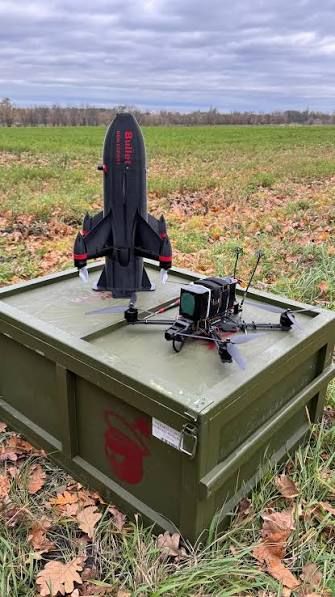
The General Chereshnya Bullet is a Ukrainian interceptor unmanned aerial vehicle developed to counter hostile attack and reconnaissance drones. The system is intended primarily for air-defence interception, including engagements against Shahed-136-type one-way attack UAVs.
The Bullet was introduced in 2025 after development conducted with Ukrainian defence units that provided technical requirements and participated in field evaluation. According to the available account, General Chereshnya began mass production on 20 October 2025 after field testing.
By 2026 the Bullet had progressed from Ukrainian combat use to wider production and integration efforts. General Cherry confirmed to Janes in August 2026 that Bullet production was also underway in Finland.
Development and production
During development, several Bullet configurations were evaluated in parallel by Ukrainian defence units. The design and software were subsequently adapted using feedback from operational conditions.
In autumn 2025, General Chereshnya supplied hundreds of Bullet interceptors to more than 20 Ukrainian defence units for combat trials. The reported value of these aircraft exceeded UAH 20 million. The first video-documented interceptions of Shahed-type attack UAVs were reported by the manufacturer in November 2025.
In December 2025, the Ukrainian Ministry of Defence reportedly codified the Bullet and assigned it a NATO Stock Number. This enabled centralized government procurement and made the system available through Ukrainian military procurement marketplaces.
An updated Bullet iteration was introduced in April 2026. The revised aircraft incorporated a fuselage refined using combat feedback, compatibility with remote launch and control systems, and a reported deployment preparation time of one minute.
In June 2026, General Chereshnya equipped the Bullet with a special accelerator intended to improve its ability to counter faster Shahed-type variants. In July, Bullet interceptors were demonstrated operating from unmanned surface platforms. The manufacturer described this integration as a means of engaging hostile UAVs before they reached coastal cities, ports, energy facilities, and logistics hubs. Mezha reported the maritime integration and published performance figures for the interceptor.
On 23 August 2026, Finnish defence company Patria and General Cherry signed a Letter of Intent concerning production of unmanned systems in Finland. General Cherry confirmed the following day that production of both the Bullet interceptor and the Air Speed FPV UAV was already underway there. The Finnish production was described as being intended mostly for the European Union, while Patria said potential joint development was focused on Western European defence requirements. The cooperation was associated with Ukraine's Build with Ukraine initiative.
Design
The Bullet uses a tail-sitter vertical take-off and landing configuration. It takes off vertically, transitions to horizontal flight after gaining altitude, and can land vertically. The airframe has an elongated projectile-like fuselage.
Propulsion is electric and drives four rotors. Operators control the UAV through a ground control station and a dedicated control panel. Target detection and guidance can use an onboard computing module with an artificial-intelligence targeting system.
The platform has been offered in several configurations distinguished by their optical and video-transmission equipment. Available reporting also states that an AI-based data-processing module can be integrated as an option.
Operational history
Bullet interceptors entered combat trials with Ukrainian defence units during 2025. By late November 2025, General Chereshnya had released video showing successful engagements against Shahed-type attack UAVs. Reporting cited combined Bullet and AIR interceptor operations as accounting for dozens of destroyed Shahed-like drones by December 2025.
By early 2026, a company representative stated that Bullet systems had intercepted several hundred Shahed drones. The supplied sources do not provide an independently verified total for these claims.
The Bullet has also been integrated with unmanned surface platforms for coastal air-defence missions. Demonstrations showed the interceptor operating from sea drones, extending the concept beyond fixed land-based launch positions.
Variants
- Bullet: Baseline interceptor UAV developed for engaging attack and reconnaissance drones.
- Updated 2026 iteration: Version introduced in April 2026 with a refined fuselage, support for remote launch and control systems, and reduced preparation time.
- Accelerator-equipped configuration: Configuration reported in June 2026 with an additional accelerator intended for interception of faster Shahed-type UAV variants.
Operators
- Ukraine: Used by Ukrainian defence units for combat trials and operational interceptions. Hundreds of aircraft were supplied to more than 20 units during autumn 2025.
Specifications (Bullet)
General characteristics
- Configuration: Tail-sitter VTOL interceptor UAV
- Propulsion: Electric powerplant driving four rotors
- Payload: Up to 0.8 kg
- Control radio frequency range: 150 MHz to 2.7 GHz
- Video frequency range: 1.2 to 7.2 GHz
Performance
- Maximum speed: Up to 310 km/h
- Maximum flight range: 20 km
- Maximum altitude: 6 km
Mission equipment
- Control: Ground control station and dedicated control panel
- Targeting: Onboard computing module with optional AI-assisted target processing
 Argentina
 Armenia
 Australia
 Austria
 Austria-Hungary
 Belgium
 Brazil
 United Kingdom
 United States
 Brunei
 Bulgaria
 Canada
 Chile
Chile China
China Colonial America
 Colombia
 Confederate States
 Croatia
 Czech
Czech Denmark
 Egypt
Egypt Finland
 France
 Georgia
 Germany
 German Imperial
 Greece
 Holland
 Hungary
 India
India Indonesia
 Iran
Iran Iraq
Iraq Ireland
 Israel
 Italy
Italy Japan
Japan Japan (1940)
 Jordan
 Kingdom of Italy
 Malaysia
 Mexico
 Myanmar
 Nazi Germany
 Netherlands
 New Zealand
 North Korea
 Norway
 Pakistan
 Peru
Peru Philippines
 Poland
 Portugal
 Prussia
 Romania
 Russia
 Saudi Arabia
 Serbia
 Singapore
 Slovakia
 Slovenia
 South Africa
 South Korea
 Soviet Union
 Spain
Spain Sweden
 Switzerland
 Syria
Syria Taiwan
 Thailand
 Turkey
 UAE
UAE Vietnam
 Yugoslavia