
History
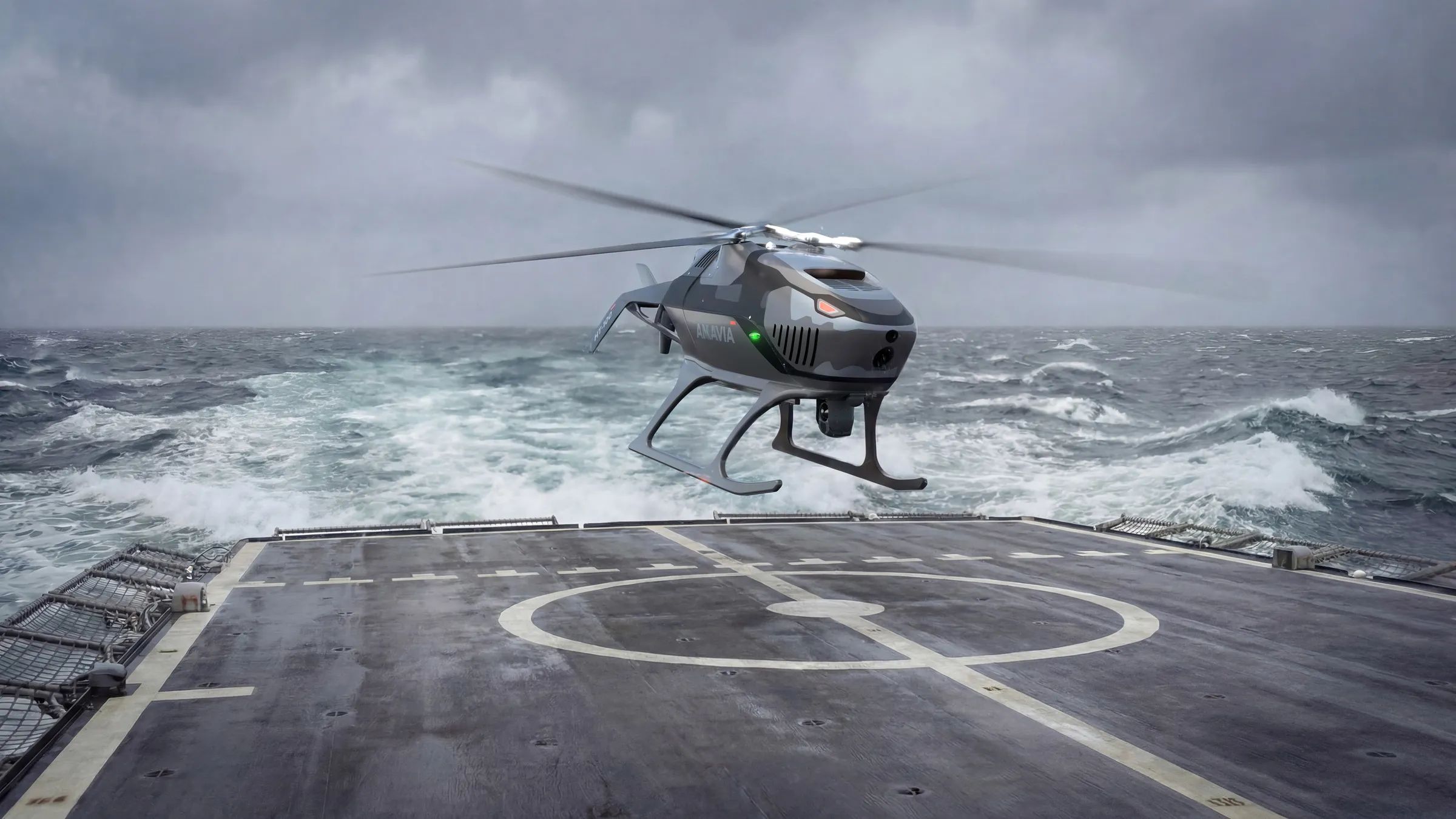
The ANAVIA HT-100 Naval is a maritime unmanned helicopter developed in Switzerland from the company's HT-100 platform. It retains the basic 120 kg maximum take-off weight class of the original aircraft while incorporating equipment intended for shipborne operations.
The naval model is designed for persistent maritime missions, autonomous flight and recovery from moving vessels. ANAVIA specifies a maximum flight time of six hours, a maximum payload capacity of 60 kg and systems intended to support autonomous deck landing.
In 2026, six HT-100 Naval helicopters completed customer acceptance for the Angolan Navy. Each aircraft underwent an individual flight test and sign-off during the acceptance process conducted with Abu Dhabi Ship Building.
Development
The HT-100 Naval was developed from the baseline HT-100 unmanned helicopter, which ANAVIA had placed in production and supplied to civil and military customers from 2021. According to Janes, the naval version retained a similar form factor but received additional avionics and command-and-control equipment for maritime operations.
The launch contract for the naval model was undertaken in collaboration with Abu Dhabi Ship Building, an EDGE Group company. ANAVIA displayed a scale model of the HT-100 Naval at IDEX 2025 in Abu Dhabi in February 2025. At that time, tests associated with operations from moving platforms were in progress, and the company planned on-vessel flight trials of a new deck landing system for the third quarter of 2025.
ANAVIA also incorporated a foldable tail to reduce the aircraft's storage footprint aboard ships. Janes reported that the aircraft measures 1.6 m in length with the tail folded. Materials and electronic subsystems received corrosion-prevention treatment for maritime use.
By September 2026, ANAVIA had completed on-site customer acceptance of six HT-100 Naval helicopters purchased by the Angolan Navy. Each aircraft was individually flight-tested and signed off. The acceptance was conducted jointly with Abu Dhabi Ship Building.
Design
The HT-100 Naval uses the same general unmanned helicopter configuration as the baseline HT-100. Its propulsion system consists of a 15 kW shaft turbine and a Flettner double-rotor arrangement with two intermeshing main rotors. The design does not require a conventional tail rotor.
Maritime adaptation
According to ANAVIA, the naval version uses a carbon-composite airframe and marine-grade surface-treated alloys for protection against saltwater and salt spray. Electronics, wiring harnesses and connectors are sealed against water ingress, while the lubrication systems are configured for maritime conditions.
The manufacturer describes the aircraft as capable of autonomous radar-guided landing on moving ship decks. Active radar sensors measure the helicopter's position, velocity and attitude relative to the vessel independently of GPS. ANAVIA states that the landing system is intended to operate in conditions up to Sea State 3.
After touchdown, a harpoon system can engage a deck grid to secure the helicopter. Emergency equipment described by the manufacturer includes flotation devices, the deck-locking harpoon and an emergency locator transmitter for over-water recovery.
Command and control
ANAVIA offers several control-station arrangements for the HT-100 Naval. These include a portable single-operator ground control station, a permanent rack-mounted installation for a ship's Combat Information Center and a containerized mission-control configuration that can be deployed aboard ships or at shore facilities.
The manufacturer also describes open-architecture interfaces for integration with a vessel's combat management system. Available communications options include encrypted MESH IP links, tracking antennas, tactical data links and optional LTE or satellite communications for beyond-line-of-sight operation.
Powerplant and fuel
The HT-100 Naval is powered by a 15 kW shaft turbine. The specified tank capacity is 60 litres, and nominal fuel consumption is 9 litres per hour. ANAVIA lists Jet A-1 and JP-8 as supported fuels, with JP-5 available on demand.
Program status
Testing of the maritime configuration and moving-deck recovery system was reported in progress during 2025. By September 2026, six production aircraft had reached customer acceptance for the Angolan Navy following individual flight tests. The available sources confirm acceptance and delivery but do not establish the subsequent operational deployment history of the six aircraft.
Operators
- Angolan Navy: Six HT-100 Naval unmanned helicopters completed customer acceptance in 2026 after individual flight tests and sign-offs.
Specifications (HT-100 Naval)
General characteristics
- Maximum take-off weight: 120 kg (264 lb)
- Maximum payload: 60 kg (132 lb)
- Typical empty weight: 66 kg (145 lb)
- Length: 2.82 m (9.25 ft)
- Width: 0.72 m (2.36 ft)
- Height: 1.00 m (3.28 ft)
- Rotor diameter: 3.75 m (12.0 ft)
- Rotor system: Flettner double rotor
- Powerplant: 15 kW shaft turbine
- Fuel capacity: 60 litres (15.8 US gal)
- Fuel: Jet A-1 or JP-8; JP-5 on demand
- Fuel consumption: 9 l/h
Performance
- Maximum flight time: 360 minutes
- Maximum airspeed: 120 km/h (65 kn)
- Operating ceiling: 4,000 m (13,123 ft)
- Maximum wind speed: 45 km/h (25 kn)
- Operating temperature: -25 °C to +55 °C (-13 °F to +131 °F)
- Payload for 1-hour endurance: 43 kg
- Payload for 2-hour endurance: 35 kg
- Payload for 4-hour endurance: 22 kg
- Payload for 6-hour endurance: 9 kg
Flight and recovery systems
- Flight autonomy: Autonomous take-off, flight and landing
- Deck landing: Radar-based relative positioning for autonomous recovery on moving vessels
- Deck securing system: Harpoon deck lock
- Emergency recovery: Flotation devices and emergency locator transmitter
- Data link: Encrypted MESH IP with optional LTE and satellite communications
Related equipment
- ANAVIA HT-100: Baseline unmanned helicopter from which the HT-100 Naval maritime variant was developed. The standard model shares the 120 kg maximum take-off weight, 15 kW turbine and Flettner rotor configuration. Additional baseline information is available from ANAVIA and EDGE Group.
 Argentina
 Armenia
 Australia
 Austria
 Austria-Hungary
 Belgium
 Brazil
 United Kingdom
 United States
 Brunei
 Bulgaria
 Canada
 Chile
Chile China
China Colonial America
 Colombia
 Confederate States
 Croatia
 Czech
Czech Denmark
 Egypt
Egypt Finland
 France
 Georgia
 Germany
 German Imperial
 Greece
 Holland
 Hungary
 India
India Indonesia
 Iran
Iran Iraq
Iraq Ireland
 Israel
 Italy
Italy Japan
Japan Japan (1940)
 Jordan
 Kingdom of Italy
 Malaysia
 Mexico
 Myanmar
 Nazi Germany
 Netherlands
 New Zealand
 North Korea
 Norway
 Pakistan
 Peru
Peru Philippines
 Poland
 Portugal
 Prussia
 Romania
 Russia
 Saudi Arabia
 Serbia
 Singapore
 Slovakia
 Slovenia
 South Africa
 South Korea
 Soviet Union
 Spain
Spain Sweden
 Syria
Syria Taiwan
 Thailand
 Turkey
 UAE
UAE Ukraine
 Vietnam
 Yugoslavia