History
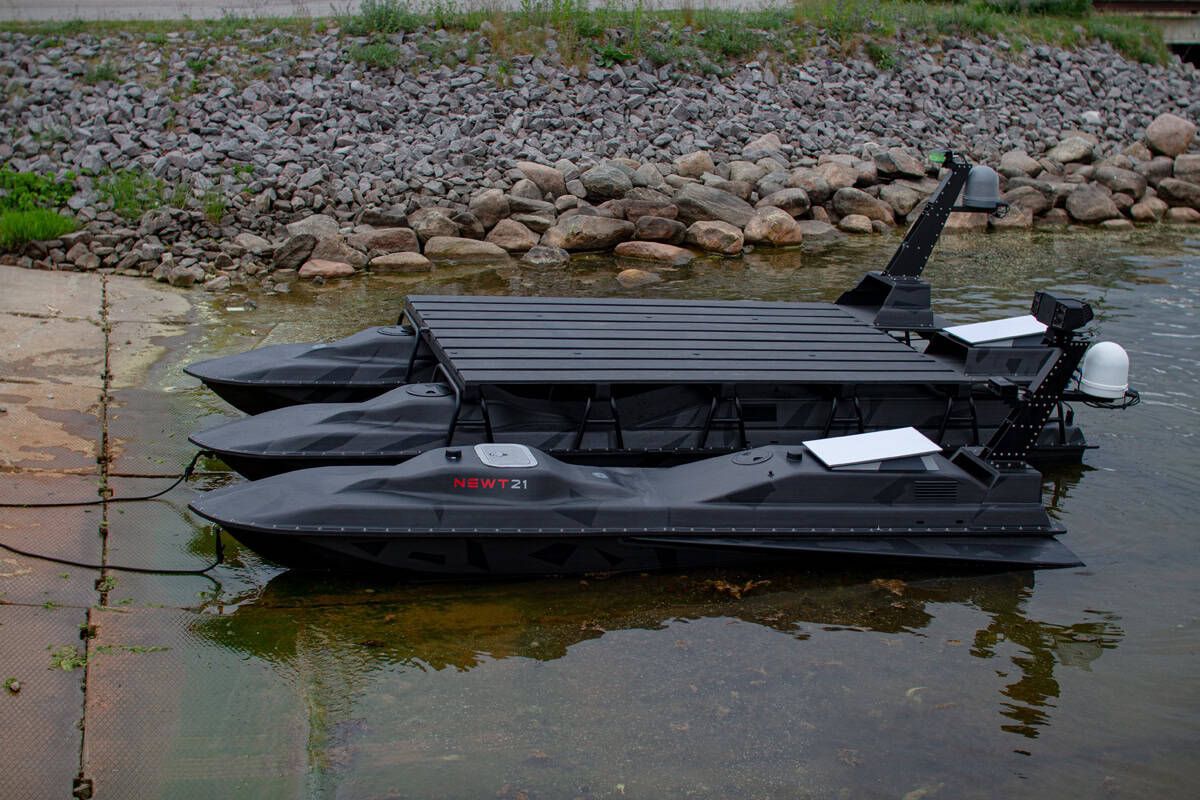
NEWT21 FOG and RAY are Latvian unmanned surface vehicle programs developed for unmanned maritime operations. In 2026, manufacturer NEWT21 completed an EU-funded project intended to modernize the vehicles and prepare their production process.
The project was formally titled Modernisation of an Unmanned Surface Vehicle (USV) and Preparation of the Production Process and carried reference number 1.2.1.1/3/25/A/005. NEWT21 stated that the work moved the FOG and RAY systems from prototype status toward production-ready configurations.
Published technical information is substantially more detailed for FOG. A February 2026 technical digest described FOG as a high-speed USV intended for persistent maritime security missions and reported its hull, propulsion, speed, range, autonomy, and sensor-integration characteristics.
Development
FOG was conceived as a relatively compact, high-speed maritime platform for security operations in response to regional threats. The design combines a low radar signature, shallow-water capability, payload capacity, autonomous navigation, and a modular structure intended to simplify repair and configuration changes.
By February 2026, published information described FOG as integrating an autonomy system from UAV Navigation Grupo Oesia and customer-selected sensor packages. The same NEWT21 FOG technical digest identified Safran navigation systems, Starlink satellite communications, Merio gimbals, Teledyne FLIR cameras, Workswell infrared zoom modules, and Contromax servos among the listed equipment suppliers.
On 18 August 2026, NEWT21 announced completion of the EU-funded modernization and production-preparation project covering both FOG and RAY. The stated result was the transition of the two USVs from prototype development toward production-ready status.
Design
FOG hull and propulsion
FOG uses a 4.5 m carbon-Kevlar hull. It is powered by a 90 hp waterjet propulsion system. The combination is intended to provide high speed and operation in shallow water while retaining payload capacity for mission equipment.
Autonomy and mission systems
FOG integrates an autonomy system supplied by UAV Navigation Grupo Oesia. Published descriptions state that the vehicle can conduct autonomous patrol, surveillance, and interdiction missions. Sensor suites can be selected according to customer requirements.
The platform is described as modular and repairable. Development also includes fleet cooperative logic intended to allow multiple vessels to operate together. Published supplier information identifies navigation, satellite communications, stabilized gimbals, electro-optical cameras, infrared modules, and servos as elements of the FOG system architecture.
The project documentation confirms that RAY was also modernized and prepared for production alongside FOG, but the supplied evidence does not provide equivalent dimensions, propulsion, performance, or payload specifications for RAY.
Program status
As of August 2026, NEWT21 had completed the EU-funded project covering modernization of FOG and RAY and preparation of their production process. The company described both vehicles as having progressed from prototype development to production-ready status. The supplied evidence does not establish operational service entry, production quantities, or confirmed operators.
Variants
- FOG — High-speed unmanned surface vehicle for maritime security missions. Published specifications identify a 4.5 m carbon-Kevlar hull, 90 hp waterjet propulsion, autonomous mission capability, and modular sensor integration.
- RAY — NEWT21 unmanned surface vehicle included with FOG in the EU-funded modernization and production-preparation project. Detailed technical specifications are not provided in the supplied evidence.
Specifications (NEWT21 FOG)
General characteristics
- Length: 4.5 m
- Hull construction: Carbon-Kevlar
- Propulsion: 90 hp waterjet
- Navigation and autonomy: Autonomous control system with navigation equipment and customer-configurable mission sensors
Performance
- Maximum speed: 55 knots
- Range: Up to 900 km
Mission equipment
- Communications: Starlink satellite communications listed among the supplied systems
- Electro-optical equipment: Customer-selected sensor suites, with Teledyne FLIR cameras and Workswell infrared zoom modules listed among available components
- Stabilized mounts: Merio gimbals listed among the supplied systems
 Argentina
 Armenia
 Australia
 Austria
 Austria-Hungary
 Belgium
 Brazil
 United Kingdom
 United States
 Brunei
 Bulgaria
 Canada
 Chile
Chile China
China Colonial America
 Colombia
 Confederate States
 Croatia
 Czech
Czech Denmark
 Egypt
Egypt Finland
 France
 Georgia
 Germany
 German Imperial
 Greece
 Holland
 Hungary
 India
India Indonesia
 Iran
Iran Iraq
Iraq Ireland
 Israel
 Italy
Italy Japan
Japan Japan (1940)
 Jordan
 Kingdom of Italy
 Malaysia
 Mexico
 Myanmar
 Nazi Germany
 Netherlands
 New Zealand
 North Korea
 Norway
 Pakistan
 Peru
Peru Philippines
 Poland
 Portugal
 Prussia
 Romania
 Russia
 Saudi Arabia
 Serbia
 Singapore
 Slovakia
 Slovenia
 South Africa
 South Korea
 Soviet Union
 Spain
Spain Sweden
 Switzerland
 Syria
Syria Taiwan
 Thailand
 Turkey
 UAE
UAE Ukraine
 Vietnam
 Yugoslavia