
History
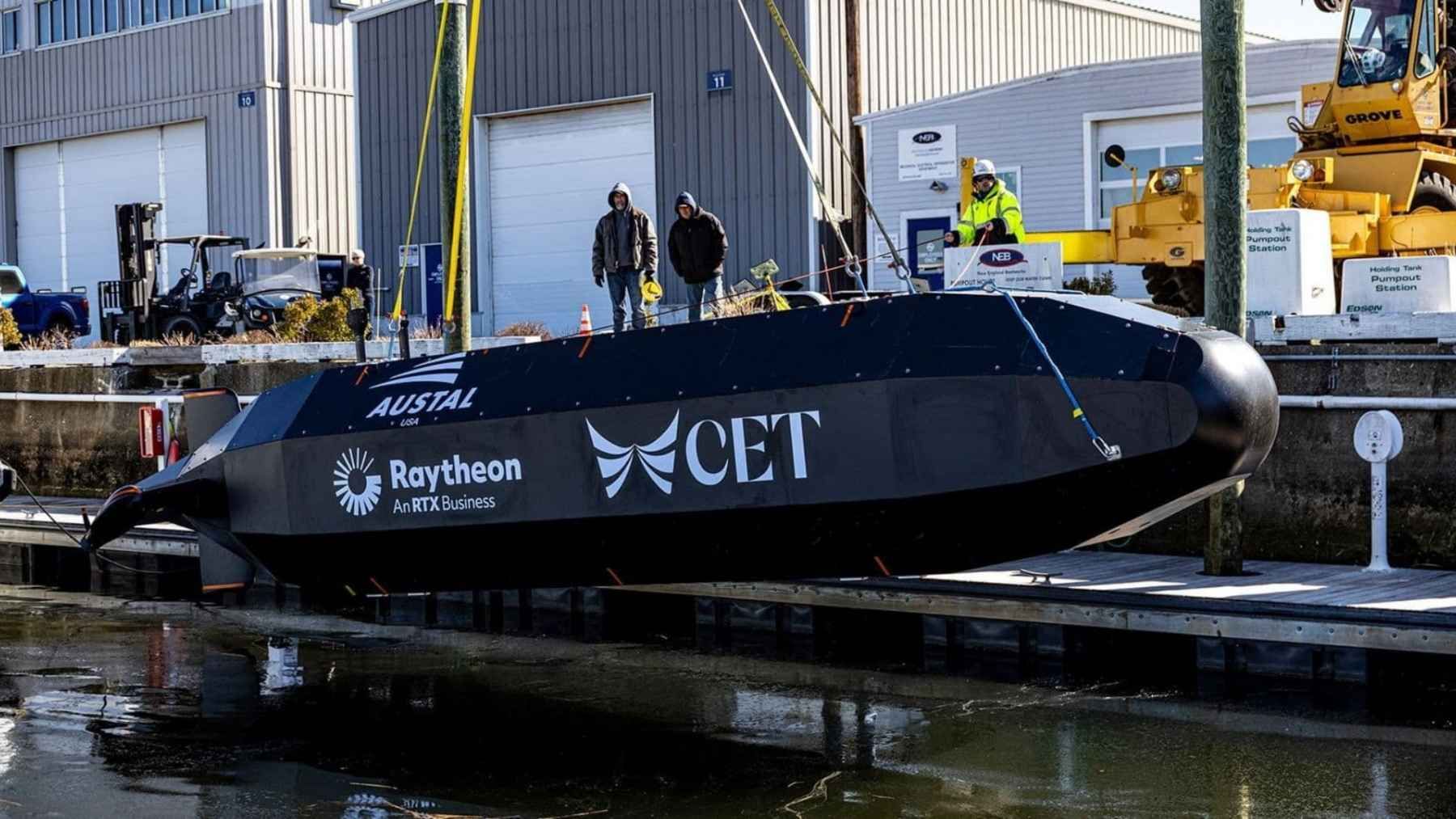
HADALUS is a long-endurance unmanned undersea vehicle developed by Raytheon, an RTX business, and Composite Energy Technologies (CET). The program is intended to provide a comparatively low-cost autonomous platform for long-range missions in support of U.S. Navy undersea operations.
The completed prototype was demonstrated in 2026 during a U.S. Navy exercise on an undersea test range. The vehicle conducted a series of at-sea missions and demonstrated a submerged launch capability while operating underwater. Raytheon described the event as the first time the U.S. Navy had observed the complete integrated capability in the water.
Raytheon and CET stated that they progressed from an initial conceptual sketch to a complete prototype and in-water demonstration in less than 18 months. The development effort included vehicle design and construction, integration of the launcher, sonar and electronics, and full-system testing before the Navy exercise. CET supplied the advanced composite vehicle architecture, while Raytheon contributed mission systems, sensors and systems-integration expertise.
The August 2026 demonstration was presented as part of a broader effort to develop autonomous end-to-end undersea capabilities. The planned mission concept could allow one unmanned vehicle to perform detection, target reacquisition and engagement functions during a single mission. These functions represent a future mission concept rather than evidence that HADALUS has entered operational service.
According to the RTX announcement, HADALUS was designed to cost approximately one-third to one-fifth as much as comparable long-endurance unmanned undersea vehicles. The companies present this lower-cost architecture as a way to make larger-scale deployment of autonomous underwater systems more practical.
Design
HADALUS is approximately 10.4 m (34 ft) long with a cross section of about 1.8 m (6 ft). Its most distinctive structural feature is a free-flooded, all-carbon-fiber exoskeleton. Raytheon and CET state that this architecture provides structural strength and payload capacity while reducing the cost of the vehicle compared with conventional long-endurance UUV designs.
The prototype integrated a launcher, sonar, electronics and associated mission systems before its at-sea demonstration. The available sources do not identify its propulsion system, maximum speed, operating depth, displacement or detailed power system.
The vehicle is intended to support modular mission equipment and sensors. Proposed mission applications described for the platform include intelligence, surveillance and reconnaissance, undersea sensing, target detection and tracking, seabed monitoring and route reconnaissance. The detect-reacquire-engage concept is intended to reduce dependence on multiple separate platforms during a future autonomous mission chain.
HADALUS has a stated endurance or range of more than 2,000 nautical miles, approximately 3,700 km. This long-endurance capability is intended to allow the vehicle to operate across large maritime areas without continuous support from crewed ships or submarines.
Program status
As of August 2026, HADALUS had reached the complete-prototype and in-water demonstration stage. During the U.S. Navy exercise, the prototype completed multiple missions on an undersea test range and demonstrated launching while submerged.
The sources do not confirm a U.S. Navy production contract, procurement quantity or operational service entry. The U.S. Navy participated in the demonstration and is the intended military user discussed by the developers, but this does not establish HADALUS as an operational fleet system.
Raytheon and CET describe the vehicle as part of a roadmap toward persistent autonomous undersea systems that could distribute sensors and mission functions across contested maritime areas. The program's future detect, reacquire and engage capability remains developmental.
Specifications (HADALUS prototype)
General characteristics
- Type: Long-endurance unmanned undersea vehicle
- Developers: Raytheon and Composite Energy Technologies
- Length: Approximately 10.4 m (34 ft)
- Cross section: Approximately 1.8 m (6 ft)
- Structure: Free-flooded, all-carbon-fiber exoskeleton
- Integrated equipment demonstrated: Launcher, sonar and electronics
- Launch capability: Submerged launch demonstrated during a 2026 U.S. Navy exercise
Performance
- Stated endurance/range: More than 3,700 km (2,000 nautical miles)
Mission systems
- Demonstrated integration: Sonar, electronics and associated mission systems
- Planned mission concept: Detection, target reacquisition and engagement functions within a single unmanned platform
 Argentina
 Armenia
 Australia
 Austria
 Austria-Hungary
 Belgium
 Brazil
 United Kingdom
 Brunei
 Bulgaria
 Canada
 Chile
Chile China
China Colonial America
 Colombia
 Confederate States
 Croatia
 Czech
Czech Denmark
 Egypt
Egypt Finland
 France
 Georgia
 Germany
 German Imperial
 Greece
 Holland
 Hungary
 India
India Indonesia
 Iran
Iran Iraq
Iraq Ireland
 Israel
 Italy
Italy Japan
Japan Japan (1940)
 Jordan
 Kingdom of Italy
 Malaysia
 Mexico
 Myanmar
 Nazi Germany
 Netherlands
 New Zealand
 North Korea
 Norway
 Pakistan
 Peru
Peru Philippines
 Poland
 Portugal
 Prussia
 Romania
 Russia
 Saudi Arabia
 Serbia
 Singapore
 Slovakia
 Slovenia
 South Africa
 South Korea
 Soviet Union
 Spain
Spain Sweden
 Switzerland
 Syria
Syria Taiwan
 Thailand
 Turkey
 UAE
UAE Ukraine
 Vietnam
 Yugoslavia