
History
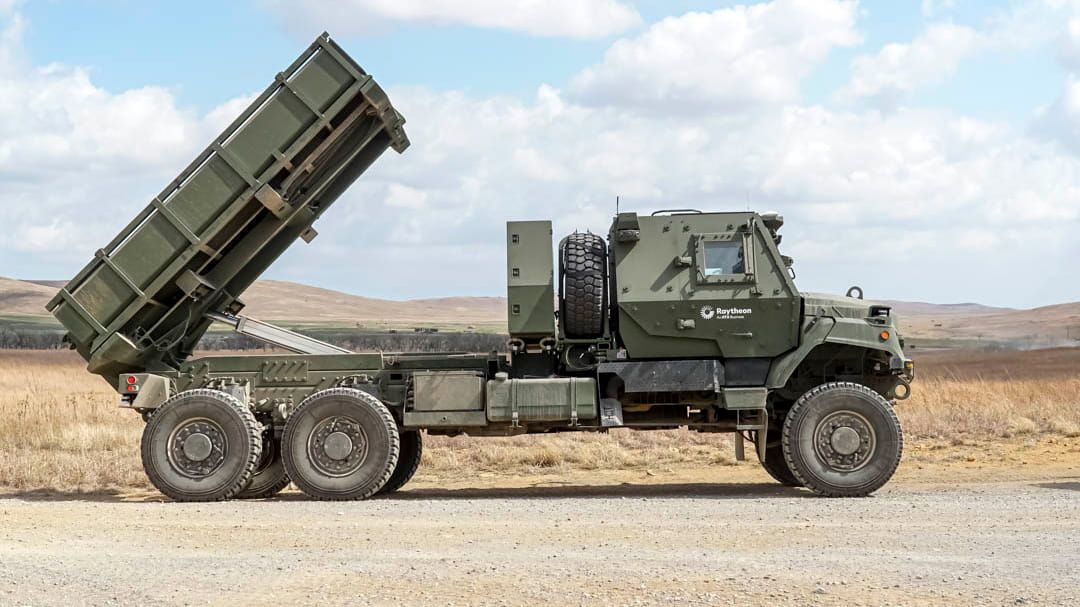
Raytheon DeepFires is an experimental autonomous missile launcher developed for the U.S. Army's future fires requirements. Its modular launcher can be configured for long-range strike, air-defense, and missile-defense missions.
The system combines a Raytheon launcher with an Oshkosh Defense FMTV A2 6×6 vehicle and Forterra autonomous-driving technology. It can travel, occupy a firing position, employ its launcher, and receive ammunition without personnel aboard, while human operators retain authority over targeting and weapon release.
DeepFires is intended to separate soldiers from exposed launch and resupply positions. Its distributed operating concept connects autonomous launchers and robotic ammunition vehicles to a protected command-and-control vehicle.
Development and 2025 demonstration
Raytheon leads launcher and weapon-system integration. Oshkosh Defense supplies the FMTV A2 vehicle platform and its electronic systems, while Forterra provides the AutoDrive autonomy system. Corvid Technologies and Collins Aerospace have also participated in the system's development.
The collaborative launcher effort completed a live-fire demonstration during the U.S. Army's Project Convergence at Fort Irwin, California, in March 2025. The prototype autonomously moved and employed an experimental Raytheon missile developed for the Joint Reduced Range Rocket program. The missile used a rocket motor produced by Ursa Major. Raytheon subsequently identified this event as a successful DeepFires live fire.
Two DeepFires prototypes were displayed at the Association of the United States Army exposition in Washington, D.C., in October 2025. One retained the armored FMTV A2 cab and could operate with or without a crew. The other replaced the cab with a compact module containing automotive, electronic, and perception equipment for entirely uncrewed operation. Contemporary reporting described the 2025 prototype unveiling and identified the U.S. Army Rapid Capabilities and Critical Technologies Office as the initial intended customer.
U.S. Army evaluations in 2026
DeepFires participated in autonomous demonstrations and simulated live-fire activities during the U.S. Army's 2026 Concept Focused Warfighting Experiment. The Army then evaluated the launcher during Project Convergence Capstone 6 at Fort Irwin from 20 to 29 July 2026.
Soldiers of the 2nd Battalion, 18th Field Artillery Regiment tested an integrated formation consisting of a DeepFires launcher, an Autonomous Resupply Vehicle, and a crewed Joint Unmanned Autonomous System Multi-Payload System Command and Control vehicle, known as JUMPS C2. The command vehicle assigned missions while soldiers retained control of tactical decisions and engagement approval. The autonomous vehicles performed the physical movement, launcher, and resupply tasks.
The evaluation examined Human Machine Integration rather than autonomous weapon selection. It also assessed how a launcher could deploy, fire, reload, and relocate while its command crew remained at a protected position. The Project Convergence evaluation built on earlier testing and included operational feedback from soldiers.
Under Secretary of the Army Michael Obadal visited the participating unit on 24 July 2026. He received briefings on DeepFires, the JUMPS C2 vehicle, and the related Juggernaut Launcher before examining their autonomous and remote-control functions. An independent field-test report also described the leader-follower arrangement used during the exercise.
Design
Vehicle and launcher
DeepFires is built on the three-axle Oshkosh Defense FMTV A2 chassis with a 6×6 drivetrain. The rear of the vehicle carries an elevating modular launcher, electrical equipment, and ammunition-resupply interfaces. Depending on the prototype configuration, the front of the vehicle contains either the standard armored cab or an uncrewed equipment module.
The cab-equipped prototype retains the three-seat FMTV A2 cab. It can be driven conventionally, controlled remotely, or operated without occupants. The cabless prototype removes the driving compartment while retaining the same basic chassis and rear launcher architecture.
The platform includes onboard electrical generation for the launcher, sensors, autonomous-driving equipment, and mission systems. It therefore does not require a separate external generator at a firing position. Raytheon also describes the system as suitable for all-terrain and all-weather use and as transportable by C-130 aircraft. The manufacturer's summary of the system is available on the official DeepFires page.
Autonomous operation
Forterra's AutoDrive system integrates environmental perception, sensor fusion, redundant localization, route generation, and control of the vehicle's drive-by-wire systems. Multiple navigation methods are intended to support movement when satellite navigation is disrupted or unavailable. The perception system constructs a three-dimensional representation of the surroundings so that the vehicle can respond to terrain and obstacles.
Autonomy applies to vehicle movement and assigned physical tasks. The fire-control system is not intended to make independent engagement decisions. Human personnel remain in the command loop in accordance with U.S. Department of Defense requirements.
The launcher is designed to operate as part of a distributed unit. A JUMPS C2 vehicle transmits missions to DeepFires and the Autonomous Resupply Vehicle. Separating these elements reduces the number of soldiers required at observable firing and ammunition-handling positions. The Army has discussed a future arrangement in which one JUMPS C2 vehicle could control as many as four autonomous launchers and several resupply vehicles, but this larger formation remains a planned capability.
Armament and mission modules
DeepFires uses a modular launcher that can be reconfigured for offensive or defensive missions. Raytheon officially identifies compatibility with Tomahawk and Patriot missiles. More detailed published configuration descriptions also associate the offensive arrangement with the Precision Strike Missile and the defensive arrangement with PAC-3 Missile Segment Enhancement and AIM-9X Sidewinder missiles.
Tomahawk provides long-range conventional strike capability at approximately 1,600 km. Precision Strike Missile Increment 1 is described as capable of engaging land targets beyond 400 km. PAC-3 MSE is a hit-to-kill interceptor for threats that include tactical ballistic missiles, cruise missiles, and aircraft, while AIM-9X provides a shorter-range infrared-guided air-defense layer. These weapons represent proposed integration options; their mention does not establish that every effector has completed live-fire qualification from DeepFires.
The modular concept allows the same vehicle architecture to support different mission packages without permanently dedicating each chassis to one weapon type. A detailed DeepFires technical description identifies offensive and defensive configurations and distinguishes the two prototype layouts.
Program status
DeepFires remained an experimental U.S. Army system in 2026. The Army had evaluated prototypes in field exercises, but the available sources did not report a production contract, operational unit assignment, or service-entry decision.
Soldier Touchpoints allow participating artillery personnel to report observations directly to engineers during testing. The development team can then modify software and system behavior between evaluation events. Testing has focused on autonomous mobility, remote command, launcher operation, robotic resupply, and communications in denied, degraded, intermittent, and limited network conditions.
The program supports the Army's broader interest in distributed long-range precision fires. Its intended advantages include dispersing launch assets, reducing personnel exposure, increasing magazine capacity, and allowing a small command element to direct several robotic vehicles. These remain development objectives rather than confirmed operational performance.
Configurations
- Armored-cab prototype: FMTV A2-based configuration with a three-seat armored cab. It supports conventional driving, remote control, or autonomous operation without occupants.
- Cabless prototype: Uncrewed configuration in which a compact automotive, electronics, and perception module replaces the cab.
- Offense-on-demand configuration: Proposed strike configuration associated with Tomahawk and Precision Strike Missile effectors.
- Defense-on-demand configuration: Proposed air- and missile-defense configuration associated with PAC-3 MSE and AIM-9X effectors.
- Heavy launcher: A heavier DeepFires version was identified as planned during the system's 2025 unveiling, but detailed specifications were not provided.
Specifications (DeepFires prototypes)
General characteristics
- Developer: Raytheon, an RTX business, with Forterra, Oshkosh Defense, Corvid Technologies, and Collins Aerospace
- Country of development: United States
- Role: Autonomous or optionally crewed modular missile launcher
- Platform: Oshkosh Defense FMTV A2, three-axle 6×6
- Crew: 0 in autonomous operation; up to 3 occupants in the armored-cab prototype
- Configurations: Armored-cab and cabless prototypes
- Autonomy system: Forterra AutoDrive with perception, sensor fusion, redundant localization, path generation, and drive-by-wire control
- Power: Onboard vehicle power for launcher and mission equipment
- Transport: C-130 transportable
Reference FMTV A2 mobility data
- Maximum road speed: 96 km/h
- Reference road range: More than 483 km
- Grade capability: 60 percent
- Side-slope capability: 30 percent
- Reference chassis curb weight: 11,281 kg with fuel
- Reference chassis dimensions: 7.27 m long, 2.44 m wide, and 2.83 m high
The mobility values, weight, and dimensions are reference figures for the underlying FMTV 6×6 platform. The launcher, autonomy equipment, and missile load affect the completed vehicle's dimensions, mass, range, and fuel consumption.
Supported and proposed effectors
- Tomahawk: Long-range conventional strike missile with an approximate range of 1,600 km
- Precision Strike Missile Increment 1: Surface-to-surface strike missile with a reported range exceeding 400 km
- PAC-3 MSE: Hit-to-kill interceptor for tactical ballistic missiles, cruise missiles, and aircraft
- AIM-9X Sidewinder: Short-range infrared-guided air-defense missile
Related equipment
- JUMPS C2: Crewed command-and-control vehicle used to assign missions to the DeepFires launcher and robotic support vehicles.
- Autonomous Resupply Vehicle: Robotic ammunition vehicle tested with DeepFires to support forward-area reloading without an exposed handling crew.
- FMTV A2: Oshkosh Defense medium tactical truck that provides the vehicle platform and automotive systems for DeepFires.
 Argentina
 Armenia
 Australia
 Austria
 Austria-Hungary
 Belgium
 Brazil
 United Kingdom
 Brunei
 Bulgaria
 Canada
 Chile
Chile China
China Colonial America
 Colombia
 Confederate States
 Croatia
 Czech
Czech Denmark
 Egypt
Egypt Finland
 France
 Georgia
 Germany
 German Imperial
 Greece
 Holland
 Hungary
 India
India Indonesia
 Iran
Iran Iraq
Iraq Ireland
 Israel
 Italy
Italy Japan
Japan Japan (1940)
 Jordan
 Kingdom of Italy
 Malaysia
 Mexico
 Myanmar
 Nazi Germany
 Netherlands
 New Zealand
 North Korea
 Norway
 Pakistan
 Peru
Peru Philippines
 Poland
 Portugal
 Prussia
 Romania
 Russia
 Saudi Arabia
 Serbia
 Singapore
 Slovakia
 Slovenia
 South Africa
 South Korea
 Soviet Union
 Spain
Spain Sweden
 Switzerland
 Syria
Syria Taiwan
 Thailand
 Turkey
 UAE
UAE Ukraine
 Vietnam
 Yugoslavia