
History
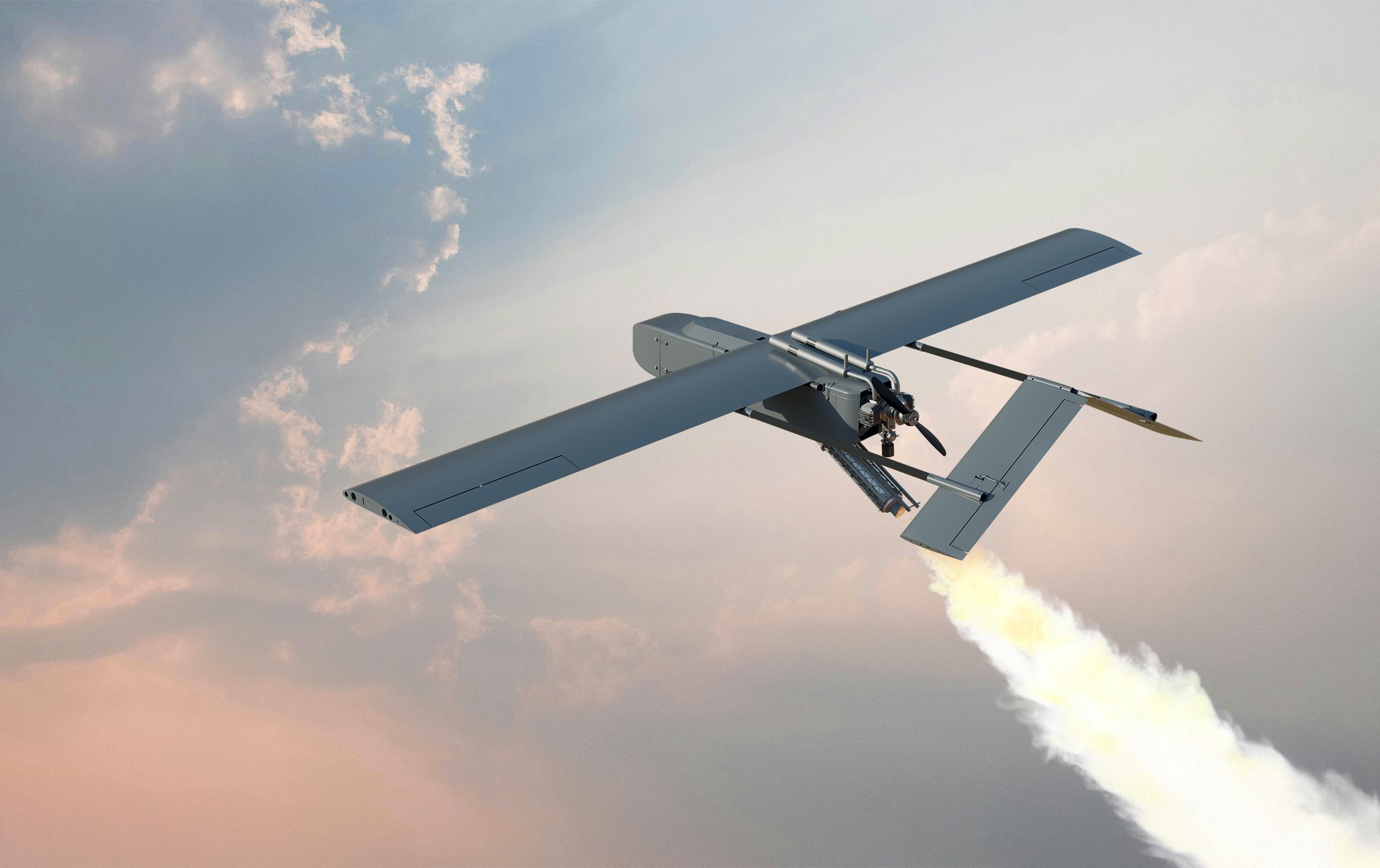
The Fire Point FP-1 is a Ukrainian long-range one-way attack unmanned aerial vehicle developed and produced by Fire Point for strikes against fixed targets deep behind enemy lines. The aircraft uses a piston engine, pusher propeller and rocket-assisted launch, allowing it to operate without a runway.
The FP-1 became one of the prominent Ukrainian deep-strike UAVs used during the Russia-Ukraine war. Published specifications differ considerably between configurations and dates, particularly for range, endurance and maximum takeoff weight. Fire Point's official FP-1 page lists a range of up to 2,600 km, while later reports describe modified aircraft flying substantially farther.
The design has also evolved beyond its original one-way strike role. Reported adaptations include extended-range wings, carriage of FPV drones and specialized payload configurations, although not every reported modification has been confirmed as a standard production version.
Development
Fire Point was established in 2023, and secondary reporting indicates that the FP-1 was already physically present that year. H. I. Sutton's FP-1 analysis records an appearance of the aircraft in Ukrainian media in October 2023. Later reporting states that Fire Point produced FP-1 systems during 2023 as the company expanded its wartime manufacturing activities.
The aircraft subsequently entered large-scale Ukrainian use. Militarnyi reported that it was displayed at a defence exhibition in Kyiv in May 2025, by which time it was already being used operationally. Fire Point continued increasing production and modifying the aircraft as Ukrainian long-range strikes against targets inside Russia expanded.
By 2026 the company was presenting the FP-1 internationally together with the shorter-range FP-2. Reporting from Eurosatory 2026 described a substantially revised specification set, including a 6 m wing, 330 kg maximum takeoff weight, 2,700 km range and 18-hour endurance. These figures conflict with Fire Point's public product page, which lists 215 kg, 2,600 km and seven hours respectively. The discrepancy indicates that published specifications may refer to different production configurations or stages of development.
Extended-range development
During 2026, reports emerged of an extended-range FP-1 configuration with redesigned outer wing sections and additional fuel capacity. Sutton identifies this development as the FP-1ER and reports a demonstrated reach of at least 2,500 km, while a range of up to 3,400 km has also been attributed to the modified configuration. Fire Point's later public claims similarly described FP-1 aircraft covering distances beyond the earlier 2,600-2,700 km figures.
Design
The FP-1 is a fixed-wing, twin-boom aircraft with an inverted V-tail and a rear-mounted pusher propeller. The basic configuration is optimized for relatively inexpensive mass production and long-distance flight rather than high speed. The aircraft has no conventional landing gear because it is intended to be expended during its attack mission.
Airframe
Published descriptions indicate a hybrid airframe using inexpensive materials together with composites in higher-load areas. Reporting describes plywood in the fuselage structure, foam in the wings, and carbon-fibre components in structural elements including the booms, spar and skin. Sutton describes the FP-1 as having a box-like fuselage, straight wing and twin-boom arrangement.
The manufacturer lists a wingspan of 6 m for the current FP-1/FP-2 family. Earlier reporting described examples with a span of approximately 2.5 m, indicating that dimensions and configurations reported under the FP-1 name have changed during development.
Powerplant and launch
The FP-1 uses a two-cylinder internal-combustion engine driving a two-blade pusher propeller. Fire Point has progressively localized engine production and related components. The aircraft is launched from a rail or ramp with a solid-propellant rocket booster and can also be dispatched from a truck-based mobile launcher.
Fire Point states that the system can be prepared for a mission in approximately 18 minutes. Runway independence allows launch teams to operate from dispersed sites and relocate after firing.
Navigation and control
The FP-1 has been developed for operation in an environment with intensive electronic warfare. Fire Point has described repeated generations of navigation improvements intended to reduce vulnerability to satellite-navigation jamming and spoofing. Reported solutions include controlled-pattern antennas, autonomous software and optical map-matching techniques.
Later reporting also describes video-based terminal control and automated optical target tracking. In this mode an operator can select a specific aim point before an onboard algorithm completes the final attack. Some FP-1 operations have additionally been associated with satellite communications, although Fire Point has not publicly confirmed every communications configuration as a standard feature.
Payload
Fire Point's published baseline specification gives the FP-1 a maximum payload of up to 60 kg. Later operational reporting describes heavier or specialized warheads in some configurations, but these should not be treated as interchangeable with the maximum-range baseline specification because payload and fuel mass directly affect range.
Operational history
The FP-1 has been used by Ukrainian forces for long-range strikes during the Russia-Ukraine war. Reporting identifies units within Ukraine's Unmanned Systems Forces, including the 414th Separate Unmanned Strike Aviation Brigade and the 1st Separate Center, in connection with FP-1 operations. Fire Point has stated that its FP-series aircraft perform a substantial proportion of Ukrainian deep-strike missions, although publicly available figures originate primarily with the manufacturer.
Deep strikes in 2026
On 6 July 2026, Ukrainian drones struck the Gazprom Neft refinery at Omsk in western Siberia. Ukrainian defence reporting and Fire Point attributed the mission to an upgraded FP-1, with a reported flight distance exceeding 2,500 km. Independent reporting confirmed the drone attack and resulting damage but did not independently establish the aircraft type, so the FP-1 attribution remains linked primarily to Ukrainian and manufacturer sources.
On 9 September 2026, Ukrainian Special Operations Forces struck industrial facilities in Russia's Yamalo-Nenets Autonomous Okrug, including the Novy Urengoy area and a site associated with Purovsky. FlightGlobal reported that Fire Point FP-1 drones were used and that the aircraft travelled more than 3,200 km. Fire Point also claimed an FP-1 long-range record. However, the Ukrainian Special Operations Forces' public account did not identify the UAV model. The FP-1 attribution is therefore strongly associated with Fire Point's statements but is not independently confirmed by the operating force.
If the FP-1 attribution is correct, the September mission exceeded the 2,600 km operating range listed on Fire Point's public product page and also exceeded the 2,700 km figure reported from Eurosatory 2026. It is more consistent with reports of the extended-range configuration for which Fire Point and secondary sources have cited figures approaching 3,400 km.
Additional roles
FP-1 aircraft have also been reported in maritime and tactical support missions. Sutton describes the aircraft carrying two smaller FPV quadcopters as a mothership, allowing the FP-1 to transport them closer to a target area and relay communications. Militarnyi reported such a configuration being used against Russian targets in Crimea in 2026.
Other reported configurations have carried pods containing S-5 unguided rockets or specialized warheads. These adaptations demonstrate the modularity of the airframe, but open sources do not establish that all of them are standardized production variants.
Variants
- FP-1: Baseline deep-strike one-way attack UAV. Fire Point lists a payload of up to 60 kg and an operating range of up to 2,600 km.
- FP-1ER: Extended-range designation used by H. I. Sutton for a modified FP-1 with redesigned outer wing sections and additional wing fuel capacity. Reported maximum-range claims reach approximately 3,400 km.
- FPV carrier configuration: Reported FP-1 adaptation carrying two smaller FPV drones and communications relay equipment for delivery and control of the smaller aircraft closer to the target area.
Operators
- Ukraine: Used by Ukrainian forces for long-range strike missions. Units associated with FP-1 operations in reporting include formations of the Unmanned Systems Forces.
Specifications (FP-1)
The following figures are the baseline specifications published on Fire Point's FP-1/FP-2 product page. Other 2026 presentations and extended-range configurations give different values, so these figures should not be combined with specifications from later modifications.
General characteristics
- Type: Long-range one-way attack UAV
- Wingspan: 6 m
- Maximum takeoff weight: 215 kg
- Maximum payload: Up to 60 kg
- Engine: Two-cylinder internal-combustion engine driving a pusher propeller
- Launch: Rocket-assisted launch from a stationary platform or truck-based launcher
- Preparation time: Approximately 18 minutes
Performance
- Maximum speed: 205 km/h
- Cruising speed: 140-180 km/h
- Operating range: Up to 2,600 km
- Maximum flight time: 7 hours
The manufacturer's published range and endurance figures are internally difficult to reconcile: seven hours at the stated cruise speeds corresponds to considerably less than 2,600 km. Separate Eurosatory 2026 reporting gave an 18-hour endurance and 2,700 km range for the FP-1, while later extended-range claims reached approximately 3,400 km. These values should therefore be treated as configuration-specific rather than as a single fixed specification set.
Armament
- Warhead or mission payload: Up to 60 kg in the baseline maximum-range configuration
Related equipment
- Fire Point FP-2: Shorter-range member of the same UAV family, configured to trade range for a heavier payload.
- Shahed-136 / Geran-2: Iranian-designed and Russian-produced one-way attack UAV family frequently compared with the FP-1 because of its long-range strike role and low-cost mass-employment concept.
 Argentina
 Armenia
 Australia
 Austria
 Austria-Hungary
 Belgium
 Brazil
 United Kingdom
 United States
 Brunei
 Bulgaria
 Canada
 Chile
Chile China
China Colonial America
 Colombia
 Confederate States
 Croatia
 Czech
Czech Denmark
 Egypt
Egypt Finland
 France
 Georgia
 Germany
 German Imperial
 Greece
 Holland
 Hungary
 India
India Indonesia
 Iran
Iran Iraq
Iraq Ireland
 Israel
 Italy
Italy Japan
Japan Japan (1940)
 Jordan
 Kingdom of Italy
 Malaysia
 Mexico
 Myanmar
 Nazi Germany
 Netherlands
 New Zealand
 North Korea
 Norway
 Pakistan
 Peru
Peru Philippines
 Poland
 Portugal
 Prussia
 Romania
 Russia
 Saudi Arabia
 Serbia
 Singapore
 Slovakia
 Slovenia
 South Africa
 South Korea
 Soviet Union
 Spain
Spain Sweden
 Switzerland
 Syria
Syria Taiwan
 Thailand
 Turkey
 UAE
UAE Vietnam
 Yugoslavia