
History
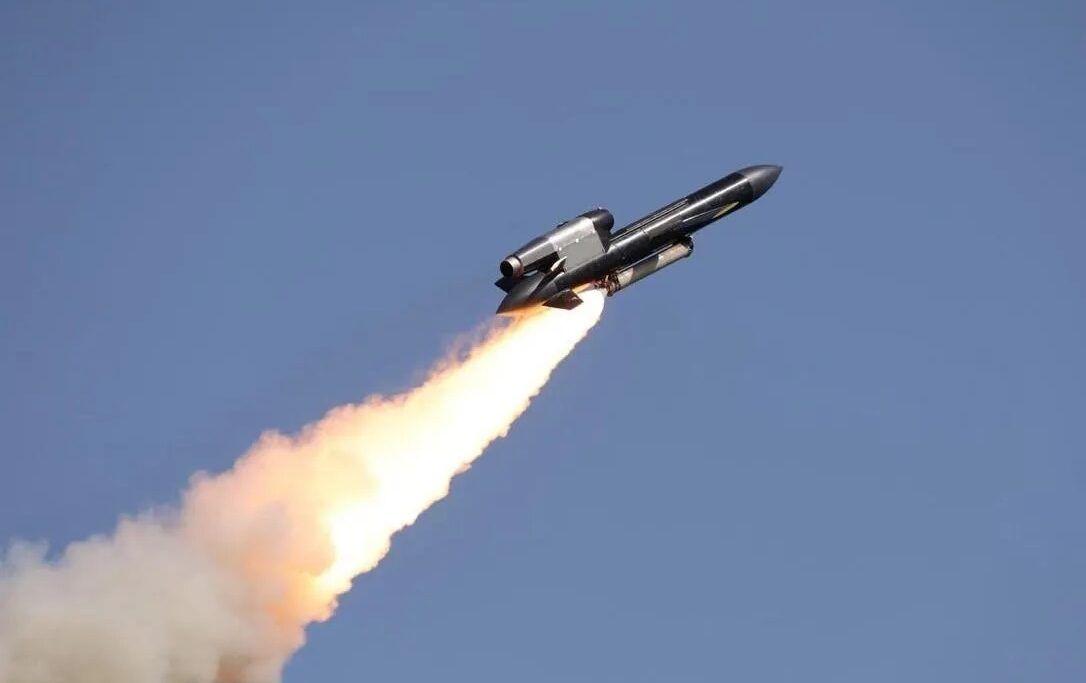
The Fire Point FP-5 Flamingo is a Ukrainian ground-launched cruise missile developed for long-range strikes against fixed military and strategic targets. It was publicly revealed in August 2025 and entered serial production during the same year.
The missile combines a large composite airframe, an externally mounted jet engine, a reusable ground-launch system and a combat payload of up to 1,150 kg. Published specifications give it a maximum range of up to 3,000 km, making it one of Ukraine's longest-range domestically produced strike weapons.
The FP-5 was developed during the Russia-Ukraine war as Ukraine expanded domestic production of long-range weapons. Fire Point emphasized simplified manufacturing, the use of available components and production scalability rather than the more complex guidance and low-observable features used by some Western cruise missiles.
Development and production
Fire Point began development after Russia's full-scale invasion of Ukraine in 2022. The missile was first shown publicly during a test launch in August 2025. Reporting collected by Wikipedia dates the first public images to 17 August 2025, while Ukrainian officials publicly discussed the weapon and its production several days later.
The design attracted attention because it closely resembled an FP-5 missile concept displayed by Milanion Group at IDEX 2025. Published reporting has described technological and supply-chain links between Fire Point and Milanion, although the Ukrainian company performs most final production in Ukraine.
Serial production was reported to have started in mid-2025. Initial output was approximately 30 missiles per month, followed by reported increases toward 50 per month in September 2025. Fire Point stated that it intended to expand production substantially. Production figures reported at different times should be treated as company targets or company claims rather than guaranteed sustained output.
Fire Point has also worked to reduce dependence on existing aircraft engines. Reports in 2026 stated that the company was testing a domestically developed jet engine, with approximately ten test engines assembled by July. A broader technical overview is available from STRASAM.
Cost and manufacturing approach
The FP-5 was designed around relatively inexpensive and rapidly manufactured components. Public estimates have generally placed its cost at roughly US$500,000 to US$600,000 per missile. In July 2026, Fire Point CEO Iryna Terekh was reported as saying that a missile cost just under US$600,000.
Reporting has associated early production missiles with refurbished Ivchenko AI-25-family aircraft engines. Fire Point reportedly acquired engines with limited remaining service life and restored them sufficiently for the several-hour flight required by the missile. The company has also used filament-wound composite structures that can be manufactured more quickly than conventional aerospace metal structures. An assessment by the Institute for Strategic Risk and Security described this approach as an example of low-cost, scalable missile production.
Design
The FP-5 uses a large cylindrical fuselage with fixed straight wings and four rear control surfaces arranged in an X configuration. A single jet engine is mounted externally above the rear fuselage. This configuration simplifies installation and gives the missile an appearance broadly comparable to some early jet-powered flying bombs and large reconnaissance drones, although the FP-5 is a modern guided weapon.
Airframe and launcher
The fuselage is primarily described as a composite monocoque structure manufactured using filament winding. Fiberglass and carbon-fiber materials reduce structural mass and are relatively transparent to radar energy, although the large airframe, exposed metallic engine installation and thermal signature limit the degree to which the overall missile can be considered low observable.
The missile is launched from the ground using a reusable mobile launcher. A launch booster accelerates the approximately 6,000 kg missile before sustained flight under jet power. Published descriptions indicate that the launcher can be transported on a road vehicle and deployed from dispersed launch positions.
Preparation for launch is reported to require approximately 20 to 40 minutes. This period includes tasks associated with preparing the missile, entering mission data and configuring the launch system.
Propulsion
Public sources widely associate operational FP-5 missiles with refurbished Ivchenko AI-25-series turbofan engines originally developed for aircraft such as the Aero L-39 Albatros. Fire Point's product-level specifications have not consistently identified the engine model, so the AI-25 installation should be regarded as strongly reported rather than a universally published official specification.
According to technical data summarized by Army Recognition, the FP-5 has a cruise speed of approximately 650 to 700 km/h and a maximum speed of 950 km/h. Other reporting has cited cruise speeds between approximately 800 and 900 km/h. The difference indicates that publicly available performance figures are not fully consistent.
Guidance
The FP-5 is designed primarily for attacks on fixed coordinates. Fire Point states that the missile follows pre-programmed topographical coordinates and can operate in environments affected by electronic interference.
Public reporting describes satellite navigation supported by inertial navigation and jamming-resistant controlled-reception antenna technology. More complex terrain-reference and scene-matching systems comparable to TERCOM or DSMAC have not been publicly confirmed for the baseline FP-5. A widely reported accuracy figure is a circular error probable of approximately 14 m under favorable conditions, although independent verification of this figure is limited.
Warhead
The maximum stated combat payload is 1,150 kg. Fire Point has not publicly disclosed a complete baseline warhead specification, including the precise explosive composition and fuze arrangement.
Analysts have proposed that some missiles may use modified aerial-bomb components, but published assessments differ over the exact type. Reports have also discussed specialized penetrating and other warhead configurations. These descriptions should not be treated as confirmation that every FP-5 carries the same warhead.
Operational history
Public reporting indicates that FP-5 missiles began combat use in 2025. Ukrainian sources reported the use of Flamingo missiles against a Russian security facility in Crimea on 30 August 2025. Subsequent satellite-image analysis indicated several impacts around the site.
On 9 October 2025, Ukrainian President Volodymyr Zelenskyy and Russian reporting both referred to the use of Flamingo missiles against targets in Russia. Russia subsequently claimed interceptions of FP-5 missiles, including an engagement reported on 10 October.
During 2026, Ukrainian authorities reported FP-5 strikes against several military-industrial and military targets inside Russia. Reported targets included the Kapustin Yar test range, an ammunition depot near Kotluban, the Votkinsk Machine Building Plant, the Promsintez explosives plant, the VNIIR-Progress facility in Cheboksary, the Titan-Barrikady complex in Volgograd, the Avitek plant in Kirov and the Progress Rocket Space Centre in Samara. Some individual strike results were supported by satellite imagery or later official statements, while other damage assessments remained based on claims and open-source analysis.
Russian forces have also reported successful interceptions. On 4 July 2026, reporting stated that five FP-5 missiles were detected with assistance from an A-50U airborne early warning aircraft and were subsequently intercepted. The incident illustrated the vulnerability of a large low-flying subsonic missile once it is detected by airborne radar and interceptors.
In August 2026, Russian officials made an unusual claim that a volunteer mobile air-defense unit in Kursk Region had shot down an FP-5 Flamingo using machine-gun fire. The claim was reported after an overnight Ukrainian attack and has not been independently established by the supplied evidence. A discussion of the reported engagement and the missile's vulnerability to visual detection at very low altitude was published by Voennoe Delo.
The FP-5's large size and subsonic flight profile make detection and interception important limitations. Very low-altitude flight can reduce detection range for ground radars because of terrain and the radar horizon, but airborne surveillance systems can observe low-flying targets from above. Mobile fire groups can provide an additional defensive layer if the missile's route is predicted and sufficient warning is available.
Variants
- FP-5 Flamingo: Baseline ground-launched cruise missile for long-range attacks against fixed targets. No separate production variant with a distinct official designation is confirmed in the supplied sources.
Operators
- Ukraine: The FP-5 is produced for Ukrainian use and has been reported in combat operations since 2025.
Specifications (FP-5 Flamingo)
General characteristics
- Type: Ground-launched cruise missile
- Manufacturer: Fire Point
- Launch weight: Up to approximately 6,000 kg
- Wingspan: Approximately 7 m according to manufacturer-derived published data; other reports give approximately 6 to 7 m
- Length: Approximately 12 to 14 m in published estimates
- Combat payload: Up to 1,150 kg
- Propulsion: Single jet engine with ground-launch booster; refurbished AI-25-family engines are widely reported for early production missiles
- Launch method: Ground launch from a reusable mobile launcher
- Launch preparation: Approximately 20 to 40 minutes
Performance
- Maximum range: Up to 3,000 km
- Cruise speed: Approximately 650 to 700 km/h in manufacturer-derived published specifications; some other reports cite higher cruise speeds
- Maximum speed: Approximately 950 km/h
- Flight endurance: Approximately 4 hours
- Operating altitude: Approximately 20 m to 10 km according to published manufacturer-derived specifications
Guidance
- Navigation: Pre-programmed coordinate navigation with reported satellite and inertial-navigation support
- Electronic-warfare resistance: Designed to operate in environments affected by radio-electronic interference
- Reported accuracy: Approximately 14 m CEP under favorable conditions
 Argentina
 Armenia
 Australia
 Austria
 Austria-Hungary
 Belgium
 Brazil
 United Kingdom
 United States
 Brunei
 Bulgaria
 Canada
 Chile
Chile China
China Colonial America
 Colombia
 Confederate States
 Croatia
 Czech
Czech Denmark
 Egypt
Egypt Finland
 France
 Georgia
 Germany
 German Imperial
 Greece
 Holland
 Hungary
 India
India Indonesia
 Iran
Iran Iraq
Iraq Ireland
 Israel
 Italy
Italy Japan
Japan Japan (1940)
 Jordan
 Kingdom of Italy
 Malaysia
 Mexico
 Myanmar
 Nazi Germany
 Netherlands
 New Zealand
 North Korea
 Norway
 Pakistan
 Peru
Peru Philippines
 Poland
 Portugal
 Prussia
 Romania
 Russia
 Saudi Arabia
 Serbia
 Singapore
 Slovakia
 Slovenia
 South Africa
 South Korea
 Soviet Union
 Spain
Spain Sweden
 Switzerland
 Syria
Syria Taiwan
 Thailand
 Turkey
 UAE
UAE Vietnam
 Yugoslavia