
History
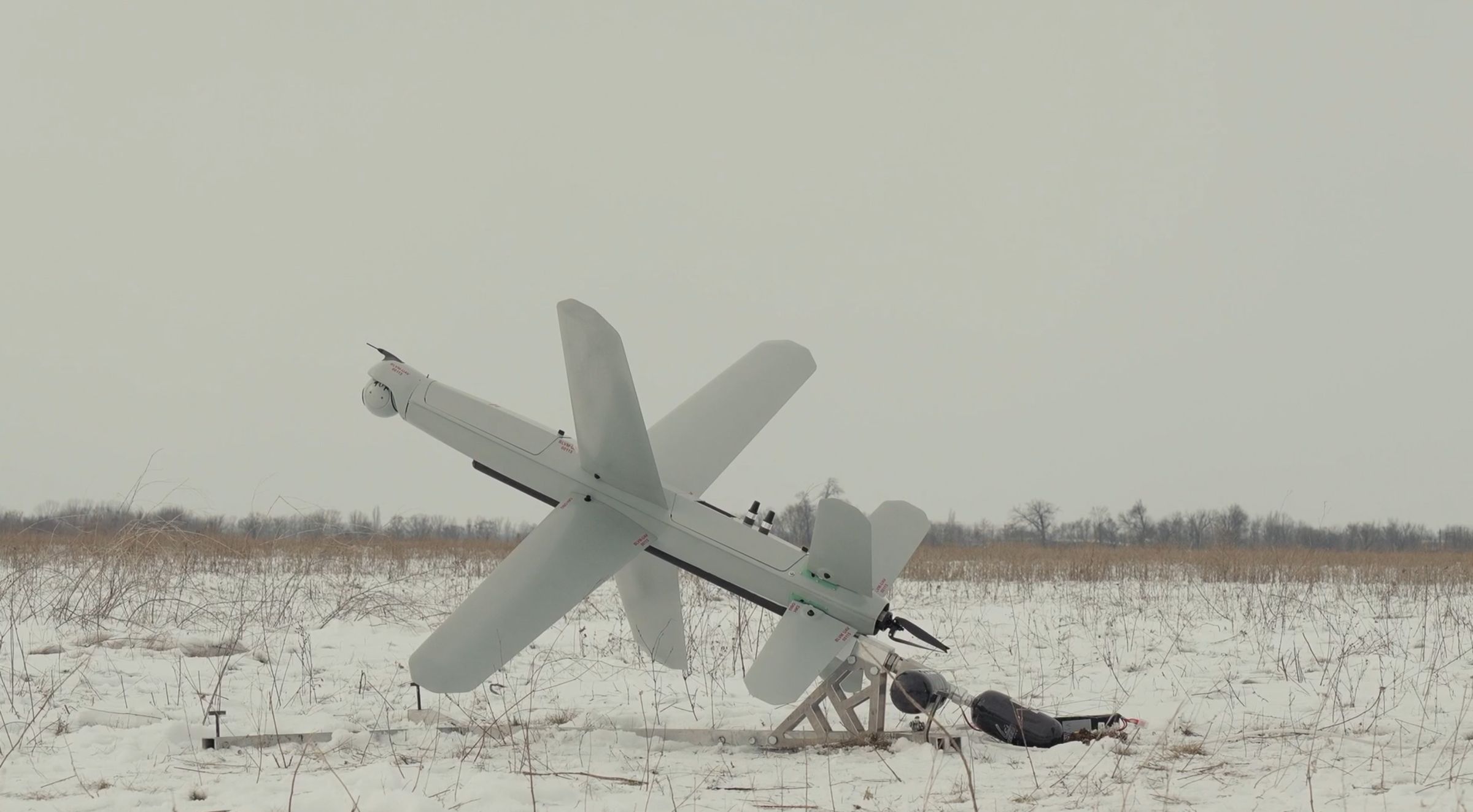
The DeViRo Bulava is a Ukrainian loitering munition developed for precision attacks against ground targets. The system combines an electrically powered X-shaped strike aircraft with a ground control station, repeaters and reconnaissance assets. Ukrainian forces have used Bulava in combat since 2024, according to the developer.
Bulava has undergone several documented improvements since entering production. Early publicly reported versions had an endurance of about 50 to 60 minutes and used repeaters to extend the control and engagement distance. By September 2026, DeViRo reported endurance of up to 110 minutes and a guaranteed engagement distance of 120 to 130 km.
The 2026 configuration also received a new multispectral optoelectronic station combining daytime and thermal-imaging channels in one unit. The operator can switch between the two channels through the ground-control software during a mission, allowing the same aircraft configuration to be used in both daylight and darkness.
Development and production
Development of Bulava was reported to have begun in 2023. A secondary overview of the program on Wikipedia states that production began in November 2023 and that operational use followed in 2024. The production date is supported by reporting from Hartpunkt, which said the Ukrainian manufacturer DeViRo and its subsidiary UAC were producing Bulava and other unmanned aircraft at a facility in Kolin, Czech Republic.
Hartpunkt reported in July 2024 that series production at the Czech facility had been running on a full scale since April 2024. At that time, representatives described an approximately 11 kg loitering munition carrying a 3.6 kg warhead, with an electric motor, a three-bladed pusher propeller and about one hour of endurance. The same report stated that targeting was supported by a gimballed day-and-night camera installed in the nose.
In February 2025, DeViRo displayed the Bulava system at the Defense Tech Innovations Forum. According to Militarnyi, the system had been created in response to Ukrainian military requirements for attacks against important Russian targets. The complete system was described as including Bulava strike drones, a ground control station, repeaters and reconnaissance equipment.
The February 2025 configuration was reported with a takeoff mass of 11.5 kg, a length of 1.5 m and a wingspan of 1.6 m. DeViRo stated that it could remain airborne for up to 50 minutes and reach about 100 km/h. Communication through a repeater and MESH networking extended the reported engagement distance from about 35 km without a repeater to as much as 55 km with one. A March 2025 technical overview published by Amalantra repeated the 11.5 kg takeoff mass, 1.5 m length, 1.6 m wingspan, 2,000 m ceiling and 35 km to 55 km range figures.
Published endurance and range figures changed as the design evolved. A later program summary records an improved version shown in September 2025 with more than 80 km of operating radius and about 75 minutes of endurance. These figures should be treated as a later development stage rather than as specifications of the original production configuration.
By September 2026, DeViRo reported a further substantial improvement. The company stated that Bulava could remain airborne for up to 110 minutes and had a guaranteed employment distance of 120 to 130 km. The developer also indicated that still greater distances could be possible depending on operational conditions and crew preparation.
2026 optical-system upgrade
The principal documented upgrade in 2026 was a new multispectral optoelectronic station. Earlier Bulava versions already used day and thermal imaging for target acquisition, but the updated station combines both channels in a single housing. This removes the need to install different optical modules for missions conducted at different times of day.
The operator can select the daytime or thermal-imaging channel through the control-station software while the aircraft is already performing its mission. DeViRo stated that the new optical system would be installed on subsequent serial-production batches of Bulava.
Design
Air vehicle
Bulava uses a distinctive X-shaped aerodynamic configuration. The arrangement gives the aircraft control authority during maneuvering and the final attack phase. The air vehicle is launched from a catapult rather than taking off conventionally.
Propulsion is electric. A rear-mounted electric motor drives a three-bladed pusher propeller. In the configuration documented in 2024 and early 2025, published speed figures were approximately 100 km/h. Because the program has undergone successive endurance and range upgrades, those early performance figures should not automatically be applied to the later 2026 configuration.
Guidance and communications
Target observation and guidance are provided through an optical station in the nose. The February 2025 system was described as having daytime and thermal-imaging channels. DeViRo also reported a machine-vision function capable of assisting with detection, tracking and terminal guidance against a target selected by the operator.
The communication system was developed for operation in an environment affected by electronic warfare. Published descriptions state that Bulava can use MESH networking and an airborne repeater to extend the data link beyond the direct operating distance of the ground station. The February 2025 figures were approximately 35 km without a repeater and up to 55 km with one.
The 2026 multispectral optical station integrates its daytime and thermal channels into a common unit. Switching between them is performed through the control software, providing a single sensor installation for both daytime and nighttime operations.
Warhead
Early production Bulava aircraft were reported with a 3.6 kg warhead. DeViRo stated in 2025 that different warhead types could be installed and that a Ukrainian-made shaped-charge thermobaric warhead was commonly used. Secondary reporting also described a larger 5 kg thermobaric option, although the available sources do not establish that this configuration was standard across production.
Ground system
Bulava is part of a wider unmanned reconnaissance and strike complex rather than only a standalone aircraft. The system described by DeViRo includes strike drones, a ground control station, repeaters and reconnaissance equipment. This allows reconnaissance, target designation, communications relay and the strike aircraft to operate as parts of a single mission architecture.
Operational history
According to DeViRo co-founder Denys Cherednychenko, Ukrainian Defense Forces began using Bulava in 2024. The developer stated that the aircraft had been used against both moving and stationary ground targets, including armored vehicles, air-defense equipment and electronic-warfare systems.
By February 2025, the developer reported confirmed strikes at distances of up to 55 km from the launch point. DeViRo later described participation in a summer campaign focused on attacks against Russian logistics and stated that Bulava had been used against radar and air-defense systems to facilitate deeper strikes by other weapons. This account represents a statement from the manufacturer rather than an independently documented list of combat engagements.
Program status
Bulava remained in serial production and active development in 2026. DeViRo stated that future production batches would receive the combined multispectral day and thermal-imaging station. The reported increase to 110 minutes of endurance and 120 to 130 km of guaranteed employment distance indicates a substantial expansion over the publicly described 2024 and early 2025 configurations.
Because several generations of Bulava have been reported within a short period, published specifications vary by date and configuration. Early figures of approximately 50 to 60 minutes of endurance and 35 to 55 km of operating distance describe earlier aircraft and communication arrangements, while the 2026 figures apply to the upgraded system.
Operators
- Ukrainian Defense Forces: DeViRo states that Bulava has been used operationally since 2024.
Specifications (2026 updated Bulava)
Performance
- Endurance: up to 110 minutes
- Guaranteed engagement distance: 120 to 130 km
Sensors and guidance
- Optical system: multispectral optoelectronic station
- Imaging channels: integrated daytime and thermal-imaging channels
- Channel control: daytime and thermal modes selectable through the ground-control software during flight
 Argentina
 Armenia
 Australia
 Austria
 Austria-Hungary
 Belgium
 Brazil
 United Kingdom
 United States
 Brunei
 Bulgaria
 Canada
 Chile
Chile China
China Colonial America
 Colombia
 Confederate States
 Croatia
 Czech
Czech Denmark
 Egypt
Egypt Finland
 France
 Georgia
 Germany
 German Imperial
 Greece
 Holland
 Hungary
 India
India Indonesia
 Iran
Iran Iraq
Iraq Ireland
 Israel
 Italy
Italy Japan
Japan Japan (1940)
 Jordan
 Kingdom of Italy
 Malaysia
 Mexico
 Myanmar
 Nazi Germany
 Netherlands
 New Zealand
 North Korea
 Norway
 Pakistan
 Peru
Peru Philippines
 Poland
 Portugal
 Prussia
 Romania
 Russia
 Saudi Arabia
 Serbia
 Singapore
 Slovakia
 Slovenia
 South Africa
 South Korea
 Soviet Union
 Spain
Spain Sweden
 Switzerland
 Syria
Syria Taiwan
 Thailand
 Turkey
 UAE
UAE Vietnam
 Yugoslavia