
History
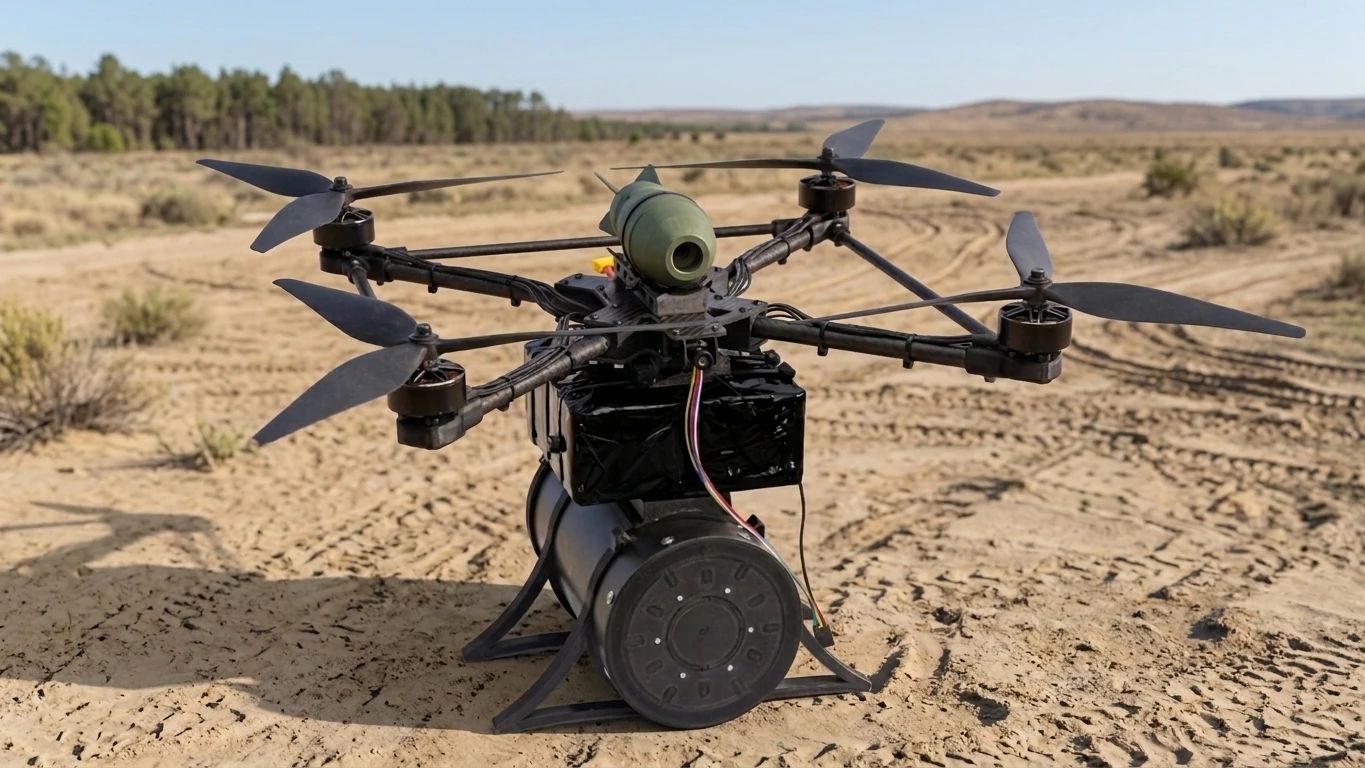
The Stellarion Deadliner is a Ukrainian series of fiber-optic first-person-view unmanned aircraft developed for front-line missions. The family includes the Deadliner Q1 and the later Deadliner Q15-30, with configurations using different fiber-optic spool lengths.
Instead of relying solely on a conventional radio control link, Deadliner aircraft use a fiber-optic connection for control and data transmission. Stellarion evaluates mission effectiveness partly by whether the aircraft maintains this connection through the required route and fully unwinds its fiber-optic spool.
Stellarion reported in September 2026 that Deadliner-series aircraft had achieved a mission success rate exceeding 70%. This figure is a manufacturer-reported measure based on missions in which the drone completed the operator-assigned task while maintaining the required communication channel.
Deadliner Q1 deployment
In May 2026, the Deadliner Q1 ranked first among fiber-optic FPV platforms by the number of combat sorties flown by Ukraine's Unmanned Systems Forces. According to operational reports cited by Stellarion, it also ranked third among strike systems in its class. The manufacturer reported that one military unit conducted 90 operational tests and combat sorties with the Q1, including missions in gusty winds, high humidity, and densely wooded terrain. The reported fiber-optic cable breakage rate during this cycle remained below 10%, according to a Defender Media report.
Stellarion also stated that its proprietary fiber-optic winding technology and in-house manufacturing kept the hardware defect rate below 2%. By that time, Q1 configurations with 15 km, 20 km, and 25 km fiber-optic spools were offered through Ukrainian state procurement channels including Brave1 Market and DOT-Chain Defence.
In July 2026, the Deadliner Q1 placed second in the overall ranking of fiber-optic strike systems among units of the Ukrainian Defence Forces.
Deadliner Q15-30
By September 2026, Ukraine's Ministry of Defence had codified the Deadliner Q15-30. Stellarion described the model as a development based on combat experience. Codification made the aircraft eligible for procurement by Ukrainian Defence Forces units through the Brave1 and DOT-Chain platforms. The development and codification were reported by Defender Media and UNITED24 Media.
The Q15-30 is intended for missions at ranges of up to 30 km while carrying a payload of up to 3 kg. Stellarion states that it can remain airborne for at least 30 minutes and reach a maximum speed of 110 km/h. The company also reported that 35 km and 40 km spool variants were being prepared for Ministry of Defence codification.
Design
The defining feature of the Deadliner family is its fiber-optic control and data connection. During flight, cable is unwound from a spool carried by the aircraft. Stellarion uses complete unwinding of the required spool as one indicator that the system maintained a stable control and data channel over the intended mission distance.
For the Deadliner Q1, Stellarion reports using proprietary fiber-optic winding technology and its own production facilities. The aircraft is offered with multiple spool lengths, allowing configurations for different mission distances.
The Deadliner Q15-30 can be integrated with a dual optical system combining daylight and thermal-imaging cameras. According to Stellarion, the video architecture can use either analog or digital options. The company states that software and structural changes are introduced continuously in response to feedback from front-line operators.
Operational history
Deadliner drones are used by Ukrainian forces in front-line operations during the Russia-Ukraine war. Available manufacturer-reported operational data show regular combat use of the Q1 by the Unmanned Systems Forces during 2026.
Stellarion reported a mission success rate above 70% across the Deadliner series. The company defines a successful mission as one in which the aircraft completes the task assigned by its operator, including maintaining a stable control and data link through the required route. This percentage is a manufacturer-reported performance measure rather than an independently verified system-wide statistic.
Variants
- Deadliner Q1: Fiber-optic FPV model documented in Ukrainian combat service during 2026. It can carry up to 2 kg and was offered with 15 km, 20 km, and 25 km fiber-optic spool configurations.
- Deadliner Q15-30: Codified model developed using combat experience. It is designed for missions up to 30 km with a payload of up to 3 kg.
- 35 km and 40 km spool configurations: Planned Deadliner variants that Stellarion reported were being prepared for Ukrainian Ministry of Defence codification.
Operators
- Ukraine: Deadliner drones are used by units of the Ukrainian Defence Forces, including operational use of the Q1 by the Unmanned Systems Forces.
Specifications (Deadliner Q1)
General characteristics
- Maximum payload: 2 kg
- Fiber-optic spool options: 15 km, 20 km, or 25 km
- Flight endurance: At least 20 minutes
Performance
- Maximum speed: 110 km/h
- Cruising speed: 60-70 km/h
Specifications (Deadliner Q15-30)
General characteristics
- Maximum payload: 3 kg
- Mission distance: Up to 30 km
- Flight endurance: At least 30 minutes
Performance
- Maximum speed: 110 km/h
Sensors and data link
- Optical payload option: Dual daylight and thermal-imaging camera system
- Video architecture: Analog or digital options
- Control and data connection: Fiber-optic link
 Argentina
 Armenia
 Australia
 Austria
 Austria-Hungary
 Belgium
 Brazil
 United Kingdom
 United States
 Brunei
 Bulgaria
 Canada
 Chile
Chile China
China Colonial America
 Colombia
 Confederate States
 Croatia
 Czech
Czech Denmark
 Egypt
Egypt Finland
 France
 Georgia
 Germany
 German Imperial
 Greece
 Holland
 Hungary
 India
India Indonesia
 Iran
Iran Iraq
Iraq Ireland
 Israel
 Italy
Italy Japan
Japan Japan (1940)
 Jordan
 Kingdom of Italy
 Malaysia
 Mexico
 Myanmar
 Nazi Germany
 Netherlands
 New Zealand
 North Korea
 Norway
 Pakistan
 Peru
Peru Philippines
 Poland
 Portugal
 Prussia
 Romania
 Russia
 Saudi Arabia
 Serbia
 Singapore
 Slovakia
 Slovenia
 South Africa
 South Korea
 Soviet Union
 Spain
Spain Sweden
 Switzerland
 Syria
Syria Taiwan
 Thailand
 Turkey
 UAE
UAE Vietnam
 Yugoslavia