
History
BlackSea Technologies MARIONETTE is a maritime launch system developed to transport and deploy fiber-optically controlled first-person-view drones from an uncrewed surface vessel. The system combines protected launch cases with remote deployment and is intended to extend fiber-optic FPV operations from land to the maritime environment.
BlackSea Technologies designed MARIONETTE for conditions in which conventional radio-frequency control and video links may be disrupted, detected, or denied. Fiber-optic FPV drones maintain their control and video connection through a physical fiber link rather than a conventional radio link.
The manufacturer states that MARIONETTE supports 5-inch, 7-inch, and 10-inch FPV drones. Enclosed self-actuating cases protect the aircraft during transit and open remotely to prepare them for launch without personnel being present at the launch point.
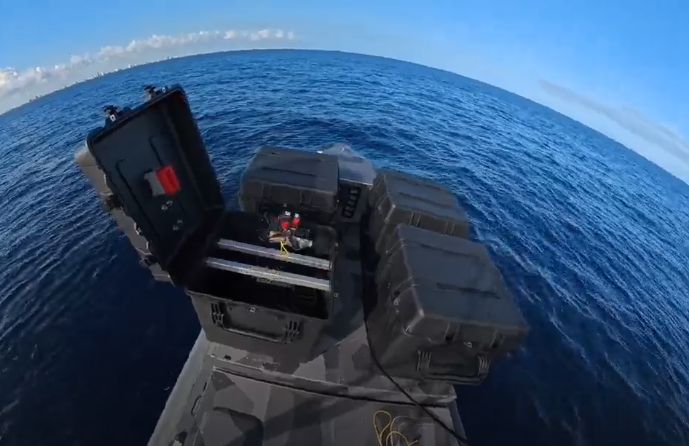
By August 2026, BlackSea Technologies had publicly presented MARIONETTE as a physical maritime FPV launch capability. Contemporary imagery described with the announcement showed four launch cases installed aboard a maritime platform, with each case appearing to accommodate one FPV drone. The exact vessel used for the demonstrated installation was not officially identified.
The system reflects operational lessons associated with the Russia-Ukraine War, where fiber-optic FPV drones have been used to maintain control and video transmission despite electronic warfare against conventional radio-controlled drones. BlackSea Technologies describes this physical connection as a way to reduce dependence on radio-frequency links in contested environments.
The manufacturer presents MARIONETTE as a way to move fiber-optic FPV capability beyond fixed land launch positions. An uncrewed surface vessel can transport the protected drones through the maritime environment and remotely deploy them after reaching the intended launch area. Further information is available from the BlackSea Technologies MARIONETTE page.
Design
MARIONETTE is built around enclosed deployment cases carried aboard an uncrewed surface vessel. The cases protect the FPV drones and associated launch components while the vessel is in transit. When a drone is required, the corresponding case can be actuated remotely and opened to position the aircraft for deployment.
The system is compatible with 5-inch, 7-inch, and 10-inch FPV drone configurations. This allows different aircraft sizes to be carried according to mission requirements without changing the basic maritime launch concept.
After deployment, control commands and real-time video are carried through the drone's fiber-optic connection rather than a conventional radio-frequency link. This arrangement is intended for environments affected by electronic warfare, GNSS denial, radio-frequency interference, or detection of conventional radio emissions.
The disclosed configuration showed four individual launch cases aboard a maritime platform. BlackSea Technologies has not identified the exact uncrewed surface vessel used in the publicly described installation, and no supported information establishes a dedicated MARIONETTE carrier platform.
Program status
MARIONETTE was publicly disclosed as a developed physical system in 2026. Available source material confirms its configuration and intended maritime employment but does not provide information about production quantities, procurement contracts, formal military adoption, operational deployment, or named operators.
Specifications (MARIONETTE)
General characteristics
- Type: Maritime launch system for fiber-optically controlled FPV drones
- Developer: BlackSea Technologies
- Launch platform: Uncrewed surface vessel
- Supported FPV drone sizes: 5-inch, 7-inch, and 10-inch configurations
- Deployment: Remotely actuated enclosed launch cases
- Disclosed installation: Four individual launch cases
Control and communications
- Drone control link: Fiber-optic physical connection
- Video transmission: Real-time video through the fiber-optic connection
- Radio-frequency dependence: Conventional RF control and video links are not required for the fiber-optic FPV connection
 Argentina
 Armenia
 Australia
 Austria
 Austria-Hungary
 Belgium
 Brazil
 United Kingdom
 Brunei
 Bulgaria
 Canada
 Chile
Chile China
China Colonial America
 Colombia
 Confederate States
 Croatia
 Czech
Czech Denmark
 Egypt
Egypt Finland
 France
 Georgia
 Germany
 German Imperial
 Greece
 Holland
 Hungary
 India
India Indonesia
 Iran
Iran Iraq
Iraq Ireland
 Israel
 Italy
Italy Japan
Japan Japan (1940)
 Jordan
 Kingdom of Italy
 Malaysia
 Mexico
 Myanmar
 Nazi Germany
 Netherlands
 New Zealand
 North Korea
 Norway
 Pakistan
 Peru
Peru Philippines
 Poland
 Portugal
 Prussia
 Romania
 Russia
 Saudi Arabia
 Serbia
 Singapore
 Slovakia
 Slovenia
 South Africa
 South Korea
 Soviet Union
 Spain
Spain Sweden
 Switzerland
 Syria
Syria Taiwan
 Thailand
 Turkey
 UAE
UAE Ukraine
 Vietnam
 Yugoslavia