
History
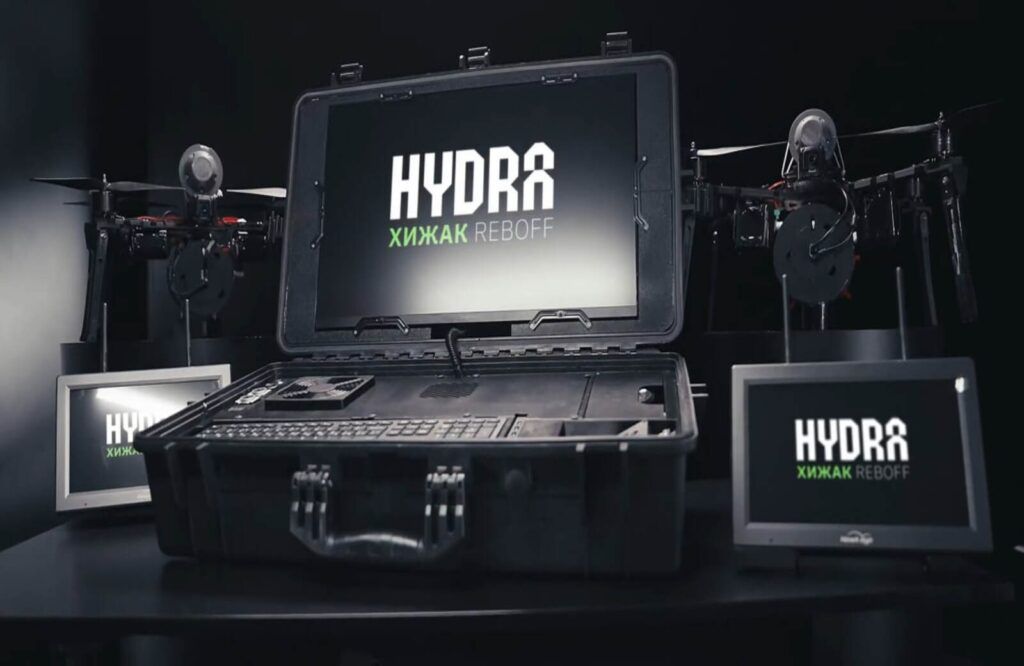
The 3DTech HYDRA Khyzhak REBOFF Digital is a Ukrainian unmanned aviation system for the parallel operation of fiber-optic FPV drones. It combines a portable HYDRA ground-control station with as many as five Khyzhak REBOFF aircraft.
The system allows one operator to connect to five drones, view their video feeds, and switch rapidly between aircraft. 3DTech developed it for coordinated sorties, consecutive attacks, group ambushes, and other missions requiring a high operational tempo.
Unlike conventional radio-controlled FPV aircraft, the connected drones exchange control and video signals through fiber-optic cables. This arrangement makes the link resistant to radio-frequency electronic warfare, although the cable remains a physical constraint on flight.
Development of 3DTech's fiber-optic Khyzhak REBOFF family began in 2023 in response to requirements from Ukrainian military personnel. Evaluation batches reached military units in 2024. According to the Ukrainian Ministry of Defence, 3DTech subsequently became the first Ukrainian developer to complete the ministry's codification process for a family of fiber-optic unmanned aircraft systems.
3DTech presented the complete HYDRA multi-drone system in 2026. The disclosed configuration joined the ground station with Khyzhak REBOFF FPV drones and added parallel video handling, automatic target detection, and connections to external situational-awareness platforms.
Design
System architecture
HYDRA is a complete unmanned aviation complex rather than an individual drone. Its principal elements are the transportable ground station and up to five fiber-optic Khyzhak REBOFF FPV aircraft. The operator can connect all five aircraft simultaneously, display their live video streams, and move quickly between their control interfaces.
This arrangement is intended to reduce the time required to operate several aircraft during one mission. It supports parallel sorties and synchronized employment without requiring five independent ground stations. The available descriptions do not state that the aircraft fly autonomously as a swarm; operator control and rapid switching between connected drones remain central features.
Ground station
The station is installed in a rugged, impact-resistant portable case. Its operator interface includes a 19-inch monitor. The internal computer uses an Intel Core i5 processor, 16 GB of memory, and 256 GB of storage.
A 6S battery can power the complex. The system can be controlled directly at the station or used in a remote-control configuration. Published information does not specify the remote operator's maximum separation from the main station.
Fiber-optic communication
A digital small form-factor pluggable module, commonly called an SFP module, handles optical signal transmission. 3DTech states that this part of the system can support a distance of up to 80 km. This figure describes the disclosed signal-transmission capability of the station and should not be confused with the flight range of an individual tethered drone.
Reports concerning the complete HYDRA configuration give the Khyzhak FPV drones a claimed range of up to 30 km. Earlier members of the Khyzhak REBOFF family used fiber spools between 10 and 20 km long, while longer-range models were being prepared separately. Effective flight distance may be shorter than the installed cable length because part of the fiber must remain available for maneuvering and changing conditions.
During operation, the station continuously monitors the quality of each fiber-optic connection. Optical diagnostic equipment supplied with the complex allows personnel to inspect the link, measure optical power, and maintain connector cleanliness.
Video, artificial intelligence, and integration
HYDRA receives live video from all connected aircraft and can show the feeds together on the station display. The operator can then select an aircraft without disconnecting the remaining drones.
A Hailo-8 artificial-intelligence accelerator supports automatic target-detection functions. The published material describes AI-assisted detection, but it does not establish autonomous target selection or autonomous weapon release.
The station supports video streaming and integration with Ukraine's DELTA and Vezha situational-awareness systems. These connections can make drone imagery available within a wider operational information environment.
Field equipment
The supplied maintenance and diagnostic equipment includes an optical time-domain reflectometer, an optical power meter, and materials for cleaning fiber-optic connectors. The kit also contains spare propellers, battery-retaining straps, screwdrivers, wrenches, hex keys, and cable ties.
Program status
As of August 2026, 3DTech had presented the HYDRA system and made it available for ordering through Ukraine's DOT-Chain and Brave1 Market procurement platforms. Public sources confirm that Khyzhak REBOFF aircraft were supplied to Ukrainian combat brigades before the HYDRA station was unveiled, but they do not provide a confirmed quantity of HYDRA stations delivered or identify specific HYDRA operators.
The system's disclosed mission concepts include coordinated mass attacks, parallel sorties, group ambushes, and maintaining a succession of FPV-drone engagements. These are stated capabilities and intended uses; the available sources do not document a specific combat action conducted with the complete five-drone HYDRA configuration.
Specifications (HYDRA ground station)
General characteristics
- Manufacturer: 3DTech
- Country of development: Ukraine
- System type: Ground-control and unmanned aviation complex for fiber-optic FPV drones
- Connected aircraft: Up to five Khyzhak REBOFF FPV drones simultaneously
- Installation: Portable impact-resistant case
- Display: 19-inch monitor
- Computer processor: Intel Core i5
- Memory: 16 GB
- Storage: 256 GB
- Power source: 6S battery
- Optical interface: Digital SFP module
- Stated optical signal distance: Up to 80 km
- AI accelerator: Hailo-8
Control and data functions
- Video handling: Simultaneous display of feeds from connected aircraft
- Aircraft selection: Rapid switching between as many as five connected drones
- Target support: AI-assisted automatic target detection
- External integration: DELTA and Vezha situational-awareness systems
- Link monitoring: Continuous monitoring of fiber-optic connection quality
- Control modes: Direct operation from the station or remote operation
 Argentina
 Armenia
 Australia
 Austria
 Austria-Hungary
 Belgium
 Brazil
 United Kingdom
 United States
 Brunei
 Bulgaria
 Canada
 Chile
Chile China
China Colonial America
 Colombia
 Confederate States
 Croatia
 Czech
Czech Denmark
 Egypt
Egypt Finland
 France
 Georgia
 Germany
 German Imperial
 Greece
 Holland
 Hungary
 India
India Indonesia
 Iran
Iran Iraq
Iraq Ireland
 Israel
 Italy
Italy Japan
Japan Japan (1940)
 Jordan
 Kingdom of Italy
 Malaysia
 Mexico
 Myanmar
 Nazi Germany
 Netherlands
 New Zealand
 North Korea
 Norway
 Pakistan
 Peru
Peru Philippines
 Poland
 Portugal
 Prussia
 Romania
 Russia
 Saudi Arabia
 Serbia
 Singapore
 Slovakia
 Slovenia
 South Africa
 South Korea
 Soviet Union
 Spain
Spain Sweden
 Switzerland
 Syria
Syria Taiwan
 Thailand
 Turkey
 UAE
UAE Vietnam
 Yugoslavia