
History
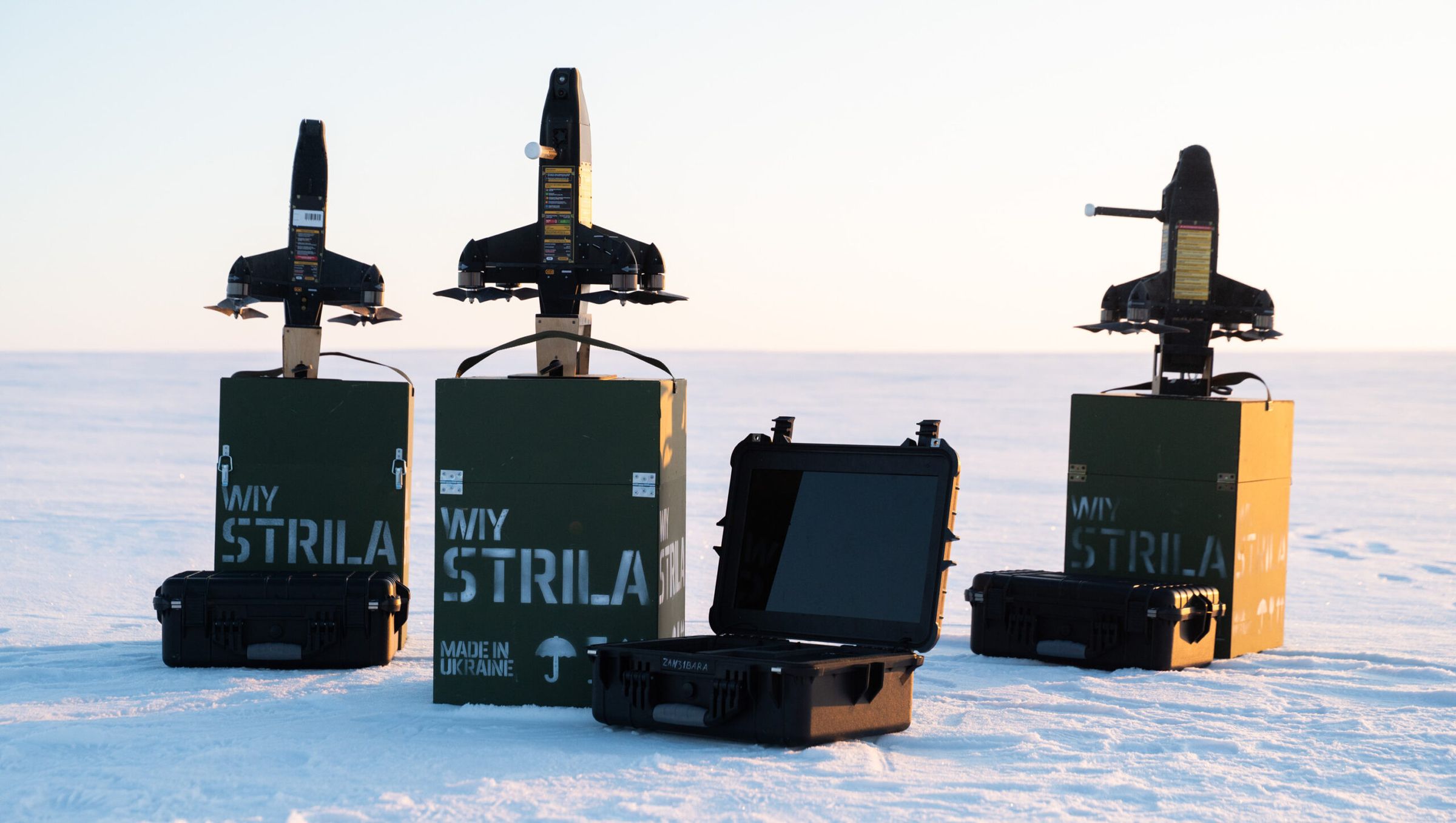
WIY STRILA is a Ukrainian high-speed interceptor unmanned aerial vehicle developed by WIY Drones for counter-UAS missions. The rocket-type interceptor is intended to engage fast and maneuverable aerial targets, including Shahed-136/131 attack drones, reconnaissance UAVs, and other strike drones.
STRILA was publicly available through Ukrainian defence procurement channels by late 2025 and underwent upgrades to its optical and navigation systems in December 2025. During 2026, production expanded substantially and the system entered serial deliveries under Ukrainian government contracts.
In March 2026, Quantum Systems announced an arrangement to supply STRILA interceptors to the National Guard of Ukraine. The initially reported quantity was 15,000 aircraft, while subsequent information increased the total assignment to 25,000.
Development and upgrades
By November 2025, STRILA was available through Ukrainian defence procurement platforms. A December 2025 upgrade introduced an improved optical module and navigation elements intended to improve operation against Shahed-136 attack UAVs, fast reconnaissance aircraft, and other drones. The revised sensor assembly combined daylight and thermal imaging cameras on a rotating mechanism.
In early 2026, WIY Drones introduced further changes. The upgraded aircraft used the SineLink communications system, which was described as allowing operation without GPS and improving resistance to electronic warfare interference. Operators could also switch communication channels during flight, while the daytime and night cameras were improved.
WIY Drones reported in March 2026 that the modified STRILA had entered serial supply under government contracts. Production had been scaled to about 100 interceptors per day, and approximately 70 percent of components were reported to be Ukrainian-made. The company also stated that every aircraft underwent module and system checks as well as flight testing before delivery.
Large-scale procurement
On 23 March 2026, Quantum Systems was reported to have been tasked with supplying 15,000 Ukrainian STRILA interceptor drones to the National Guard of Ukraine. The program followed investment in WIY Drones and was supported by German government funding. Production was to be expanded in Ukraine through cooperation between WIY Drones and Quantum Systems. Details of the initial agreement were reported by Militarnyi.
By September 2026, the stated total assignment had increased to 25,000 STRILA interceptors, indicating an additional order for 10,000 aircraft beyond the quantity announced in March.
Design
STRILA is described by its manufacturer as a rocket-type air-defence interceptor UAV. Its design emphasizes high speed, rapid launch, and interception of targets that can be difficult for conventional FPV drones or slower interceptor UAVs to reach.
Guidance and sensors
The aircraft integrates with WIY software and external targeting sources, including radar. Targeting information can provide the operator with the target bearing, altitude, and speed. STRILA has also been integrated with RADA radars and the SkyMap digital navigation and flight-planning system. Reported operation involves automatic guidance toward an interception sector followed by final engagement under human operator control.
The manufacturer describes a rotating dual-camera assembly with daylight and thermal channels. The operator can switch the video channel during flight. This arrangement supports observation in different lighting conditions and allows continued target tracking as conditions change. Current product information is available from WIY Drones.
Communications and autonomy
The upgraded 2026 configuration uses the SineLink communications system. It was reported to support operation without GPS and to improve resistance to electronic warfare jamming. WIY Drones has also been developing greater automation for the interception process. In the reported configuration, the aircraft can enter the target sector automatically, while the operator retains responsibility for the final attack. The company has also worked on optical recognition to compensate for radar errors and improve guidance accuracy.
The interceptor can return toward its launch position if an attack is cancelled, allowing an unused aircraft to be recovered rather than expended.
Operational history
WIY Drones reported in March 2026 that more than ten combat interceptions of Shahed drones had been recorded. At that time, deliveries had previously been limited while the company awaited a larger government contract, although an initial shipment numbering in the hundreds was reported to have been delivered in mid-February 2026. The March 2026 operational and production information was reported by Ukrainska Pravda.
The National Guard procurement program subsequently represented a much larger scale of planned deployment. The first public announcement covered 15,000 interceptors, and the reported assignment later rose to 25,000.
Variants
- STRILA: Original high-speed counter-UAS interceptor configuration developed by WIY Drones.
- Upgraded STRILA: Revised configuration introduced by late 2025 and early 2026 with an improved optical module, updated navigation, SineLink communications, enhanced day and night cameras, and additional electronic-warfare resistance.
Operators
- Ukraine: STRILA has been supplied under Ukrainian government contracts and used operationally against hostile UAVs. The National Guard of Ukraine was assigned a procurement program totaling 25,000 STRILA interceptors by September 2026.
Specifications (WIY STRILA)
General characteristics
- Type: Rocket-type air-defence interceptor UAV
- Air time: Up to 12 minutes
- Camera: Rotating daylight and thermal imaging camera system
- Warhead: 500 g in the manufacturer's current published specification
Performance
- Maximum speed: Up to 350 km/h in the manufacturer's current published specification
- Cruising speed: 150-200 km/h
- Tactical range: Up to 17 km
- Interception range: Up to 20 km
- Maximum flight altitude: Approximately 6,000 m
- Rate of climb: 50 m/s
Earlier 2025-2026 reports gave different figures for some parameters, including tactical ranges of approximately 14 km, maximum ranges of up to 28 km, altitudes of 4,000-5,000 m, flight endurance of about 10 minutes, and warheads of up to 800 g. A military test was also reported to have reached 400 km/h. These figures appear to reflect earlier configurations, test conditions, or differing definitions, so the specifications above use the manufacturer's current published values.
 Argentina
 Armenia
 Australia
 Austria
 Austria-Hungary
 Belgium
 Brazil
 United Kingdom
 United States
 Brunei
 Bulgaria
 Canada
 Chile
Chile China
China Colonial America
 Colombia
 Confederate States
 Croatia
 Czech
Czech Denmark
 Egypt
Egypt Finland
 France
 Georgia
 Germany
 German Imperial
 Greece
 Holland
 Hungary
 India
India Indonesia
 Iran
Iran Iraq
Iraq Ireland
 Israel
 Italy
Italy Japan
Japan Japan (1940)
 Jordan
 Kingdom of Italy
 Malaysia
 Mexico
 Myanmar
 Nazi Germany
 Netherlands
 New Zealand
 North Korea
 Norway
 Pakistan
 Peru
Peru Philippines
 Poland
 Portugal
 Prussia
 Romania
 Russia
 Saudi Arabia
 Serbia
 Singapore
 Slovakia
 Slovenia
 South Africa
 South Korea
 Soviet Union
 Spain
Spain Sweden
 Switzerland
 Syria
Syria Taiwan
 Thailand
 Turkey
 UAE
UAE Vietnam
 Yugoslavia