
History
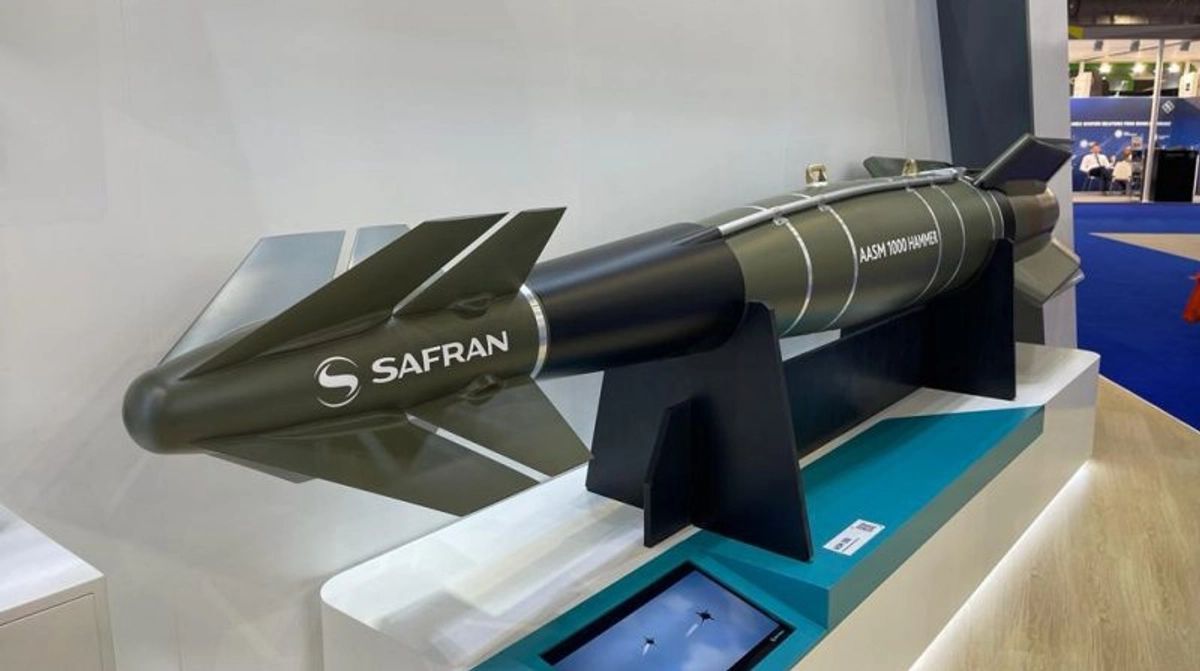
The Safran AASM Hammer, originally developed by Sagem and now associated with Safran Electronics & Defense, is a French modular precision-guided air-to-surface weapon. It combines a conventional bomb body with a nose-mounted guidance section and a rear range-extension kit that includes aerodynamic surfaces and a solid-propellant rocket booster.
The system is intended for precision strikes from stand-off distance and can use different bomb-body sizes and guidance packages. The AASM family has been integrated primarily with the Dassault Rafale and has subsequently been adapted or tested on additional combat aircraft.
In 2026, French and Swedish specialists were reported to be working on integration of the AASM Hammer with Gripen fighters intended for Ukraine. The work involves compatibility with the aircraft suspension system, weapon-management functions and transfer of target data.
Development
Development of the AASM began in 1997, when the French defence procurement authority launched an international competition for a modular air-to-ground weapon. In 2000, Sagem received a contract for an initial batch of 744 AASM kits. The original schedule envisaged deliveries earlier in the decade, but deliveries ultimately began in 2007.
The AASM entered French service in 2007. The GPS and inertial-navigation version was deployed on French Air Force Rafale aircraft from 2008, while French naval aviation followed with the weapon on Rafale fighters. A second order for 680 weapons was placed in 2009. Contemporary descriptions of the program are available from Airforce Technology.
The family subsequently expanded beyond its original 250 kg configuration. A 125 kg version was tested in 2009, while larger 500 kg and 1,000 kg configurations have also been associated with the AASM family. The system became widely known by the export name Hammer, expanded as Highly Agile Modular Munition Extended Range.
Design
The AASM Hammer is not simply a single-purpose bomb. It is a modular conversion system fitted to a compatible bomb body. Its main elements are a guidance section installed at the nose and a rear range-extension assembly. The rear unit incorporates control surfaces and a solid-fuel rocket motor, giving the weapon additional energy after release instead of relying only on unpowered glide performance.
The system has been associated with bomb bodies in the 125 kg, 250 kg, 500 kg and 1,000 kg classes. Sources identify compatible bodies including weapons from the Mark 80 family, such as the Mk 82, Mk 83 and Mk 84, as well as the BLU-109 penetrator in appropriate configurations.
Guidance
The baseline guidance option combines an inertial navigation system with satellite navigation. Additional configurations add either imaging infrared terminal guidance or laser guidance. These alternatives allow the weapon family to be adapted to different target and mission requirements.
The baseline INS/GPS version is consistently identified as SBU-38. Published secondary sources disagree over the assignment of the SBU-54 and SBU-64 designations to the imaging-infrared and laser-guided versions. Sources that identify SBU-64 as the imaging-infrared model and SBU-54 as the semi-active laser model conflict with other summaries that reverse those two designations, so the guidance types are treated separately here rather than assigning an uncertain designation.
Range extension
The rear propulsion kit contains a solid-propellant booster. This distinguishes the AASM from purely unpowered glide-bomb conversion kits and increases the distance available between the launch aircraft and the target. Reported range depends on release altitude, speed and weapon configuration. The supplied material attributes a range of more than 70 km to the basic system under suitable conditions, while older published descriptions cite more than 60 km from high altitude.
Later Hammer 250 XLR and Hammer 1000 XLR developments are intended to increase range further. They are described as using a revised propulsion arrangement, but the supplied material does not establish final production specifications for these versions.
Operational history
The AASM became operational with French forces during the late 2000s. One secondary account places its first combat use on 20 April 2008 in Afghanistan, when a Rafale released two AASM weapons in support of ground forces.
The weapon was also employed during French operations over Libya in 2011. Secondary reporting describes long-range engagements during the campaign, including a reported strike against a tank from approximately 55 km. These operational examples demonstrated the stand-off role for which the weapon had been developed.
Ukraine later received AASM Hammer weapons and adapted them for Soviet-designed aircraft. The supplied material states that Ukrainian forces first integrated the weapon with MiG-29 fighters and subsequently with Su-25 attack aircraft. Ukraine is also listed among current users in a 2026 equipment reference from Army Recognition.
In September 2026, reporting stated that AASM Hammer integration was being prepared for Gripen fighters intended for Ukraine. Saab and French specialists, including Safran, were described as participating. The integration requires mechanical compatibility with the aircraft stores arrangement as well as software and data interfaces between the weapon and the aircraft weapon-management system.
Variants
- INS/GPS version: Baseline all-weather guidance configuration combining inertial navigation with satellite navigation. The 250 kg version is identified as SBU-38.
- Imaging-infrared version: Adds an imaging-infrared terminal guidance function to the inertial and satellite-navigation system for increased terminal precision.
- Laser-guided version: Adds laser terminal guidance to the inertial and satellite-navigation system and is intended to support precision engagement of designated targets, including moving targets.
- 125 kg configuration: Lighter AASM configuration that was successfully tested in 2009.
- 250 kg configuration: Principal AASM configuration and the version most extensively described in published technical data.
- 500 kg configuration: Heavier bomb-body option within the modular AASM family.
- 1,000 kg configuration: Heavy configuration developed to extend the family to larger bomb bodies.
- Hammer 250 XLR: Extended-range development intended to provide greater reach than the standard configuration.
- Hammer 1000 XLR: Extended-range development based on the 1,000 kg class configuration.
Operators
- France: The original operator. AASM weapons entered service with the French Air Force and French naval aviation and are closely associated with the Dassault Rafale.
- Croatia: Listed as an AASM Hammer user by a 2026 secondary equipment reference.
- Egypt: Listed as an AASM Hammer user in current secondary references.
- India: Operates AASM Hammer weapons and has pursued integration and industrial cooperation involving the system.
- Morocco: Listed among international AASM Hammer users.
- Qatar: Listed among international AASM Hammer users.
- Ukraine: Operational user of AASM Hammer weapons, including adaptations for MiG-29 and Su-25 aircraft. Integration with Gripen was reported in progress in 2026.
Specifications (AASM 250)
General characteristics
- Type: Rocket-assisted precision-guided air-to-surface stand-off munition
- Bomb-body class: 250 kg
- Overall length: Approximately 3.0-3.1 m in published secondary specifications
- Launch mass: Approximately 330-340 kg in published secondary specifications
- Propulsion: Solid-propellant rocket booster in the rear range-extension kit
Performance
- Range: More than 70 km under suitable high-altitude release conditions according to later descriptions; older references cite more than 60 km
- Guidance: INS/GPS baseline, with imaging-infrared or laser-guided alternatives
- Baseline accuracy: Approximately 10 m circular error probable is reported for the INS/GPS configuration
- Terminal-guidance accuracy: Published secondary sources report approximately 1 m circular error probable for infrared or laser-guided configurations under suitable conditions
Warhead and integration
- Compatible bomb bodies: Standard 250 kg-class bodies including the Mk 82 and other compatible designs identified for the AASM family
- Primary launch platform: Dassault Rafale
- Other reported integrations or adaptations: Mirage 2000 family aircraft, Mirage F1, F-16, Tejas, MiG-29 and Su-25; Gripen integration was reported in progress in 2026
 Argentina
 Armenia
 Australia
 Austria
 Austria-Hungary
 Belgium
 Brazil
 United Kingdom
 United States
 Brunei
 Bulgaria
 Canada
 Chile
Chile China
China Colonial America
 Colombia
 Confederate States
 Croatia
 Czech
Czech Denmark
 Egypt
Egypt Finland
 Georgia
 Germany
 German Imperial
 Greece
 Holland
 Hungary
 India
India Indonesia
 Iran
Iran Iraq
Iraq Ireland
 Israel
 Italy
Italy Japan
Japan Japan (1940)
 Jordan
 Kingdom of Italy
 Malaysia
 Mexico
 Myanmar
 Nazi Germany
 Netherlands
 New Zealand
 North Korea
 Norway
 Pakistan
 Peru
Peru Philippines
 Poland
 Portugal
 Prussia
 Romania
 Russia
 Saudi Arabia
 Serbia
 Singapore
 Slovakia
 Slovenia
 South Africa
 South Korea
 Soviet Union
 Spain
Spain Sweden
 Switzerland
 Syria
Syria Taiwan
 Thailand
 Turkey
 UAE
UAE Ukraine
 Vietnam
 Yugoslavia