
History
The Khagantak-243, also designated K-243 and described as a Long Range Glide Bomb, is an Indian air-launched precision-guided weapon developed by JSR Dynamics with Bharat Electronics. It is intended for stand-off attacks against ground targets and is designed to retain navigation capability in environments affected by satellite-navigation jamming.
The K-243 belongs to a wider Khagantak family of glide weapons offered in several weight classes. The 300 kg K-243 has been integrated with the Indian Air Force's Sukhoi Su-30MKI, and the first reported drop test of the weapon was conducted in September 2026.
Publicly available figures for the weapon's maximum range are not fully consistent. Reporting associated specifically with the K-243 gives a range of 100-120 km when released from 39,000 ft, while other reporting has cited up to 180 km for Khagantak weapons. The lower figure is therefore used here as the specific published K-243 performance figure.
Development
The Khagantak project was developed by JSR Dynamics in collaboration with Bharat Electronics. A published Khagantak summary states that the wider family was displayed as a prototype at Aero India 2019 and that JSR Dynamics was responsible for the weapon body and control systems while Bharat Electronics supplied electronics and guidance subsystems.
The project uses a modular approach intended to support different weapon sizes and guidance configurations. The K-243 is one member of a family that also includes the heavier K-450, K-720 and K-1260. Reported masses for these weapons are 540 kg, 720 kg and 1,350 kg respectively, compared with 300 kg for the K-243.
According to the available reporting, the K-243 was integrated with the Sukhoi Su-30MKI before its first reported drop test. Photographs published by JSR Dynamics showed the weapon carried on an outer wing pylon of the aircraft.
Testing
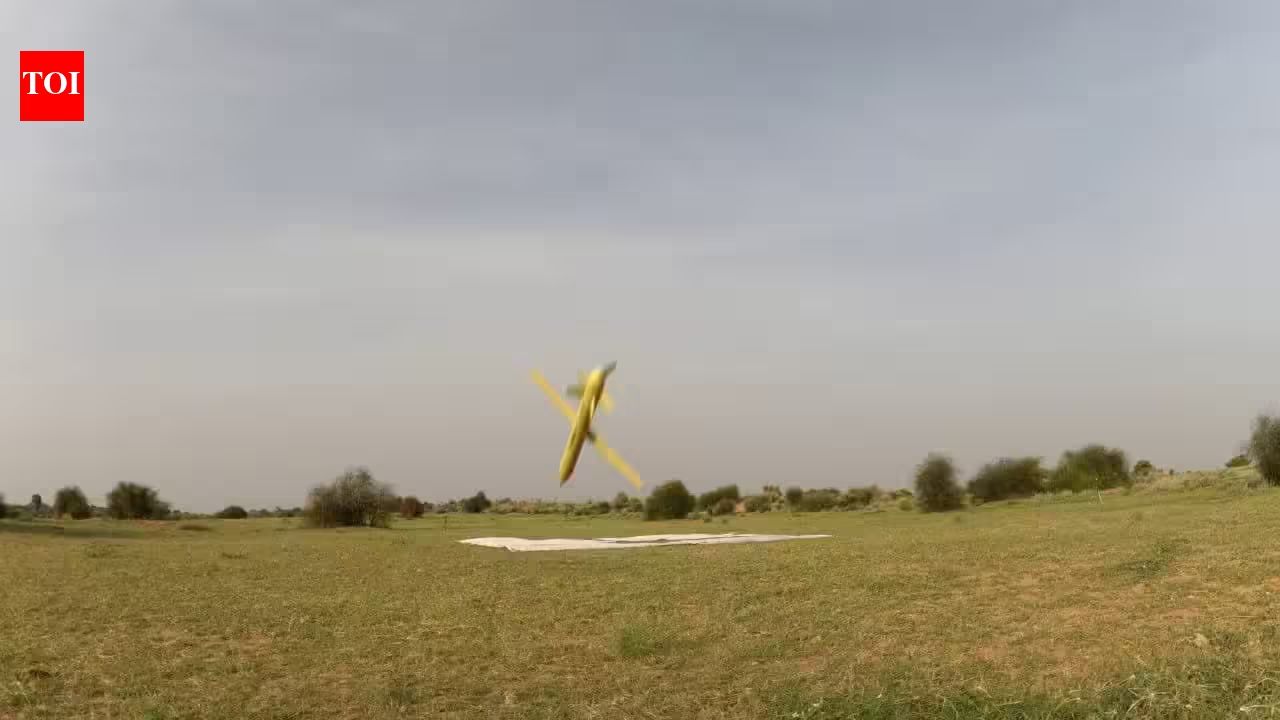
On 2 September 2026, the Indian Air Force conducted the maiden reported drop test of the Khagantak-243. A Firstpost report stated that the trial achieved its intended objectives. Images associated with reporting of the test showed the weapon striking a ground target.
The test announcement did not identify the launch platform used for that particular drop or state the release distance. The Su-30MKI nevertheless remains the aircraft explicitly reported as having been integrated with the K-243.
A News18 report also described the tested weapon as a 300 kg-class glide bomb with jamming-resistant navigation. That report cited a range of up to 180 km. This differs from the K-243-specific figure of 100-120 km at a 39,000 ft release altitude, and the available material does not establish that 180 km applies to the tested K-243 configuration.
Design
The Khagantak-243 is an unpowered glide weapon designed to extend the distance between the launch aircraft and a ground target. The weapon uses aerodynamic surfaces to glide after release rather than relying on a propulsion system.
Available descriptions show a cylindrical body with mid-body glide wings and five aft control surfaces. The glide surfaces provide lift after release, while the control surfaces are used to guide the weapon toward its programmed target.
Guidance
The K-243 uses a global navigation satellite system for mid-course guidance. A terminal seeker can be added to improve accuracy during the final stage of the attack.
The weapon can also be fitted with jamming-resistant GPS equipment. This configuration is intended to allow continued operation when normal satellite-navigation signals are degraded or denied by electronic warfare.
Descriptions of the wider Khagantak family also refer to optional electro-optical, infrared and passive-homing seeker configurations. These capabilities are associated with the modular family, and the supplied material does not establish that every seeker type was fitted to the K-243 used in the September 2026 test.
Warhead
The K-243 has a reported overall mass of 300 kg. A published description of the weapon associates the K-243 with a Mk 81 general-purpose blast-fragmentation warhead and approximately 125 kg of explosive content. The available reporting does not establish whether this was the warhead configuration used during the first drop test.
Aircraft integration
JSR Dynamics has reported integration of the K-243 with the Sukhoi Su-30MKI. Company imagery has shown the munition carried on an outer wing pylon. The available sources do not identify other aircraft on which the K-243 has completed integration.
Program status
The Khagantak-243 reached its first publicly reported Indian Air Force drop test in September 2026. Reporting stated that the mission objectives were achieved, but the available material does not establish that the weapon has entered operational service or serial production.
Variants
- K-243: 300 kg Long Range Glide Bomb and the subject of the September 2026 Indian Air Force drop test.
- K-450: Heavier member of the same weapon family with a reported mass of 540 kg.
- K-720: Heavier family member with a reported mass of 720 kg.
- K-1260: Largest of the listed family members, with a reported mass of 1,350 kg.
Specifications (Khagantak-243 K-243)
General characteristics
- Type: Long-range air-launched precision-guided glide bomb
- Mass: 300 kg (661 lb)
- Guidance: GNSS mid-course guidance
- Optional guidance equipment: Terminal seeker and jamming-resistant GPS
- Integrated aircraft: Sukhoi Su-30MKI
Performance
- Reported release altitude for stated range: 11,900 m (39,000 ft)
- Reported range: 100-120 km (54-64.8 nmi) from the stated release altitude
Warhead
- Reported warhead type: Mk 81 general-purpose blast-fragmentation warhead
- Reported explosive content: approximately 125 kg
 Argentina
 Armenia
 Australia
 Austria
 Austria-Hungary
 Belgium
 Brazil
 United Kingdom
 United States
 Brunei
 Bulgaria
 Canada
 Chile
Chile China
China Colonial America
 Colombia
 Confederate States
 Croatia
 Czech
Czech Denmark
 Egypt
Egypt Finland
 France
 Georgia
 Germany
 German Imperial
 Greece
 Holland
 Hungary
 Indonesia
 Iran
Iran Iraq
Iraq Ireland
 Israel
 Italy
Italy Japan
Japan Japan (1940)
 Jordan
 Kingdom of Italy
 Malaysia
 Mexico
 Myanmar
 Nazi Germany
 Netherlands
 New Zealand
 North Korea
 Norway
 Pakistan
 Peru
Peru Philippines
 Poland
 Portugal
 Prussia
 Romania
 Russia
 Saudi Arabia
 Serbia
 Singapore
 Slovakia
 Slovenia
 South Africa
 South Korea
 Soviet Union
 Spain
Spain Sweden
 Switzerland
 Syria
Syria Taiwan
 Thailand
 Turkey
 UAE
UAE Ukraine
 Vietnam
 Yugoslavia