
History
The Rolls-Royce F130 is a turbofan engine selected for the U.S. Air Force B-52 Commercial Engine Replacement Program. It is derived from the commercial BR725 architecture and is intended to replace the Pratt & Whitney TF33 engines used by the B-52H. The re-engined bomber is planned to become the B-52J.
The U.S. Air Force selected the F130 in September 2021. Each B-52J is planned to retain eight engines arranged as four twin-engine pods. Rolls-Royce plans to manufacture, assemble and test the engines in Indianapolis, and more than 600 engine deliveries have been expected for the program according to a Rolls-Royce press release.
The F130 program has progressed through twin-pod, sea-level and altitude testing before aircraft flight evaluation. By September 2026, flight-test engines were being assembled in Indianapolis, while additional endurance and integration work was continuing. Initial deliveries of these engines were expected to begin in April 2027.
Development and twin-pod testing
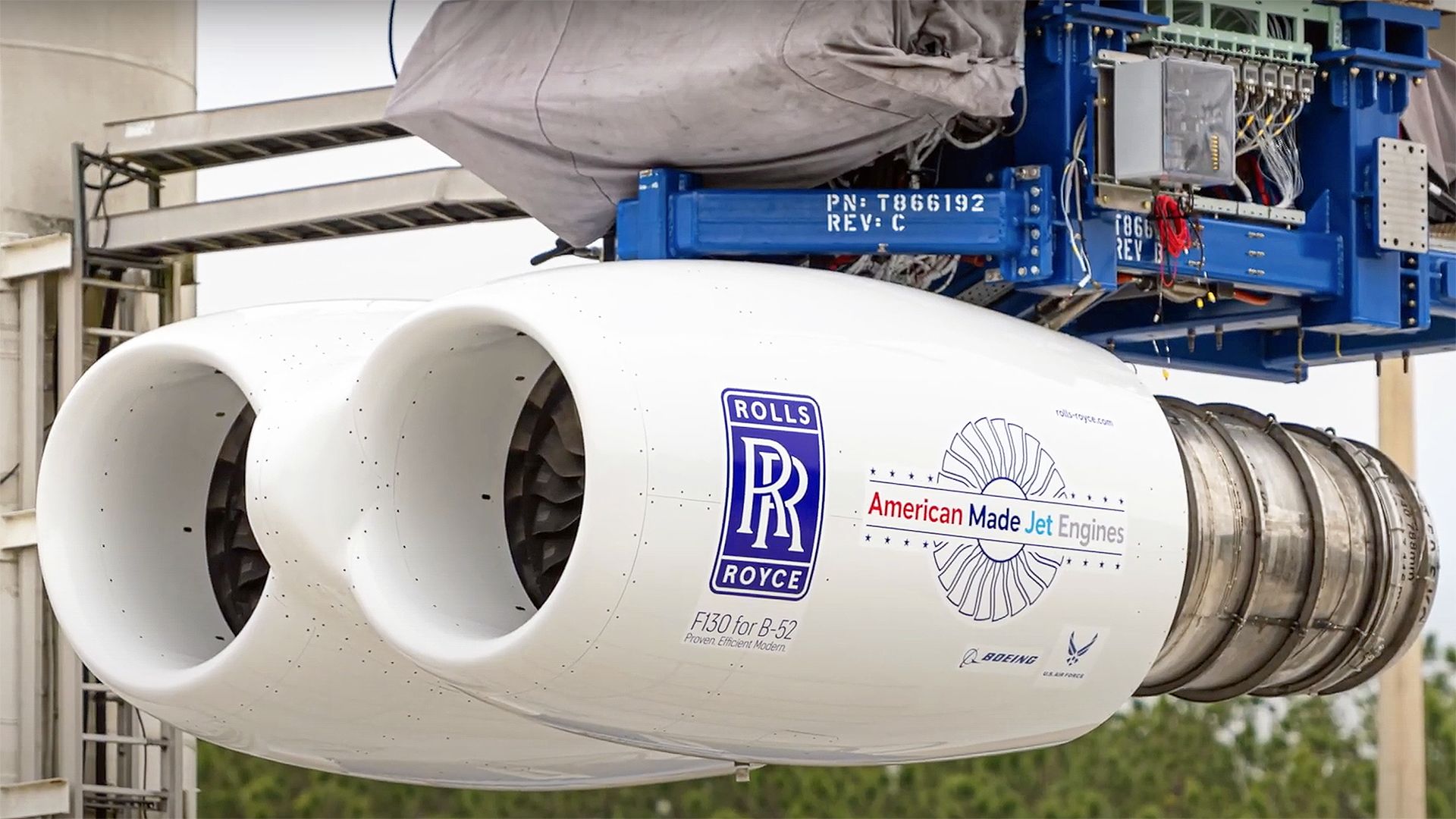
In 2023, Rolls-Royce was testing F130-200 engines at NASA's Stennis Space Center in Mississippi. A specialized stand allowed two engines to operate simultaneously in a representative B-52 twin-engine pod. Testing examined inlet airflow, crosswind effects and interactions between the two engines. The engines were operated up to full power, and Rolls-Royce reported that the measured results were consistent with its analytical models and those developed by Boeing. Details of this phase were reported by Air & Space Forces.
The early pod campaign was intended to reduce integration risk before the final nacelle configuration was completed. Rolls-Royce examined several pod configurations while studying how air entered the closely spaced nacelles and whether exhaust or airflow from one engine could adversely affect the other. No unexpected harmonic interaction or cross-ingestion problem was reported during the tests described in 2023.
The F130-200 is based on the BR725 commercial engine. However, the B-52 application requires changes to digital engine controls and the connections for hydraulic and fuel systems. Boeing serves as the overall propulsion-system integrator and has worked with Rolls-Royce on inlet characteristics, accessory systems, cooling, electrical generation and maintenance access.
Critical design review and altitude testing
The program completed its Critical Design Review in late 2024, allowing construction of the initial flight-test engines to proceed. Subsequent testing included sea-level operation at Rolls-Royce facilities in Indianapolis and further work on the twin-pod arrangement.
In February 2026, Rolls-Royce completed altitude and operability testing at the Arnold Engineering Development Complex in Tennessee. The campaign evaluated performance during sustained high-altitude operation and used distortion screens to reproduce disturbed or turbulent inlet airflow. Integrated Drive Generator testing was also conducted with Boeing to verify stable electrical generation. The milestone and test activities were described by Air Data News.
Later work included testing with the final inlet and nacelle geometry, additional sea-level operability work, preparations for water-ingestion testing and an endurance campaign intended to accumulate approximately twice the anticipated use of engines during the flight-test program. In September 2026, Rolls-Royce said the F130 was moving toward B-52J flight testing. Twenty flight-test engines were being assembled, with the first deliveries expected from April 2027, according to Army Recognition.
Design
BR725-derived architecture
The F130 uses the architecture of the Rolls-Royce BR725, part of a commercial engine family credited in the supplied sources with more than 30 million operating hours. The military installation adapts this architecture to the B-52's unusual eight-engine configuration and to the electrical, hydraulic and maintenance requirements of the modernized bomber.
The F130-200 is equipped with digital engine controls. The B-52 installation also requires specific hydraulic and fuel-line connections and integration with redesigned nacelles, inlets and supporting aircraft systems.
Twin-engine installation
The B-52J is planned to retain four underwing pods, each containing two F130 engines. Twin-pod testing has therefore been an important part of the development program. Testing has examined inlet airflow, interactions between adjacent engines and operation under crosswind conditions before the final installation is flown on the aircraft.
The new engines are designed to be interchangeable between positions in a pod rather than permanently configured for a left or right position. Rolls-Royce demonstrated a conversion between positions using a parts kit and instructions. Two experienced mechanics completed the conversion in about 90 minutes during a company test. This arrangement is intended to simplify spare-engine logistics compared with the existing TF33 installation.
Electrical and aircraft integration
Integration work includes the accessory gearbox, cooling arrangements and electrical generation. The altitude-test campaign included Integrated Drive Generator evaluation with Boeing. The broader B-52J conversion also requires changes to power distribution, hydraulics, pneumatics, cockpit controls, displays, flight avionics and onboard engine-start capability.
Program status
As of September 2026, the F130 had completed major ground-test phases but had not yet entered B-52 flight testing. Assembly of 20 flight-test engines was underway in Indianapolis, and the first deliveries were scheduled to begin in April 2027. These engines are intended to support modification of the initial B-52 test aircraft and the subsequent flight-evaluation program.
Published figures in the supplied sources differ on the number of B-52 aircraft planned for conversion, with reports citing either 75 or 76 aircraft. Rolls-Royce material states that more than 600 F130 engines are expected to be delivered. The U.S. Air Force plans to retain the B-52 into the 2050s, with the F130 forming a central part of the aircraft's long-term modernization.
The engine replacement is intended to improve reliability, maintainability, efficiency and mission availability while supporting the upgraded aircraft's electrical requirements. A secondary source, The National Interest, has reported thrust of approximately 17,000 lbf per engine and described fleet conversion as expected in the early 2030s. These figures remain program-related estimates rather than evidence of an operational B-52J fleet.
Specifications (F130-200)
General characteristics
- Type: Turbofan aircraft engine
- Manufacturer: Rolls-Royce
- Derivative: Rolls-Royce BR725 architecture
- Primary application: U.S. Air Force B-52J modernization
- Planned installation: Eight engines per aircraft in four twin-engine pods
- Assembly and testing location: Indianapolis, United States
- Engine controls: Digital engine controls
- Pod-position configuration: Engine can be converted for either position within the twin-engine installation
Performance
- Reported thrust: Approximately 75.6 kN (17,000 lbf) per engine
Related equipment
- Rolls-Royce BR725: Commercial engine architecture from which the F130 is derived.
- Pratt & Whitney TF33: Existing B-52H engine that the F130 is intended to replace.
 Argentina
 Armenia
 Australia
 Austria
 Austria-Hungary
 Belgium
 Brazil
 United Kingdom
 Brunei
 Bulgaria
 Canada
 Chile
Chile China
China Colonial America
 Colombia
 Confederate States
 Croatia
 Czech
Czech Denmark
 Egypt
Egypt Finland
 France
 Georgia
 Germany
 German Imperial
 Greece
 Holland
 Hungary
 India
India Indonesia
 Iran
Iran Iraq
Iraq Ireland
 Israel
 Italy
Italy Japan
Japan Japan (1940)
 Jordan
 Kingdom of Italy
 Malaysia
 Mexico
 Myanmar
 Nazi Germany
 Netherlands
 New Zealand
 North Korea
 Norway
 Pakistan
 Peru
Peru Philippines
 Poland
 Portugal
 Prussia
 Romania
 Russia
 Saudi Arabia
 Serbia
 Singapore
 Slovakia
 Slovenia
 South Africa
 South Korea
 Soviet Union
 Spain
Spain Sweden
 Switzerland
 Syria
Syria Taiwan
 Thailand
 Turkey
 UAE
UAE Ukraine
 Vietnam
 Yugoslavia