

History
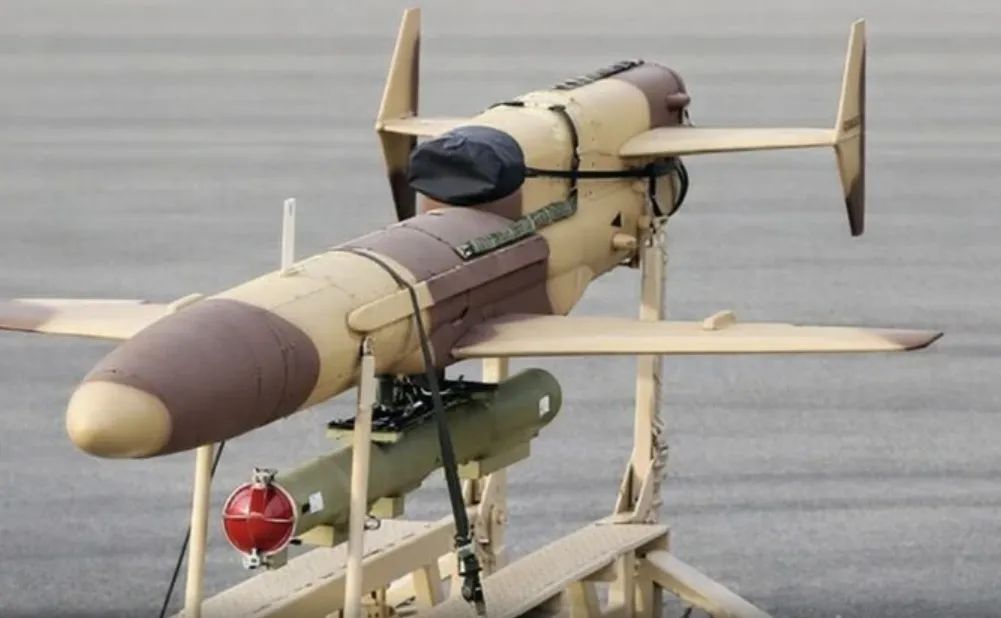
The Geran-5 is a Russian jet-powered long-range strike weapon first observed in combat in 2026. Although it carries the Geran designation, its conventional fuselage and wing arrangement differs substantially from the delta-wing configuration associated with earlier members of the family.
The weapon combines the characteristics of a one-way attack unmanned aircraft with those of a small cruise missile. Published data indicate a takeoff weight of about 850 kg, a 90 kg warhead, a cruise speed of approximately 450–600 km/h, and a range close to 950 km.
Geran-5 has been used during the Russia-Ukraine war and has become a target for Ukrainian interceptor drones. Several examples were destroyed by the Sting S high-speed interceptor during combat testing of that system in 2026.
Development and introduction
Geran-5 was first observed in combat around January 2026. Its appearance represented a significant departure from earlier Geran strike vehicles because the design abandoned the characteristic tailless delta planform in favor of a more conventional cruise-missile-like aerodynamic layout. The configuration has been linked to design features associated with the Iranian Karrar family, although the supplied evidence does not establish Geran-5 as a direct derivative.
The change in layout accompanied a move toward substantially higher speed. Geran-5 uses turbojet propulsion rather than the piston propulsion associated with earlier long-range Geran designs. The higher cruise speed reduces flight time and shortens the period available to detect, classify, and intercept the weapon.
Geran-5 has been described as capable of ground launch and possible airborne launch from Su-25 aircraft. Ground-launch descriptions include the use of a solid-fuel booster. Air launch remains a reported employment concept in the supplied evidence rather than a confirmed standard operational method.
Combat use
Geran-5 was employed against Ukraine during 2026. Ukrainian forces subsequently began using interceptor drones against the type. The Sting S interceptor destroyed several Geran-5 weapons during active combat testing, including an interception conducted by the Rubin crew of the 1020th Anti-Aircraft Missile Regiment.
Design
Airframe
Geran-5 uses an elongated conventional fuselage with wings rather than the broad delta configuration characteristic of several earlier Geran models. This gives the weapon an appearance and aerodynamic arrangement closer to a small cruise missile than to a conventional delta-wing one-way attack UAV.
Published dimensional figures are inconsistent. One set of data gives a length of about 6 m and a wingspan of approximately 5.5 m, while another gives about 6.5 m length and 3.2 m wingspan. The supplied evidence therefore does not establish a single definitive dimensional set.
The reported full takeoff weight is approximately 850 kg. The payload is about 90 kg and has been described as a high-explosive unitary or fragmentation warhead.
Powerplant
The Geran-5 is powered by a Chinese TELEFLY TF-TJ2000A turbojet producing approximately 200 kgf, or about 1.96 kN, of thrust. The engine supports a reported cruise speed of approximately 450–600 km/h. Some broader assessments place the upper speed near 650 km/h, but the more detailed technical data supplied for the weapon give 600 km/h as the upper cruise figure.
Guidance and communications
Recovered or documented Geran-5 systems include an FCU flight controller, a SADRA/MINSOO inertial navigation system, and a Comet-M12 satellite-navigation unit with a 12-element controlled reception pattern antenna. This antenna arrangement is intended to improve resistance to interference with satellite navigation signals.
The documented communications architecture also includes a Tracker V3 telemetry system based on a Raspberry microcomputer and 3G/LTE modems, together with a Xingkai Tech XK-F358 mesh modem. These components indicate that the weapon can incorporate telemetry and network communications in addition to its autonomous navigation equipment.
Other descriptions of the guidance architecture include an altimeter, Pitot system, inertial measurement equipment, and satellite navigation. A circular error probable of less than 10 m has been assessed for the system, but this value is not independently established by the supplied technical evidence and should be treated as an estimate.
Flight characteristics
Detailed published performance data give a flight duration of about two hours and an estimated maximum range of up to approximately 950 km. Some descriptions round this figure to about 1,000 km. The maximum altitude is estimated at approximately 6,000 m, while recorded operational use has been described between about 200 m and 3,000 m.
Operational history
Geran-5 entered combat use during the Russia-Ukraine war in 2026. Its higher speed distinguishes it from slower piston-powered one-way attack UAVs and reduces the time available for defensive interception.
By September 2026, Ukrainian Sting S interceptor drones had destroyed several Geran-5 weapons. These engagements demonstrated that dedicated high-speed unmanned interceptors could be used against the type despite its substantially greater speed compared with earlier propeller-driven Geran vehicles.
Specifications (Geran-5)
General characteristics
- Type: Jet-powered long-range one-way strike weapon / small cruise-missile-type unmanned aircraft
- Takeoff weight: approximately 850 kg
- Length: published figures approximately 6–6.5 m
- Wingspan: conflicting published figures of approximately 3.2–5.5 m
- Warhead: approximately 90 kg; high-explosive unitary or fragmentation configurations have been described
- Powerplant: 1 × TELEFLY TF-TJ2000A turbojet
- Engine thrust: approximately 200 kgf (1.96 kN)
Performance
- Cruise speed: approximately 450–600 km/h
- Estimated range: up to approximately 950 km; some descriptions round this to about 1,000 km
- Flight endurance: about 2 hours
- Maximum altitude: estimated at approximately 6,000 m
- Recorded operating altitude: approximately 200–3,000 m
Guidance and communications
- Navigation: inertial navigation with satellite-navigation assistance
- Satellite-navigation system: Comet-M12 with 12-element controlled reception pattern antenna
- Telemetry: Tracker V3 system with Raspberry-based computing and 3G/LTE modems
- Mesh communications: Xingkai Tech XK-F358 modem
 Argentina
 Armenia
 Australia
 Austria
 Austria-Hungary
 Belgium
 Brazil
 United Kingdom
 United States
 Brunei
 Bulgaria
 Canada
 Chile
Chile China
China Colonial America
 Colombia
 Confederate States
 Croatia
 Czech
Czech Denmark
 Egypt
Egypt Finland
 France
 Georgia
 Germany
 German Imperial
 Greece
 Holland
 Hungary
 India
India Indonesia
 Iran
Iran Iraq
Iraq Ireland
 Israel
 Italy
Italy Japan
Japan Japan (1940)
 Jordan
 Kingdom of Italy
 Malaysia
 Mexico
 Myanmar
 Nazi Germany
 Netherlands
 New Zealand
 North Korea
 Norway
 Pakistan
 Peru
Peru Philippines
 Poland
 Portugal
 Prussia
 Romania
 Saudi Arabia
 Serbia
 Singapore
 Slovakia
 Slovenia
 South Africa
 South Korea
 Soviet Union
 Spain
Spain Sweden
 Switzerland
 Syria
Syria Taiwan
 Thailand
 Turkey
 UAE
UAE Ukraine
 Vietnam
 Yugoslavia