
History
The Saetbyol-9, also known as Morning Star-9, is a North Korean propeller-driven armed unmanned aerial vehicle developed for reconnaissance and strike missions. Its configuration broadly resembles the U.S. MQ-9 family, although available evidence indicates that it is not an identical copy and its onboard systems and performance remain largely undisclosed.
The aircraft was observed at Panghyon Airbase by September 2022 and was publicly displayed in Pyongyang in July 2023. Subsequent activity at Panghyon showed continued testing, infrastructure expansion, and preparations for production of Saetbyol-class strategic UAVs.
By late 2025, two armed Saetbyol-9 aircraft were displayed by the Korean People's Air Force with guided missiles and glide munitions. Production-related imagery released in 2026 showed the type associated with expanding North Korean UAV manufacturing facilities, although the number of aircraft produced remains unknown.
Development and public unveiling
North Korea expanded its work on larger reconnaissance and attack UAVs during the early 2020s. In January 2021, the country's leadership stated that designs for unmanned striking equipment and reconnaissance systems had been completed, indicating a broader move toward strategic unmanned aircraft.
An aircraft identified as a Saetbyol-9-class UAV was present at Panghyon Airbase on 25 September 2022. Further imagery showed the type at the airbase in June 2023, including an aircraft positioned on the runway with probable ground-support vehicles nearby.
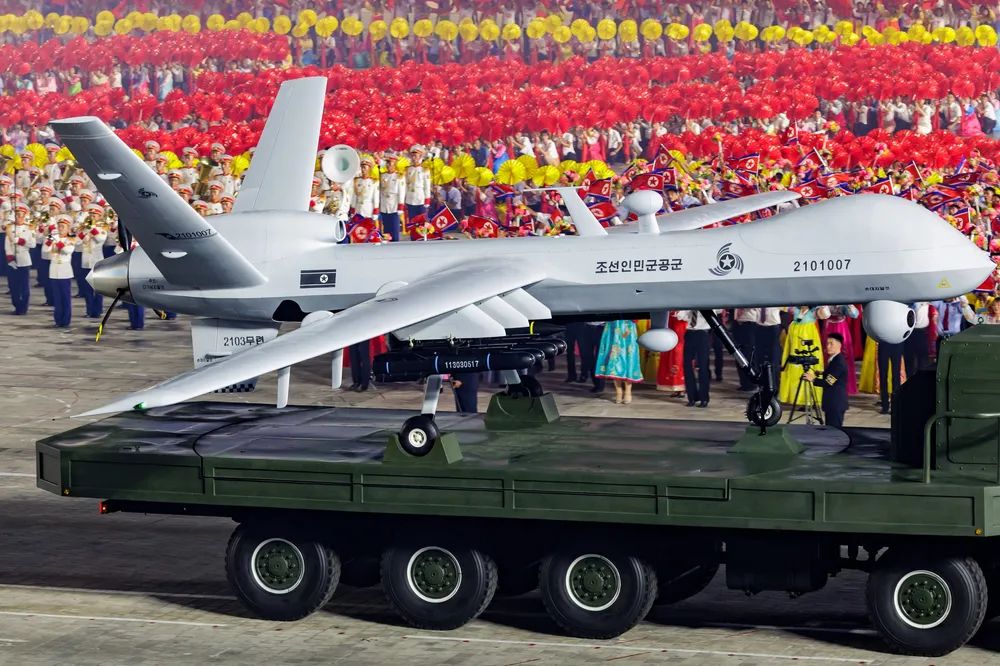
The Saetbyol-9 was publicly presented on 27 July 2023 during the Weaponry Exhibition 2023 and military events in Pyongyang. It appeared alongside the larger Saetbyol-4 reconnaissance UAV. The Saetbyol-9's general arrangement closely resembles the MQ-9 family, but the North Korean aircraft is assessed to be shorter, at approximately 9 m in length compared with about 11 m for the MQ-9A.
Available assessments through 2024 treated the large Saetbyol-class aircraft as prototype or pre-production systems undergoing research, testing, development, and engineering work rather than as fully established operational aircraft. The designs were expected to continue changing as testing progressed.
Production and test infrastructure
Large North Korean UAV production and flight testing are concentrated around the 6 January Factory and Panghyon Airbase. The 6 January Factory is believed to manufacture Saetbyol-4-class, Saetbyol-9-class, and other large UAVs. Aircraft produced there are transported to facilities at Panghyon Airbase for reassembly and flight testing.
Construction of seven additional UAV hangars with approximately 40 m wide openings began at the Panghyon support area in 2024. The hangars were completed by March 2025 and were designed to accommodate aircraft in the Saetbyol-4 and Saetbyol-9 size classes. The infrastructure expansion indicated preparations for continued production and the establishment of a small experimental or test unit, although no reliable production totals were available.
In November 2025, the Korean People's Air Force displayed two armed Saetbyol-9 aircraft during events marking the service's 80th anniversary. The two aircraft showed visible configuration differences. One had broader wings and only a ventral communications antenna, while the other carried both ventral and dorsal antennas.
By February 2026, a Saetbyol-9 was visible at the Panghyon production complex. Later imagery released in 2026 showed North Korean facilities assembling several types of military UAVs, including the Saetbyol-9. These developments demonstrated an effort to move beyond isolated prototypes toward repeat manufacturing, but the intended production scale remained undisclosed.
Design
Airframe
The Saetbyol-9 is a propeller-driven unmanned aircraft with long, straight wings, a slender fuselage, and multiple underwing weapon stations. Its external arrangement resembles the U.S. MQ-9 family, but the aircraft differs in dimensions and details and should not be regarded as an identical clone.
The aircraft's length has been assessed at approximately 9 m. Reliable figures for wingspan, maximum takeoff weight, engine power, speed, altitude, endurance, and range have not been disclosed.
Sensors and communications
The Saetbyol-9 is intended to support reconnaissance as well as attack missions. However, the capabilities of its sensors, communications equipment, targeting systems, and data links have not been publicly established. Available assessments indicate that the aircraft is unlikely to carry equipment equivalent to the most advanced targeting and communications systems fitted to the MQ-9A.
Aircraft displayed in November 2025 showed differences in antenna arrangements. One example had only a ventral communications antenna, while another carried both dorsal and ventral antennas, indicating that multiple equipment configurations were being tested or fielded.
Armament
The Saetbyol-9 has multiple weapon stations beneath its wings. Two aircraft displayed in November 2025 each carried eight North Korean guided missiles resembling the AGM-114 Hellfire and two glide munitions. The glide munitions were assessed to be in the 50–100 kg class. This load represents the displayed configuration and does not establish the full range of weapons that the aircraft may eventually be able to employ.
Program status
The Saetbyol-9 progressed from an aircraft observed at Panghyon in 2022 to public demonstrations, flight testing, armed displays, and production-related activity over the following four years. By 2025, the Korean People's Air Force was publicly displaying armed examples, while facilities associated with the type were being expanded to support additional aircraft.
Evidence from 2026 indicates that North Korea was establishing manufacturing capacity for the Saetbyol-9 and other military UAVs. The exact number of completed aircraft, production rate, operational units, readiness level, and deployment pattern have not been disclosed.
Panghyon Airbase remains closely associated with Saetbyol-class testing and support because of its proximity to the manufacturing complex, maintenance facilities, specialized UAV hangars, and flight-test infrastructure.
Specifications (Saetbyol-9)
General characteristics
- Type: Armed unmanned aerial vehicle
- Role: Reconnaissance and strike
- Length: Approximately 9 m, assessed
- Propulsion: Propeller-driven
- Configuration: Long-wing unmanned aircraft with multiple underwing weapon stations
Armament
- Weapon stations: Multiple underwing stations
- Guided missiles: Eight North Korean missiles resembling the AGM-114 Hellfire were carried by each of two aircraft displayed in November 2025
- Glide munitions: Two carried by each aircraft in the November 2025 display; assessed mass class of approximately 50–100 kg each
 Argentina
 Armenia
 Australia
 Austria
 Austria-Hungary
 Belgium
 Brazil
 United Kingdom
 United States
 Brunei
 Bulgaria
 Canada
 Chile
Chile China
China Colonial America
 Colombia
 Confederate States
 Croatia
 Czech
Czech Denmark
 Egypt
Egypt Finland
 France
 Georgia
 Germany
 German Imperial
 Greece
 Holland
 Hungary
 India
India Indonesia
 Iran
Iran Iraq
Iraq Ireland
 Israel
 Italy
Italy Japan
Japan Japan (1940)
 Jordan
 Kingdom of Italy
 Malaysia
 Mexico
 Myanmar
 Nazi Germany
 Netherlands
 New Zealand
 Norway
 Pakistan
 Peru
Peru Philippines
 Poland
 Portugal
 Prussia
 Romania
 Russia
 Saudi Arabia
 Serbia
 Singapore
 Slovakia
 Slovenia
 South Africa
 South Korea
 Soviet Union
 Spain
Spain Sweden
 Switzerland
 Syria
Syria Taiwan
 Thailand
 Turkey
 UAE
UAE Ukraine
 Vietnam
 Yugoslavia