
History
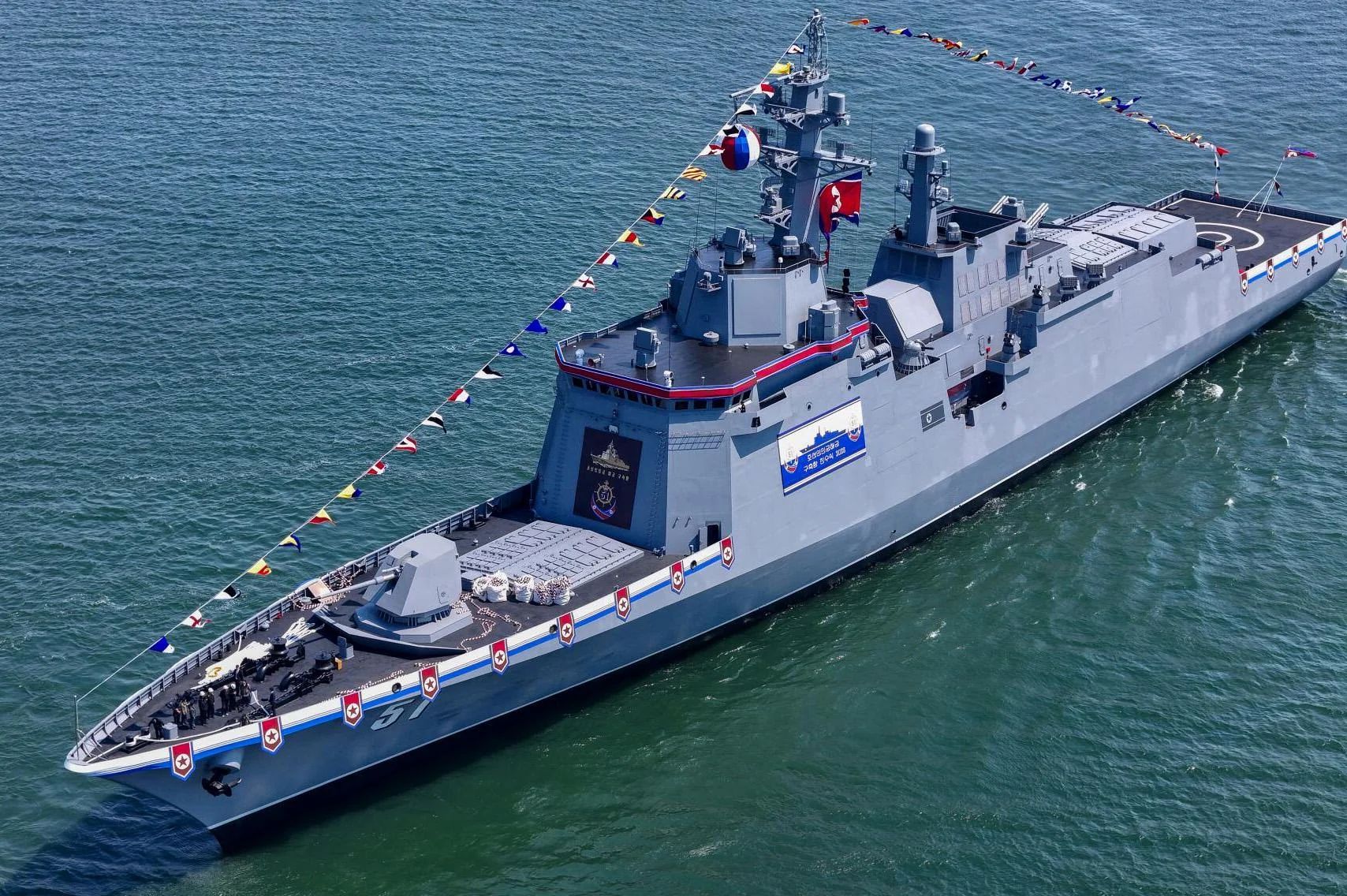
The Choe Hyon class is a North Korean class of approximately 5,000-tonne guided-missile destroyers developed for the Korean People's Army Navy. The ships represent a major increase in the size and missile capacity of North Korea's surface combatants and are intended for long-range naval combat, land attack, air defense, and other maritime missions.
The lead ship, Choe Hyon, was launched in April 2025 and commissioned in June 2026. The second ship, Kang Kon, entered service in September 2026. North Korea has also begun work on additional ships and has announced plans to continue construction of large surface combatants.
Kang Kon was formally assigned a role within North Korea's nuclear retaliation framework when it was commissioned. This declaration applies specifically to the second ship and does not by itself establish the detailed nuclear armament of every vessel in the class.
Development and construction
Construction activity associated with the new class was identified at North Korea's Nampo Shipyard in 2024. The lead ship, Choe Hyon, was built at Nampo and launched on 25 April 2025. It was the largest warship built by North Korea at that time. Satellite analysis and subsequent reporting described the class as a new generation of guided-missile destroyers intended to support a broader expansion of North Korean naval capabilities. Further analysis of the program has been published by CSIS Beyond Parallel.
The second ship, Kang Kon, was constructed on North Korea's east coast. During an attempted launch at Chongjin on 21 May 2025, the vessel lost stability and tipped over, damaging the hull. North Korea recovered the ship, moved it for repair and inspection, and relaunched it at Najin on 12 June 2025. Satellite imagery reviewed by CSIS Beyond Parallel showed the vessel floating in a graving dock after the recovery effort.
North Korea subsequently announced construction of additional ships. Work on a third Choe Hyon-class destroyer began in 2025, with completion reported as planned for October 2026. By June 2026, reporting also indicated that a fourth ship was under construction and that North Korea intended to build two large surface combatants annually under its 2026-2030 naval construction program.
Testing and commissioning
Choe Hyon conducted weapon trials after its launch. Reported tests included strategic cruise missiles, anti-ship missiles, naval guns, and other shipboard systems. Additional evaluation launches were reported during 2026 before the vessel entered service.
Choe Hyon was commissioned on 23 June 2026 at Nampo and assigned to the West Sea Fleet of the Korean People's Army Navy. North Korean state reporting described the vessel as domestically built and armed with indigenous weapon systems. The commissioning and program status were also reported by USNI News.
Kang Kon began sea trials in June 2026. In July, North Korean media showed the ship conducting combat-system and acceptance testing with strategic cruise missiles, anti-aircraft weapons, naval guns, and other guided munitions. One image appeared to show a Hwasal-2 land-attack cruise missile being cold-launched from an amidships vertical launch system cell.
Kang Kon was commissioned on 6 September 2026 at Wonsan and assigned to the East Sea Fleet. During the ceremony, North Korean leadership described the ship as part of the state's nuclear retaliation architecture and associated it with retaliatory strike missions as well as the defense of maritime sovereignty.
Design
The Choe Hyon class uses a large conventional surface-combatant layout with a forward gun, multiple vertical missile launch areas, a superstructure designed to carry modern sensors, close-in defensive weapons, and an aviation area at the stern. The hull and superstructure use angled surfaces that reduce the number of large vertical faces, although the supplied sources do not establish a measured radar-cross-section reduction.
Published dimensions are not fully consistent. Open-source references give a length of approximately 142 to 145 m, while a beam of about 16 m is reported in detailed secondary reference data. Displacement is much more consistently reported at approximately 5,000 tonnes.
Sensors and combat systems
The ships carry multiple radar and fire-control systems as well as electronic warfare equipment and decoy launchers. One detailed open-source reference identifies a phased-array search radar, three fire-control radars, two navigation radars, identification friend-or-foe equipment, and hull-mounted sonar. These detailed sensor identifications are not independently confirmed by the other supplied sources.
Armament
The class is centered on a substantial missile armament. Open-source technical reporting describes 74 vertical launch cells of several sizes, positioned in groups forward and amidships. Independent imagery and later weapons trials confirm the presence of vertical launch systems, although the exact load carried in each cell has not been publicly established.
Demonstrated or reported weapons include strategic land-attack cruise missiles, anti-ship missiles, anti-aircraft weapons, a large-caliber main gun, automatic close-in guns, and other guided munitions. Kang Kon was shown apparently cold-launching a Hwasal-2 cruise missile from an amidships VLS cell during 2026 testing. Secondary reference material also attributes two twin 533 mm torpedo launchers to the class.
A detailed secondary technical source identifies the main gun as a 127 mm weapon and describes two 30 mm AK-630 close-in mounts together with a Pantsir-ME-type close-in weapon system. These exact identifications should be treated cautiously because they are not confirmed in the other supplied independent reporting.
Aviation facilities
The stern incorporates a flight deck and an associated hangar area. Open-source descriptions state that the facilities can support a naval helicopter or an unmanned aerial vehicle for surveillance and other shipborne tasks.
Operational history
By September 2026, two Choe Hyon-class destroyers had been commissioned. Choe Hyon serves with the West Sea Fleet, while Kang Kon serves with the East Sea Fleet. Their introduction gives the Korean People's Army Navy substantially larger missile-armed surface combatants than its earlier principal warships.
North Korea has used the class for repeated weapons and combat-system trials. These have included strategic cruise-missile launches, anti-ship missile tests, gun firing, air-defense activity, and electronic warfare evaluation. The operational maturity of individual systems remains difficult to determine from the supplied public reporting.
The commissioning of Kang Kon added an explicit strategic role. North Korean state media stated that the ship forms part of the country's nuclear retaliation framework. The supplied sources do not establish the exact nuclear warhead, missile configuration, or deployment arrangements associated with this mission.
Ships of the class
- Choe Hyon (51) - Lead ship. Built at Nampo Shipyard, launched on 25 April 2025, commissioned on 23 June 2026, and assigned to the West Sea Fleet.
- Kang Kon (52) - Second ship. Its first launch attempt failed on 21 May 2025. It was recovered and relaunched on 12 June 2025, began sea trials in June 2026, and was commissioned on 6 September 2026 for service with the East Sea Fleet.
- Third ship - Construction began in 2025, with completion officially planned for October 2026. A name is not established in the supplied sources.
- Fourth ship - Reported under construction in 2026. A name and completion date are not established in the supplied sources.
Operators
- North Korea - Korean People's Army Navy. Two ships, Choe Hyon and Kang Kon, were commissioned by September 2026, while additional ships were under construction.
Specifications (Choe Hyon-class destroyer)
General characteristics
- Type: Guided-missile destroyer
- Displacement: Approximately 5,000 tonnes
- Length: Approximately 142-145 m in supplied open-source references
- Beam: Approximately 16 m in detailed secondary reference data
- Complement: More than 300 personnel in detailed secondary reference data
- Aviation facilities: Stern flight deck and hangar area for a helicopter or unmanned aerial vehicle
Performance
- Maximum speed: Reported as approximately 30 knots
- Range: Reported as approximately 5,500 nautical miles
Armament
- Main gun: One 127 mm turreted gun in detailed secondary reference reporting
- Vertical launch system: Reported 74 cells of several sizes; the exact missile allocation is not publicly established
- Missiles: Strategic cruise missiles, anti-ship missiles, anti-aircraft weapons, and other guided munitions demonstrated or reported
- Close-in weapons: Two 30 mm AK-630 mounts and a reported Pantsir-ME-type system in secondary technical reporting
- Torpedoes: Two twin 533 mm torpedo launchers in secondary technical reporting
 Argentina
 Armenia
 Australia
 Austria
 Austria-Hungary
 Belgium
 Brazil
 United Kingdom
 United States
 Brunei
 Bulgaria
 Canada
 Chile
Chile China
China Colonial America
 Colombia
 Confederate States
 Croatia
 Czech
Czech Denmark
 Egypt
Egypt Finland
 France
 Georgia
 Germany
 German Imperial
 Greece
 Holland
 Hungary
 India
India Indonesia
 Iran
Iran Iraq
Iraq Ireland
 Israel
 Italy
Italy Japan
Japan Japan (1940)
 Jordan
 Kingdom of Italy
 Malaysia
 Mexico
 Myanmar
 Nazi Germany
 Netherlands
 New Zealand
 Norway
 Pakistan
 Peru
Peru Philippines
 Poland
 Portugal
 Prussia
 Romania
 Russia
 Saudi Arabia
 Serbia
 Singapore
 Slovakia
 Slovenia
 South Africa
 South Korea
 Soviet Union
 Spain
Spain Sweden
 Switzerland
 Syria
Syria Taiwan
 Thailand
 Turkey
 UAE
UAE Ukraine
 Vietnam
 Yugoslavia