
History
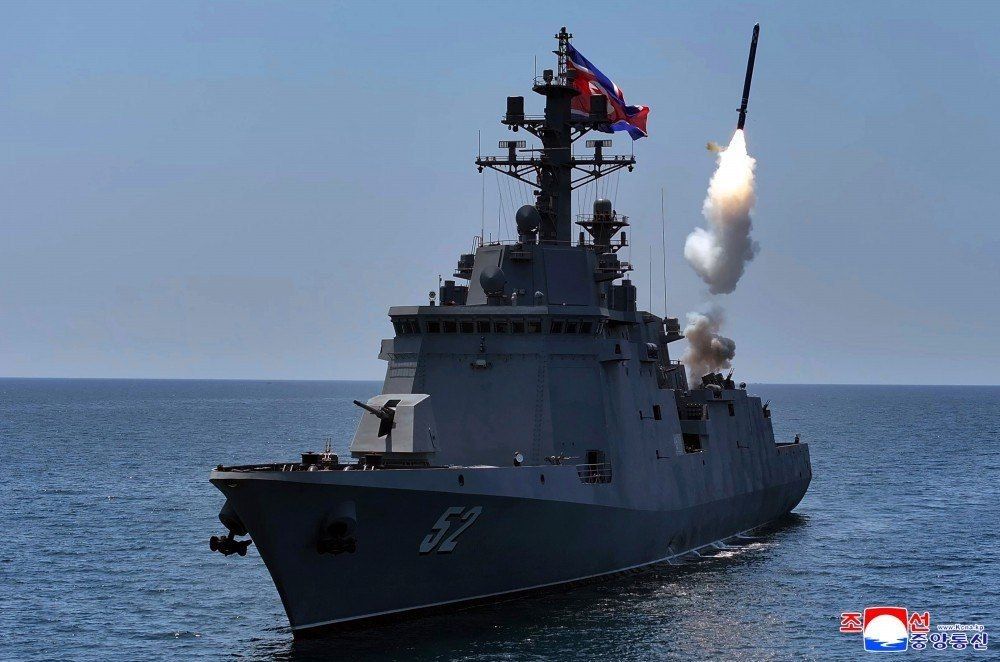
Kang Kon is the second Choe Hyon-class guided-missile destroyer operated by the Korean People's Navy. The approximately 5,000-ton warship is part of North Korea's effort to move beyond a fleet historically centered on smaller coastal combatants and to field larger surface ships with modern missile and sensor systems.
The ship is identified by hull number 52 and follows the lead ship Choe Hyon, hull number 51. The class combines extensive vertical launch systems with fixed-face phased-array radar panels and multiple close-range defensive weapons. Publicly available imagery and analysis indicate a multirole configuration intended for anti-air, anti-ship, land-attack and anti-submarine missions, although several weapon details remain estimates rather than independently confirmed specifications.
Kang Kon entered commissioned service at Wonsan on September 6, 2026. Its commissioning followed a difficult construction and testing period that included a failed launch attempt, salvage work, renewed launching, navigation trials and weapons testing.
Construction and launch
Open-source analysis indicates that construction of the second Choe Hyon-class ship may have begun at the Hambuk Shipyard in Chongjin in May 2024. Satellite imagery examined by the Beyond Parallel project documented construction activity, the subsequent failed launch and salvage operations involving the second destroyer.
On May 21, 2025, an attempted launch at Chongjin went wrong when the stern entered the water prematurely while the bow remained on the shipway. The accident damaged the vessel and was publicly acknowledged by North Korean state media. CNN reported that the ship capsized during the failed launch process, while later reporting indicated that the damage was less extensive than initially feared.
Following salvage and repair work, the vessel was relaunched on June 12, 2025. USNI News identifies June 12 as the relaunch date after the May 21 accident. The ship was named Kang Kon and assigned hull number 52. A compiled account in the Kang Kon reference article likewise records the June 12 launching and identifies the vessel as the second ship of the class.
Trials and commissioning
By March 2026, Kang Kon was reported to have remained berthed for an extended period. North Korean state media later reported a navigation test on June 4, 2026. On July 5, Kim Jong Un observed testing involving a reportedly nuclear-capable cruise missile and other weapons associated with the ship, and ordered the trials to be completed so that the destroyer could enter active service within two months. Kang Kon was reported back at Rason Port on July 16.
The lead ship Choe Hyon had been commissioned on June 23, 2026. Approximately two and a half months later, Kang Kon was formally commissioned at Wonsan on September 6, 2026. Naval News reported that the ceremony was attended by Kim Jong Un and senior government and military officials. The commissioning made Kang Kon the second operational member of the Choe Hyon class.
Design
Kang Kon is a large guided-missile surface combatant with an estimated displacement of approximately 5,000 tonnes. Published assessments place the Choe Hyon-class hull at about 145 m in length. Satellite-image analysis has also produced an estimated beam of about 16 m. These dimensions make the class substantially larger than the frigates and corvettes that previously formed the principal large surface combatants of the Korean People's Navy.
Sensors and electronic systems
The ship has four fixed-face phased-array radar panels positioned around the upper superstructure. Additional sensors and communications equipment are carried on the mast. Naval News also reports a comprehensive electronic-warfare suite. The fixed radar arrangement is a significant departure from the simpler sensor fits associated with earlier North Korean surface combatants.
Armament
Kang Kon carries a bow-mounted naval gun assessed at approximately 127 mm and several groups of vertical launch cells positioned forward and aft. The exact number and arrangement of VLS cells remain uncertain because published open-source assessments disagree. Analysis summarized in the Kang Kon reference article identifies 74 cells of several sizes, while Naval News reports 88 vertical launch cells divided among five configurations. The discrepancy reflects interpretation of photographs and publicly released imagery rather than a confirmed official weapons inventory.
The larger vertical launch cells are assessed as suitable for cruise missiles and ballistic missiles. North Korean statements have described the class as having anti-aircraft, anti-ship, anti-submarine and anti-ballistic missile capabilities. Reports also state that some cruise and ballistic missiles associated with the ship may be capable of carrying nuclear warheads. These nuclear-capability statements are North Korean claims and reporting based on the weapons displayed or tested with the class, rather than independently verified details of Kang Kon's deployed missile load.
Additional reported weapons include inclined missile launchers concealed within the central superstructure, a short-range missile and gun system resembling the Russian Pantsir-M family, and two close-in rotary cannon systems. Naval News also reports twin 533 mm torpedo launchers, several countermeasure launchers and multiple remotely operated heavy machine-gun positions. Because much of the detailed configuration has been derived from imagery, individual component identification should be treated as an assessment.
Aviation facilities
The stern incorporates a helicopter flight deck. Available sources confirm the deck but do not establish a permanently embarked helicopter type or aviation detachment for Kang Kon.
Operational history
Kang Kon was formally commissioned into the Korean People's Navy on September 6, 2026. The supplied reporting confirms its entry into service but does not document subsequent deployments or combat operations. Its commissioning followed navigation and weapons trials conducted earlier in 2026.
Specifications (Kang Kon)
General characteristics
- Type: Guided-missile destroyer
- Class: Choe Hyon class
- Hull number: 52
- Displacement: Approximately 5,000 tonnes
- Length: Approximately 145 m
- Beam: Approximately 16 m, based on satellite-image analysis
- Aviation facilities: Stern helicopter flight deck
Sensors
- Primary radar arrangement: Four fixed-face phased-array radar panels
- Electronic warfare: Reported electronic-warfare suite
Armament
- Main gun: One bow-mounted naval gun assessed at approximately 127 mm
- Vertical launch system: Multiple groups of cells of different sizes; published estimates differ between 74 and 88 total cells
- Close-in defense: Missile-and-gun close-in weapon system and additional rotary cannon systems reported from imagery
- Torpedoes: Two twin 533 mm launchers reported by Naval News
- Countermeasures: Multiple decoy and countermeasure launchers reported
Related equipment
- Choe Hyon: Lead ship of the Choe Hyon class, hull number 51, commissioned on June 23, 2026.
 Argentina
 Armenia
 Australia
 Austria
 Austria-Hungary
 Belgium
 Brazil
 United Kingdom
 United States
 Brunei
 Bulgaria
 Canada
 Chile
Chile China
China Colonial America
 Colombia
 Confederate States
 Croatia
 Czech
Czech Denmark
 Egypt
Egypt Finland
 France
 Georgia
 Germany
 German Imperial
 Greece
 Holland
 Hungary
 India
India Indonesia
 Iran
Iran Iraq
Iraq Ireland
 Israel
 Italy
Italy Japan
Japan Japan (1940)
 Jordan
 Kingdom of Italy
 Malaysia
 Mexico
 Myanmar
 Nazi Germany
 Netherlands
 New Zealand
 Norway
 Pakistan
 Peru
Peru Philippines
 Poland
 Portugal
 Prussia
 Romania
 Russia
 Saudi Arabia
 Serbia
 Singapore
 Slovakia
 Slovenia
 South Africa
 South Korea
 Soviet Union
 Spain
Spain Sweden
 Switzerland
 Syria
Syria Taiwan
 Thailand
 Turkey
 UAE
UAE Ukraine
 Vietnam
 Yugoslavia