

History
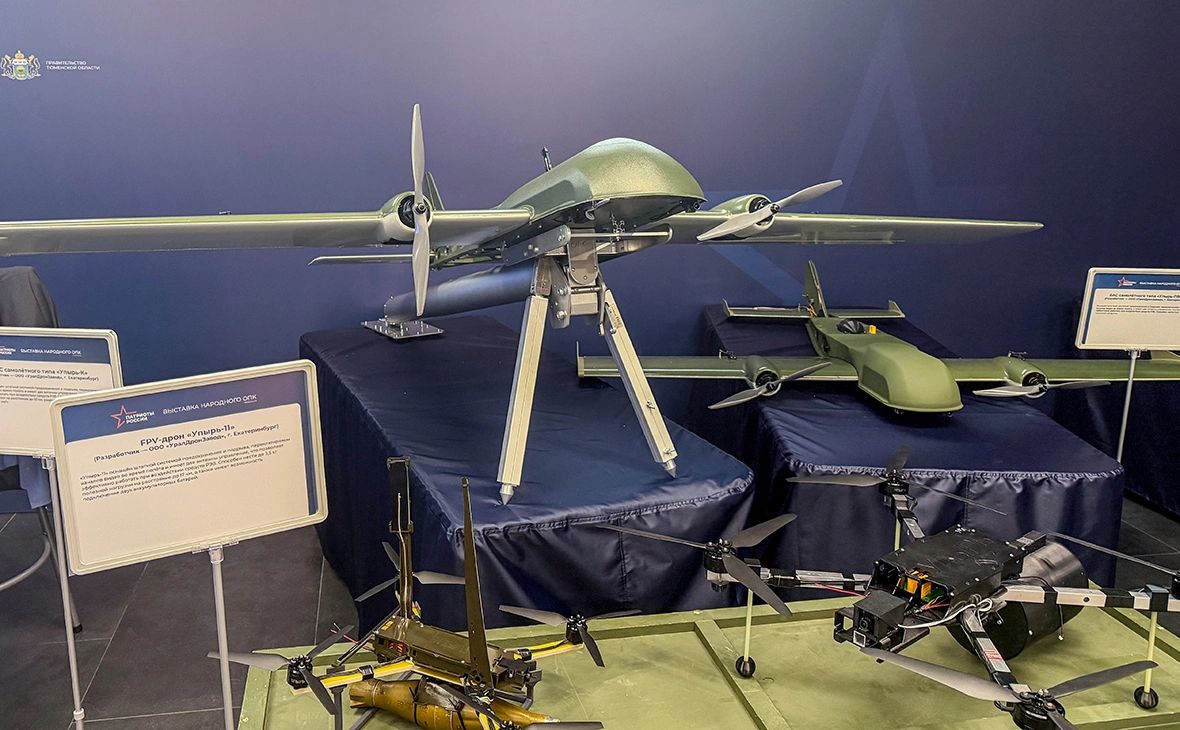
The Uraldronzavod Upyr-K is a Russian fixed-wing strike unmanned aerial vehicle developed as part of the Upyr family of attack drones. It uses a twin-engine configuration and an open wooden airframe, and it is intended to carry substantially heavier warheads than the earlier Upyr FPV quadcopter.
The Upyr-K was developed by Uraldronzavod in Sverdlovsk Region. Its stated combat payload is up to 12 kg, while published range claims vary from about 50 to 80 km from the launch point.
The aircraft was observed in the Russia-Ukraine war during 2026. Ukrainian personnel had encountered drones of this type before their designation became publicly known, and an Upyr-K was later intercepted by the Ukrainian 59th Yakiv Handziuk Assault Brigade.
Development and public presentation
The Upyr-K emerged from the wider Upyr drone program established by Uraldronzavod. Unlike the original Upyr, which is a small multirotor FPV attack drone, the Upyr-K is an aircraft-type fixed-wing design intended to combine greater range with a much larger payload.
Evidence from June 2026 shows the type operating before its designation was widely identified. In August 2026, Uraldronzavod publicly presented the Upyr-K at an exhibition in Tyumen. The company stated that the aircraft could operate at approximately 50 km from its launch point and carry up to 12 kg of combat load. Another company statement cited a maximum range of up to 80 km, so the available range figures are not fully consistent. The manufacturer stated that a 50 km operating distance had been demonstrated in practice.
Design
The Upyr-K is a twin-engine fixed-wing one-way attack UAV. Its structure is openly framed rather than enclosed by a conventional aerodynamic fuselage, and wooden elements are used in the airframe. This construction distinguishes it visually from the smaller multirotor Upyr FPV drone.
The aircraft carries a video system for operator observation and terminal attack. As observed in June 2026, its video transmission operated at approximately 2.0-2.1 GHz. Available information does not establish its exact dimensions, flight speed, propulsion specifications, or complete guidance architecture.
Warhead
The Upyr-K can carry a combat payload of up to 12 kg. A TM-62 anti-tank mine is among the documented payload options. The munition is intended to detonate on impact through a contact or modified fuze. The heavier payload gives the Upyr-K greater carrying capacity than the Russian Molniya-2 strike UAV.
Operational history
Russian forces used aircraft of this type on the Ukrainian front before the Upyr-K designation became widely known. In June 2026, an aircraft identified as an Upyr-K was recorded by a Ukrainian interceptor drone.
On 17 September 2026, personnel of the Ukrainian 59th Yakiv Handziuk Assault Brigade's unmanned-systems element intercepted an Upyr-K using another drone. The engagement provided additional confirmation that the fixed-wing type was being used operationally during the Russia-Ukraine war.
Specifications (Upyr-K)
General characteristics
- Type: Fixed-wing one-way strike unmanned aerial vehicle
- Configuration: Twin-engine, open-frame aircraft
- Structure: Wooden structural elements
- Combat payload: Up to 12 kg
Performance
- Operating range: About 50 km demonstrated according to the manufacturer; other manufacturer statements cite up to 80 km
Guidance and communications
- Video transmission frequency: Approximately 2.0-2.1 GHz, as observed in June 2026
Armament
- Warhead capacity: Up to 12 kg
- Documented payload: TM-62 anti-tank mine
- Fuzing: Contact or modified impact fuze
Related equipment
The Upyr-K belongs to the broader Upyr family but differs substantially from the original Upyr FPV quadcopter. It has also been described as an alternative to the Molniya-2 fixed-wing strike UAV, offering a higher payload capacity.
 Argentina
 Armenia
 Australia
 Austria
 Austria-Hungary
 Belgium
 Brazil
 United Kingdom
 United States
 Brunei
 Bulgaria
 Canada
 Chile
Chile China
China Colonial America
 Colombia
 Confederate States
 Croatia
 Czech
Czech Denmark
 Egypt
Egypt Finland
 France
 Georgia
 Germany
 German Imperial
 Greece
 Holland
 Hungary
 India
India Indonesia
 Iran
Iran Iraq
Iraq Ireland
 Israel
 Italy
Italy Japan
Japan Japan (1940)
 Jordan
 Kingdom of Italy
 Malaysia
 Mexico
 Myanmar
 Nazi Germany
 Netherlands
 New Zealand
 North Korea
 Norway
 Pakistan
 Peru
Peru Philippines
 Poland
 Portugal
 Prussia
 Romania
 Saudi Arabia
 Serbia
 Singapore
 Slovakia
 Slovenia
 South Africa
 South Korea
 Soviet Union
 Spain
Spain Sweden
 Switzerland
 Syria
Syria Taiwan
 Thailand
 Turkey
 UAE
UAE Ukraine
 Vietnam
 Yugoslavia