
History
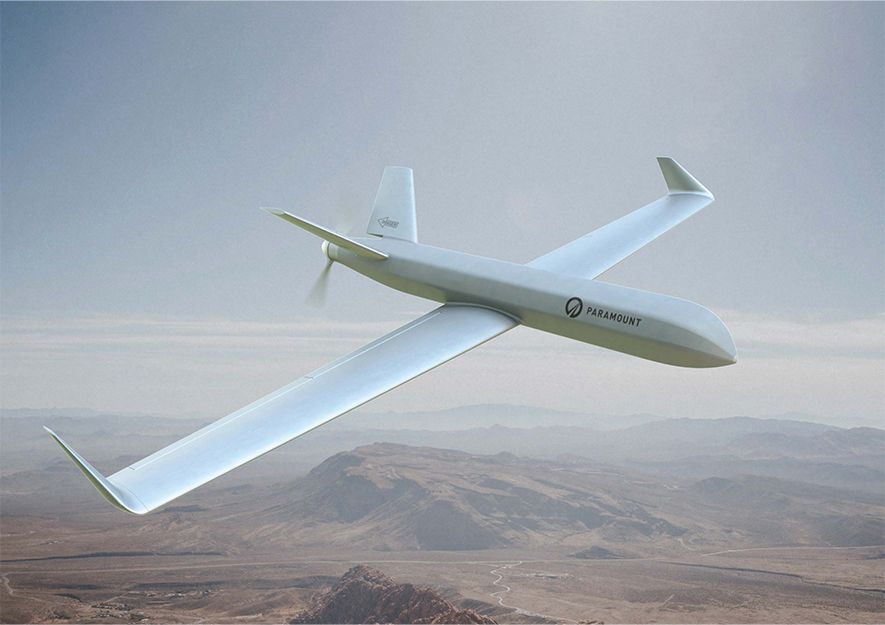
The Paramount V-Raven is a vertical take-off and landing unmanned aerial vehicle developed in South Africa for intelligence, surveillance and reconnaissance missions, with a light-attack configuration also planned. Paramount publicly launched the aircraft at the AAD 2026 defence exhibition in September 2026.
The V-Raven evolved from the earlier N-Raven programme. Development moved away from the original catapult-launched concept toward a recoverable VTOL aircraft family intended to operate from dispersed locations without runways, catapults or fixed launch infrastructure.
The aircraft is offered with petrol or electric propulsion. The petrol-powered configuration emphasizes endurance and range, while the electric configuration provides shorter-duration operation using the same basic VTOL concept.
Development
The V-Raven was revealed during AAD 2026 at Air Force Base Waterkloof, where Paramount presented it as a system intended for operations across large areas, remote terrain and dispersed operating locations. The change from the N-Raven programme also reflected a shift toward a reusable VTOL platform rather than a system dependent on catapult launch infrastructure.
The ISR configuration was presented with an electro-optical/infrared sensor. A separate light-attack configuration is planned to integrate unspecified precision-guided glide munitions. The available information does not identify the weapons or state that the armed configuration has entered service.
Design
Airframe and VTOL operation
The V-Raven has a wingspan of 3.6 m and a fuselage length of 2.1 m. Maximum take-off weight is 65 kg. Its VTOL arrangement allows deployment and recovery without a conventional runway, launch catapult or fixed recovery infrastructure.
This configuration is intended to permit operations from dispersed and difficult locations. The source material does not specify the exact lift-propulsion arrangement or provide details of the airframe materials, landing system or flight-control architecture.
Sensors and mission equipment
The ISR version carries an electro-optical/infrared sensor for surveillance and reconnaissance. The planned light-attack version is intended to carry precision-guided glide munitions, although the type, number and weight of these weapons have not been disclosed.
Propulsion and endurance
The petrol-powered V-Raven has a stated endurance of up to eight hours, a range of up to 1,200 km and a cruise speed of approximately 140 km/h. Its stated communications range with the ground station is up to 150 km.
An electric configuration is also available. It has a stated endurance of up to two hours and a range of up to 250 km.
Program status
The V-Raven was publicly launched in September 2026. The ISR configuration had been presented with its EO/IR mission system, while the light-attack configuration remained planned. The available information does not identify operational users, production quantities or an entry-into-service date.
Variants
- V-Raven ISR: VTOL intelligence, surveillance and reconnaissance configuration equipped with an electro-optical/infrared sensor.
- V-Raven light-attack configuration: Planned armed version intended to integrate unspecified precision-guided glide munitions.
- Petrol-powered V-Raven: Configuration with stated endurance of up to eight hours and range of up to 1,200 km.
- Electric V-Raven: Configuration with stated endurance of up to two hours and range of up to 250 km.
Specifications (V-Raven)
General characteristics
- Length: 2.1 m
- Wingspan: 3.6 m
- Maximum take-off weight: 65 kg
- Take-off and landing: Vertical take-off and landing
Performance — petrol-powered configuration
- Cruise speed: approximately 140 km/h
- Endurance: up to 8 hours
- Range: up to 1,200 km
- Ground-station communications range: up to 150 km
Performance — electric configuration
- Endurance: up to 2 hours
- Range: up to 250 km
Mission equipment
- ISR sensor: electro-optical/infrared system
- Planned armament: unspecified precision-guided glide munitions for the proposed light-attack configuration
 Argentina
 Armenia
 Australia
 Austria
 Austria-Hungary
 Belgium
 Brazil
 United Kingdom
 United States
 Brunei
 Bulgaria
 Canada
 Chile
Chile China
China Colonial America
 Colombia
 Confederate States
 Croatia
 Czech
Czech Denmark
 Egypt
Egypt Finland
 France
 Georgia
 Germany
 German Imperial
 Greece
 Holland
 Hungary
 India
India Indonesia
 Iran
Iran Iraq
Iraq Ireland
 Israel
 Italy
Italy Japan
Japan Japan (1940)
 Jordan
 Kingdom of Italy
 Malaysia
 Mexico
 Myanmar
 Nazi Germany
 Netherlands
 New Zealand
 North Korea
 Norway
 Pakistan
 Peru
Peru Philippines
 Poland
 Portugal
 Prussia
 Romania
 Russia
 Saudi Arabia
 Serbia
 Singapore
 Slovakia
 Slovenia
 South Korea
 Soviet Union
 Spain
Spain Sweden
 Switzerland
 Syria
Syria Taiwan
 Thailand
 Turkey
 UAE
UAE Ukraine
 Vietnam
 Yugoslavia