
History
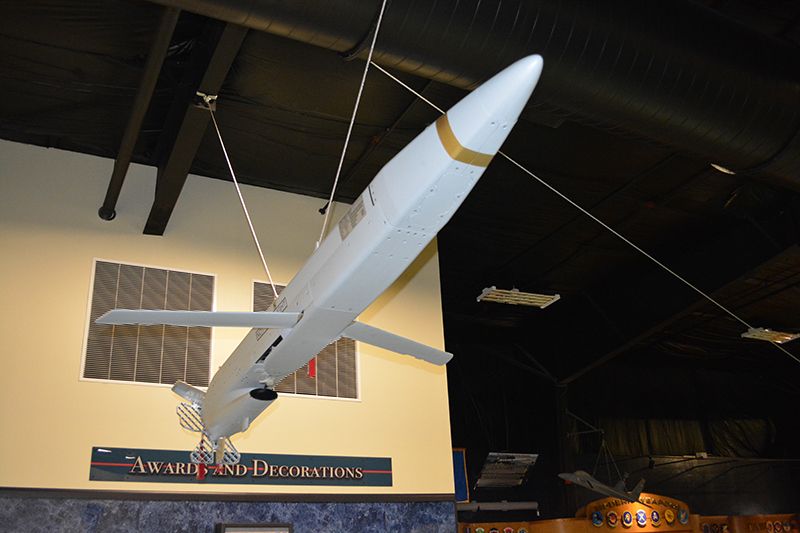
The ADM-160 Miniature Air-Launched Decoy, commonly known as MALD, is a United States family of expendable air-launched vehicles designed to confuse and distract integrated air-defense systems. The vehicle can imitate the radar signature and flight behavior of aircraft or standoff weapons, creating additional targets for hostile radar operators and surface-to-air missile units.
The program originated in a U.S. Defense Advanced Research Projects Agency effort begun in 1995. Teledyne Ryan developed the original ADM-160A, while Raytheon later produced the substantially redesigned ADM-160B and the ADM-160C MALD-J electronic-warfare variant.
MALD is intended to improve the survivability of crewed aircraft and other weapons by drawing defensive attention away from them. The MALD-J retains the decoy mission while adding active radar-jamming capability for operations inside an enemy air-defense threat area.
Development
DARPA initiated the Miniature Air-Launched Decoy Advanced Concept Technology Demonstration program in 1995. Teledyne Ryan received a development contract for the ADM-160A flight vehicle in November 1996. The first ADM-160A flight took place in January 1999, and its test and evaluation program was completed by 2001.
The ADM-160A used a Hamilton Sundstrand TJ-50 miniature turbojet, flip-out wings and GPS-aided navigation. Its mission was programmed before launch, and its signature augmentation equipment was intended to imitate aircraft with different radar signatures. U.S. Air Force plans for large-scale procurement were subsequently reduced, and the original development effort was effectively discontinued.
In late 2002, the U.S. Air Force opened a new competition for further MALD development. Raytheon received the system development and demonstration contract in May 2003, and the resulting vehicle received the ZADM-160B designation during development. The ADM-160B used a different, larger airframe and a more powerful TJ-150 turbojet.
ADM-160B prototypes completed nine release flight tests from F-16 aircraft between May and July 2006. The first powered flight followed in June 2007. Production-representative vehicles were delivered in 2009, and ADM-160B decoys began reaching U.S. Air Force units in significant numbers during 2010.
Raytheon began development of the ADM-160C MALD-J in 2009. The new version combined the decoy mission with active electronic attack against early-warning, acquisition and tracking radars. Initial MALD-J deliveries took place in 2012, and initial operational capability was declared in 2015. Additional production contracts followed, including a Lot 11 order for 250 vehicles in 2018.
An enhanced MALD-X configuration was demonstrated in 2018 with improved electronic-warfare payloads, enhanced data links and capabilities intended to support lower-altitude operation. MALD-X also formed the basis for a Navy-specific MALD-N development.
Design
Airframe and propulsion
The Raytheon ADM-160B is a compact turbojet-powered expendable vehicle carried externally by a launch aircraft. Its wings deploy after release. The ADM-160B is larger and heavier than the earlier ADM-160A and uses a Hamilton Sundstrand TJ-150 turbojet producing approximately 1.5 kN of thrust.
Guidance and decoy function
MALD follows a programmed autonomous route using GPS-aided inertial navigation. Its mission can be planned to reproduce the flight path and behavior of a more valuable aircraft or standoff weapon. The basic decoy does not use a conventional explosive warhead. Instead, it carries equipment intended to reproduce radar characteristics that cause hostile sensors and operators to treat the vehicle as a more important target.
By generating additional credible radar tracks, multiple MALDs can complicate an air-defense network's target identification and engagement process. Defensive radars may track the decoys, and surface-to-air missile units may expend interceptors against them rather than against crewed aircraft or strike weapons.
Electronic warfare
The ADM-160C MALD-J adds active electronic-attack equipment while retaining the basic decoy function. It is designed as an expendable stand-in jammer that can operate inside a threat area and interfere with early-warning, acquisition and tracking radars. MALD-J can operate independently or in coordination with other electronic-warfare assets.
Aircraft integration
Confirmed integration includes the U.S. Air Force B-52H, F-16C and A-10. Integration with the B-1B has also been planned. The wreckage of an individual MALD does not normally identify the aircraft from which it was launched.
Operational history
The first known combat use of the ADM-160 family occurred in May 2023, when MALD vehicles appeared in Ukrainian Air Force operations during the Russia-Ukraine war. They have subsequently been used as penetration aids and to stimulate Russian air-defense systems.
During Operation Midnight Hammer against Iranian nuclear facilities in June 2025, U.S. officials described a complex deception plan intended to obscure the direction and composition of the strike. The available evidence supports possible MALD participation in that deception architecture, but does not conclusively establish every vehicle or sortie involved.
MALD employment was also assessed as likely during the opening phase of Operation Epic Fury. U.S. Air Force A-10C aircraft returning from the theater were observed with mission markings representing MALDs among other weapons, providing further evidence of the system's use in operations connected with Iran.
In September 2026, photographs released from Iran showed wreckage identified as belonging to a Raytheon ADM-160. The identification was supported by the Raytheon CAGE code 15090 visible on components. The exact ADM-160 variant, location, launch platform and circumstances of the loss were not conclusively established. Iranian claims described the vehicle as intercepted, but the available wreckage could not determine whether it had been shot down, malfunctioned or completed its programmed flight and crashed after exhausting its fuel.
Beyond its direct decoy role, a MALD can be used to stimulate an air-defense network into transmitting and reacting. Radar emissions produced during such an engagement can reveal locations, frequencies, operating patterns and command relationships to supporting intelligence-gathering assets. This allows decoys to contribute indirectly to maintaining an electronic order of battle without placing an aircrew at the same level of risk.
Variants
- ADM-160A — Original Teledyne Ryan design developed under the DARPA program. It used a TJ-50 turbojet, GPS-aided navigation and signature augmentation equipment.
- MALI — Miniature Air-Launched Interceptor derivative developed from the early MALD concept for possible use against cruise missiles. It used a more powerful TJ-50M engine, imaging-infrared terminal guidance and command-link midcourse guidance. Development testing ended in December 2002 after a supersonic flight.
- ADM-160B — Raytheon redesign with a different airframe, greater size and weight, TJ-150 turbojet and increased range. Production-representative vehicles were delivered from 2009.
- DATM-160B — Inert training version used for load-crew training.
- ADM-160C MALD-J — Electronic-warfare derivative of the ADM-160B that combines radar-signature deception with active radar jamming.
- MALD-X — Enhanced development configuration demonstrated in 2018 with improved electronic-warfare payloads, enhanced data links and capabilities for lower-altitude operation.
- MALD-N — U.S. Navy-oriented development based on MALD-X.
Operators
- United States Air Force — Principal operator of the ADM-160B and ADM-160C MALD-J family.
- Ukrainian Air Force — ADM-160 vehicles have been used operationally with Ukrainian aircraft since 2023.
- United States Navy — Has pursued and acquired improved MALD developments derived from MALD-X, including the MALD-N program.
Specifications (ADM-160B)
General characteristics
- Length: approximately 2.85 m (9 ft 4 in)
- Wingspan: approximately 1.71 m (5 ft 7 in) with wings deployed
- Weight: approximately 110 kg (250 lb)
- Powerplant: Hamilton Sundstrand TJ-150 turbojet
- Thrust: approximately 1.5 kN (340 lbf)
- Guidance: GPS-aided inertial navigation
Performance
- Maximum speed: approximately Mach 0.91
- Service ceiling: more than 12,200 m (40,000 ft)
- Range: approximately 925 km (500 nmi; 575 mi), with publicly available figures varying slightly by mission description
- Endurance: approximately 90 minutes, including up to about 50 minutes of on-station loiter in published mission data
Payload
- Decoy equipment: radar-signature emulation equipment intended to imitate selected aircraft or standoff weapons
- Warhead: no conventional explosive warhead on the basic ADM-160B decoy
 Argentina
 Armenia
 Australia
 Austria
 Austria-Hungary
 Belgium
 Brazil
 United Kingdom
 Brunei
 Bulgaria
 Canada
 Chile
Chile China
China Colonial America
 Colombia
 Confederate States
 Croatia
 Czech
Czech Denmark
 Egypt
Egypt Finland
 France
 Georgia
 Germany
 German Imperial
 Greece
 Holland
 Hungary
 India
India Indonesia
 Iran
Iran Iraq
Iraq Ireland
 Israel
 Italy
Italy Japan
Japan Japan (1940)
 Jordan
 Kingdom of Italy
 Malaysia
 Mexico
 Myanmar
 Nazi Germany
 Netherlands
 New Zealand
 North Korea
 Norway
 Pakistan
 Peru
Peru Philippines
 Poland
 Portugal
 Prussia
 Romania
 Russia
 Saudi Arabia
 Serbia
 Singapore
 Slovakia
 Slovenia
 South Africa
 South Korea
 Soviet Union
 Spain
Spain Sweden
 Switzerland
 Syria
Syria Taiwan
 Thailand
 Turkey
 UAE
UAE Ukraine
 Vietnam
 Yugoslavia