
History
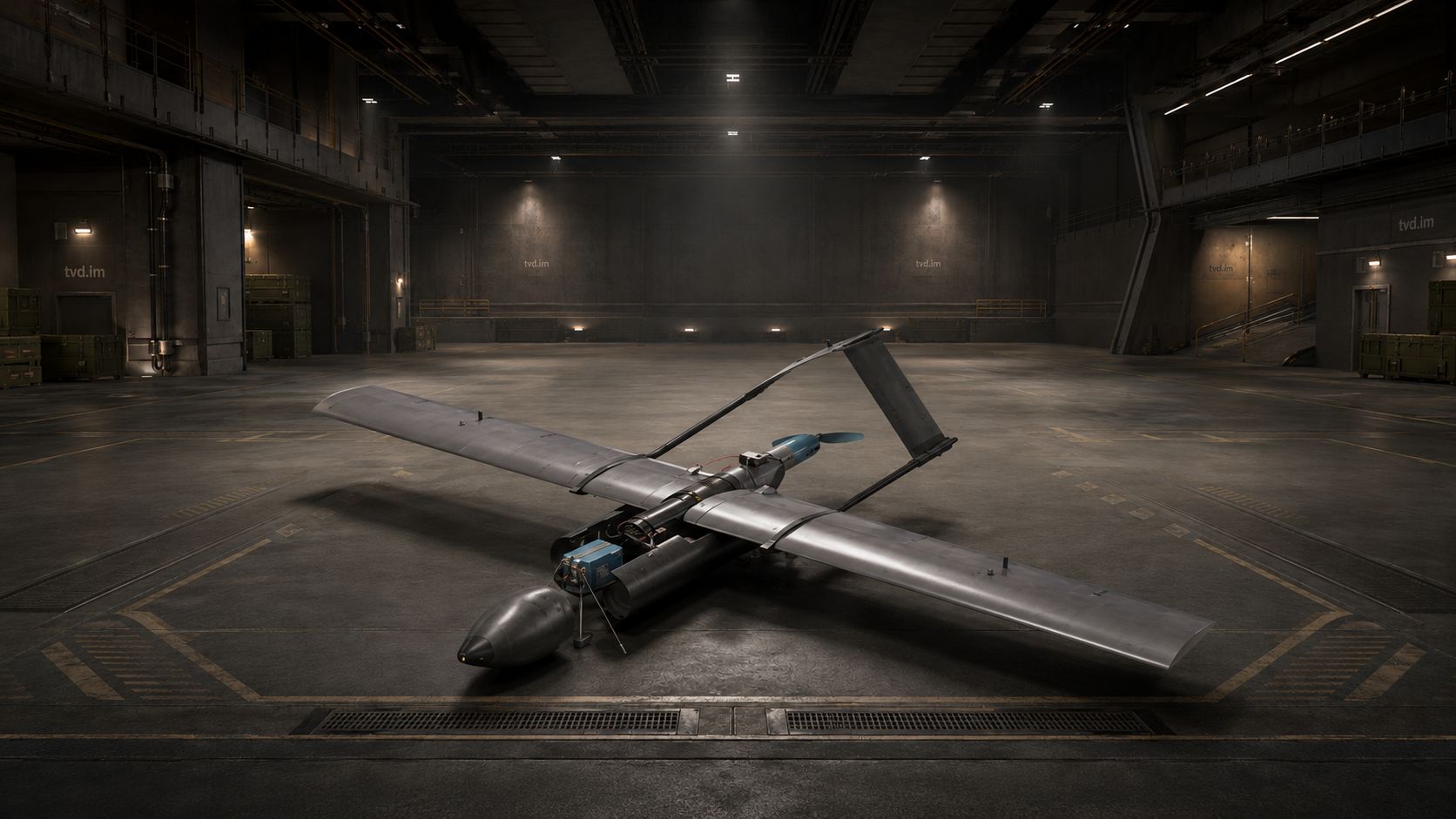
The OM Defence Systems SPECTR is an unmanned decoy aircraft designed to create a deliberately enlarged radar return. Its principal payload is an adjustable microwave retroreflector that can make the small aircraft resemble a substantially larger aerial target on radar.
SPECTR is intended to distract and exhaust hostile air-defense systems by presenting a radar signature resembling a genuine incoming threat. The aircraft combines autonomous navigation, electric propulsion, catapult launch, and a lightweight airframe with a 1.2 kg radar-reflector assembly.
The system was publicly displayed at the Eurosatory defense exhibition in June 2026. Reporting from the exhibition described a completed aircraft with published dimensions and performance data, establishing 2026 as the earliest supported physical milestone for the SPECTR configuration.
Development and public presentation
SPECTR was developed by OM Defence Systems as a purpose-built radar decoy. Militarnyi reported that the system was presented at Eurosatory in June 2026 and described it as an automated press-and-fly aircraft intended to deceive, distract, and deplete enemy air-defense resources.
Sources differ in their characterization of the developer's national identity. Defence Blog described OM Defence Systems as UK-based, while Ukrainian publications described the company as Ukrainian. The available subject metadata identifies the United Kingdom as the development country.
By August 2026, reporting stated that SPECTR had reached Technology Readiness Level 6, indicating that a prototype had been demonstrated in a relevant environment. The aircraft was also reported to be undergoing field trials with the Ukrainian military. These reports describe evaluation activity rather than confirmed operational service.
Design
Airframe and propulsion
SPECTR uses a lightweight polyvinyl chloride airframe and has a maximum takeoff weight of 12 kg. The aircraft is electrically powered and uses a pusher-propeller arrangement. It is launched from a catapult, allowing operation without a runway.
The reported dimensions are 1,400 mm in length, 2,690 mm in span, and 400 mm in height. The design is intended for relatively simple deployment from dispersed positions.
Radar-signature system
The defining component is a 1.2 kg adjustable microwave corner reflector operating across the 3–20 GHz frequency range. The reflector receives incident radar energy and returns a stronger signal toward the radar source. This increases the apparent radar cross-section of the aircraft.
Specifications presented at Eurosatory indicated that operators can vary the apparent radar cross-section from about 1 m² to more than 10 m². This allows SPECTR to imitate different classes of aerial target across several radar frequency bands. Other reporting summarized the effect as making the aircraft's radar signature appear roughly twenty times larger than its unenhanced signature.
The purpose of the enlarged return is to make hostile air-defense sensors treat the decoy as a more significant target. A defending force may track the aircraft, activate radars, or expend interceptor missiles against it. Radar activation can also reveal the location of emitting air-defense systems.
Navigation and control
SPECTR is described as an automated or autonomous aircraft. Navigation can use automatic, inertial, and GPS-based modes. Sources also describe the aircraft as resistant to electronic-warfare interference, although detailed resistance methods and performance figures have not been published in the available material.
Program status
By August 2026, SPECTR had reportedly reached Technology Readiness Level 6 and was undergoing field trials with the Ukrainian military. No source in the available material confirms series production, formal service entry, procurement quantities, or operational combat deployment.
OM Defence Systems has also presented SPECTR as a complementary system to its Kestrel hard-kill drone interceptor. In that concept, SPECTR performs the deception role while Kestrel provides a separate interception capability. The two aircraft remain distinct systems.
Specifications (SPECTR)
General characteristics
- Type: Unmanned radar-decoy aircraft
- Maximum takeoff weight: 12 kg
- Length: 1,400 mm
- Span: 2,690 mm
- Height: 400 mm
- Airframe material: Polyvinyl chloride
- Propulsion: Electric pusher motor
- Launch method: Catapult
- Navigation: Automatic, inertial, and GPS-based modes
Performance
- Range: Up to 500 km
- Endurance: Up to 240 minutes
- Maximum speed: More than 120 km/h
- Operating altitude: 500–5,000 m
- Maximum reported crosswind: 10 m/s
- Operating temperature: −20°C to +60°C
Radar-decoy equipment
- Reflector type: Adjustable microwave corner reflector
- Reflector mass: 1.2 kg
- Frequency range: 3–20 GHz
- Adjustable radar cross-section: Approximately 1 m² to more than 10 m²
 Argentina
 Armenia
 Australia
 Austria
 Austria-Hungary
 Belgium
 Brazil
 United States
 Brunei
 Bulgaria
 Canada
 Chile
Chile China
China Colonial America
 Colombia
 Confederate States
 Croatia
 Czech
Czech Denmark
 Egypt
Egypt Finland
 France
 Georgia
 Germany
 German Imperial
 Greece
 Holland
 Hungary
 India
India Indonesia
 Iran
Iran Iraq
Iraq Ireland
 Israel
 Italy
Italy Japan
Japan Japan (1940)
 Jordan
 Kingdom of Italy
 Malaysia
 Mexico
 Myanmar
 Nazi Germany
 Netherlands
 New Zealand
 North Korea
 Norway
 Pakistan
 Peru
Peru Philippines
 Poland
 Portugal
 Prussia
 Romania
 Russia
 Saudi Arabia
 Serbia
 Singapore
 Slovakia
 Slovenia
 South Africa
 South Korea
 Soviet Union
 Spain
Spain Sweden
 Switzerland
 Syria
Syria Taiwan
 Thailand
 Turkey
 UAE
UAE Ukraine
 Vietnam
 Yugoslavia