
History
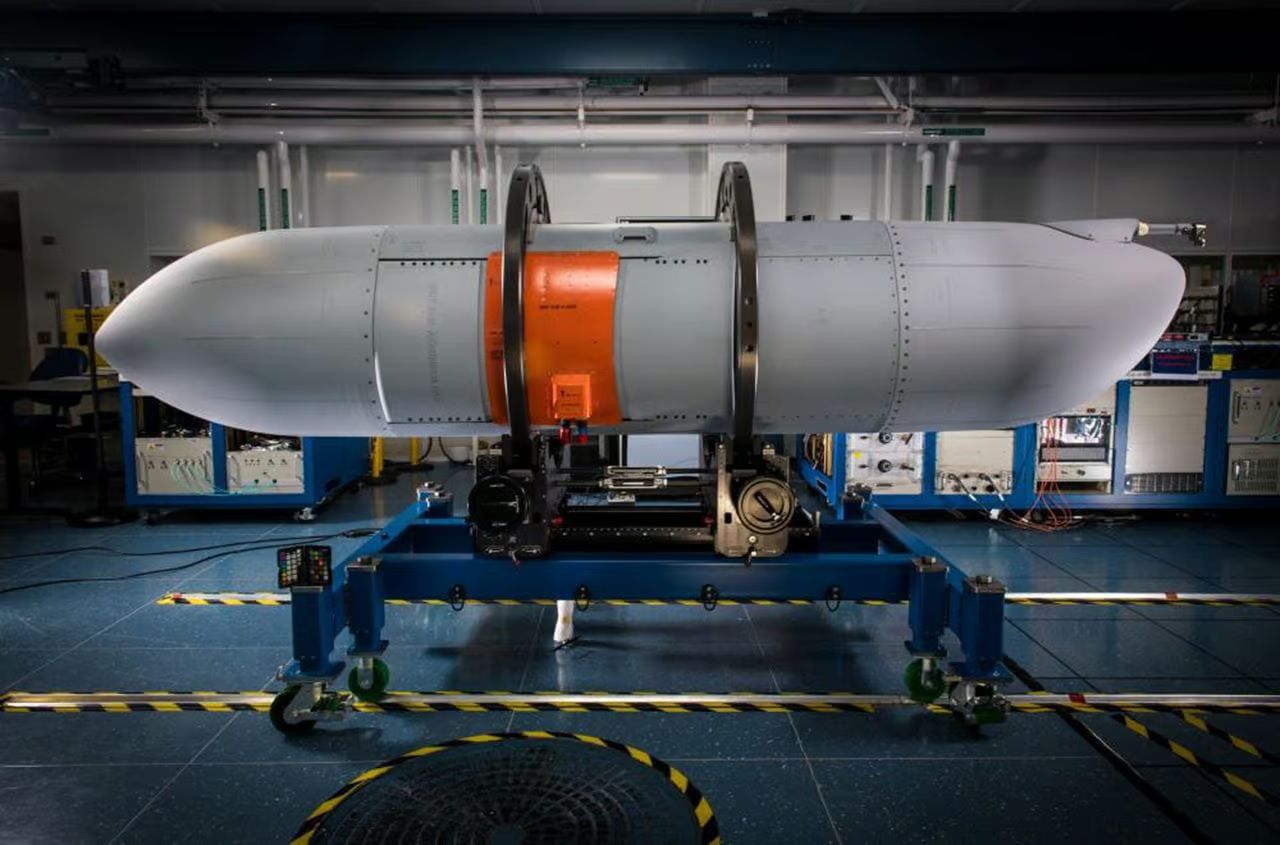
The Raytheon AN/ALQ-249(V)1 Next Generation Jammer Mid-Band, commonly called NGJ-MB, is an external airborne electronic attack system developed for the U.S. Navy's EA-18G Growler. It is the mid-band increment of the broader Next Generation Jammer program, which is intended to augment and ultimately replace the legacy AN/ALQ-99 Tactical Jamming System.
NGJ-MB uses digital, software-based and active electronically scanned array technologies to disrupt, deny and degrade hostile air-defense and ground-communication systems. The program is a cooperative effort between the U.S. Department of Defense and the Australian Ministry of Defence.
The system entered production after completing Milestone C in 2021. Production pods reached the fleet in 2023, Initial Operational Capability was achieved in December 2024, and Raytheon continued receiving follow-on production contracts as the system moved into wider deployment.
Development and testing
The U.S. Navy established the Next Generation Jammer program to provide improved airborne electronic attack capability against advanced and emerging electronic-warfare threats. The program was structured in frequency-band increments, with Mid-Band followed by Low Band and High Band capabilities.
Raytheon was selected in 2013 for the NGJ technical-development phase. A protest temporarily stopped work that year, but the U.S. Navy subsequently continued with Raytheon as the prime contractor. A prototype jammer pod was flight tested in November 2014. Later testing concentrated on integrating the system with the EA-18G Growler and demonstrating safe carriage and operation.
A flight-test campaign using the NGJ-MB configuration on an EA-18G began in August 2020. The program then completed Milestone C in 2021, authorizing entry into the Production and Deployment acquisition phase. The Naval Air Systems Command states that Low Rate Initial Production III was awarded in March 2023 and that the first production pods were delivered to the fleet in July 2023.
Production
Raytheon describes NGJ-MB as being in the production and deployment phase and identifies the system as an advanced electronic attack capability for the EA-18G. In December 2024, Raytheon received a follow-on U.S. Navy production contract valued at $590 million. In May 2025, the company received another $580 million production contract for Lot V shipsets.
In August 2026, Raytheon completed a 1,579-square-meter manufacturing expansion in Forest, Mississippi. The $50 million project was intended to make the facility a production, test and integration hub for NGJ-MB and was expected to create 100 high-skill jobs by 2028.
Design
The AN/ALQ-249(V)1 is an externally carried electronic-attack system for the EA-18G Growler. According to the U.S. Navy fact file, one shipset consists of two jammer pods. Small hardware and software modifications to the aircraft provide the interfaces required for carriage, communication and employment.
NGJ-MB combines active electronically scanned arrays with an all-digital back end. Raytheon states that the system can operate at significantly enhanced ranges, attack multiple targets simultaneously and employ advanced jamming techniques. Its modular open-systems architecture is intended to support rapid hardware and software upgrades and adaptation to changing threats.
The system concentrates on the middle frequency bands of the electromagnetic spectrum. Its purpose is to disrupt, deny and degrade hostile electronic systems, including air-defense networks and ground communications. The Raytheon NGJ-MB description also states that the architecture can be scaled to other missions and platforms.
Operational history
The U.S. Navy originally scheduled Initial Operational Capability for an earlier date, but later program reporting states that NGJ-MB achieved Initial Operational Capability in December 2024. This later achieved milestone supersedes the earlier planned schedule.
The AN/ALQ-249(V)1 was deployed operationally with Electronic Attack Squadron 133, VAQ-133, aboard USS Abraham Lincoln during the carrier strike group's 2024 deployment. Naval Air Warfare Center Weapons Division subsequently described this deployment as the system's first combat use.
Australia has participated directly in NGJ-MB development through the cooperative program. The Royal Australian Air Force also operates the EA-18G Growler platform for which the system was developed.
Program status
NGJ-MB is in production and deployment. Raytheon's continuing production contracts and its expanded Mississippi manufacturing site support additional manufacture, testing and integration. It forms the mid-band element of the larger Next Generation Jammer family, while separate Low Band and High Band increments address other portions of the electromagnetic spectrum.
Variants
- AN/ALQ-249(V)1 NGJ-MB: Mid-band external airborne electronic attack system for the EA-18G Growler and the production configuration identified by the U.S. Navy.
Operators
- United States: U.S. Navy operator of the AN/ALQ-249(V)1 on the EA-18G Growler. The system achieved Initial Operational Capability in December 2024.
- Australia: Cooperative development participant through the Australian Ministry of Defence and Royal Australian Air Force, which operates the EA-18G Growler.
Specifications (AN/ALQ-249(V)1 NGJ-MB)
General characteristics
- Primary function: Airborne electronic attack.
- Contractor: Raytheon.
- Host aircraft: EA-18G Growler.
- Installation: External jammer pods with supporting aircraft hardware and software modifications.
- Shipset: Two pods.
- Frequency coverage: Middle frequency bands of the electromagnetic spectrum.
Electronic attack capabilities
- Architecture: Digital and software-based system with active electronically scanned arrays.
- Target engagement: Designed to attack multiple targets simultaneously.
- Mission: Disrupt, deny and degrade hostile air-defense and ground-communication systems.
- Upgrade approach: Modular open-systems architecture supporting rapid hardware and software updates.
Related equipment
- AN/ALQ-99 Tactical Jamming System: Legacy airborne electronic attack system that the Next Generation Jammer family is intended to augment and ultimately replace.
- Next Generation Jammer Low Band: Separate NGJ increment intended to provide electronic attack capability in lower frequency bands.
- Next Generation Jammer High Band: Planned NGJ increment covering higher frequency bands.
 Argentina
 Armenia
 Australia
 Austria
 Austria-Hungary
 Belgium
 Brazil
 United Kingdom
 Brunei
 Bulgaria
 Canada
 Chile
Chile China
China Colonial America
 Colombia
 Confederate States
 Croatia
 Czech
Czech Denmark
 Egypt
Egypt Finland
 France
 Georgia
 Germany
 German Imperial
 Greece
 Holland
 Hungary
 India
India Indonesia
 Iran
Iran Iraq
Iraq Ireland
 Israel
 Italy
Italy Japan
Japan Japan (1940)
 Jordan
 Kingdom of Italy
 Malaysia
 Mexico
 Myanmar
 Nazi Germany
 Netherlands
 New Zealand
 North Korea
 Norway
 Pakistan
 Peru
Peru Philippines
 Poland
 Portugal
 Prussia
 Romania
 Russia
 Saudi Arabia
 Serbia
 Singapore
 Slovakia
 Slovenia
 South Africa
 South Korea
 Soviet Union
 Spain
Spain Sweden
 Switzerland
 Syria
Syria Taiwan
 Thailand
 Turkey
 UAE
UAE Ukraine
 Vietnam
 Yugoslavia