
History
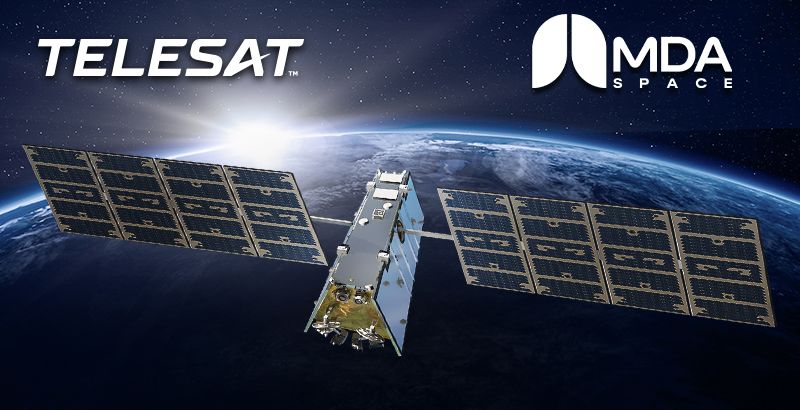
Telesat Lightspeed is a Canadian low Earth orbit broadband communications constellation developed by Telesat, with the spacecraft being built by MDA Space. The network is intended to provide enterprise-class connectivity for telecom, government, maritime, aeronautical, and other customers worldwide.
The constellation is designed around MDA AURORA next-generation broadband satellites. Telesat describes the network as using a combination of low Earth orbits, phased-array antennas with hopping beams, onboard digital processing, and optical inter-satellite links to create a globally connected mesh network, including coverage of polar regions.
On 4 August 2026, Telesat announced a major Canadian defence agreement that expanded the fully funded Lightspeed constellation to 225 satellites and added secure Military Ka-band capability for Canadian Armed Forces operations in the Arctic. The Telesat contract announcement values the initial agreement at C$2.3 billion, with two five-year options bringing the potential total to C$2.7 billion.
Development
Telesat selected MDA Space as prime satellite contractor for Lightspeed in 2023 and awarded an initial order for 198 satellites based on the MDA AURORA product line. In December 2024, Telesat and MDA Space announced completion of the spacecraft Preliminary Design Review, along with reviews of multiple major subsystems. The companies then moved into detailed engineering and manufacturing work, including preparation for the Critical Design Review. At that time, Telesat stated that it planned to begin launching Lightspeed satellites in 2026. The milestone was described in the MDA Space development update.
In 2025, MDA Space, Canada's Department of National Defence, and Telesat announced a strategic partnership associated with the Enhanced Satellite Communications Project – Polar program. The effort was intended to provide Canadian Armed Forces connectivity in the Arctic.
The 4 August 2026 agreement converted that defence requirement into a large Lightspeed service commitment. Telesat said 69 additional fully funded satellites would increase its initial funded constellation from 156 to 225 spacecraft. MDA Space, using its own manufacturing-contract baseline, said the expansion represented 27 satellites beyond the previously announced 198-satellite order, also bringing its Lightspeed production total to 225. MDA Space valued the contract increase at C$474 million. That increase includes the additional satellites, long-lead items, and the addition of 500 MHz of military Ka-band capability to satellites already being built, replacing the same amount of commercial Ka-band spectrum. MDA Space described the change in its constellation expansion announcement.
Design
Telesat Lightspeed is based on a distributed constellation rather than a single spacecraft. Its satellites are intended to operate in a combination of low Earth orbits that provide global coverage, including polar areas. Telesat states that the much lower orbital altitude than geostationary satellites is intended to support network latency of about 30–50 milliseconds.
Each satellite is designed with phased-array antennas using hopping beams that can redirect capacity to changing areas of demand. Full digital modulation, demodulation, and data routing are performed in space. Optical inter-satellite links are intended to connect spacecraft directly and support a global mesh network. These features are summarized in Telesat's Lightspeed technology infographic.
Following the 2026 defence expansion, MDA Space stated that all MDA AURORA satellites being designed, built, and tested for Lightspeed would carry 500 MHz of military Ka-band spectrum alongside commercial Ka-band spectrum. For satellites already in production, the military allocation replaces an equivalent amount of commercial Ka-band spectrum. The Canadian military service is intended to cover the Arctic from 65 to 90 degrees north latitude.
Program status
The 225 Lightspeed satellites are to be manufactured by MDA Space at its high-volume facility in Montréal. The 69-satellite expansion announced in August 2026 is to be funded by milestone-based Government of Canada payments beginning in the third quarter of 2026.
Telesat stated that the additional satellites would be launched on SpaceX Falcon 9 rockets. Several launch services were already secured, while another Falcon 9 launch remained subject to completion of a launch services agreement. Earlier program planning called for launches to begin in 2026, but the supplied sources do not confirm that a Lightspeed satellite had actually launched by August 2026.
Service under the Canadian defence contract is scheduled to begin in 2028. Telesat said its expected start of global Lightspeed service remained targeted for the first quarter of 2028. The first phase of the Enhanced Satellite Communications Project – Polar agreement covers Military Ka-band service, while user terminals, ground and control infrastructure, training, and support services are to be addressed under a separate agreement.
Specifications (Telesat Lightspeed constellation)
Constellation and network
- Network type: Low Earth orbit broadband communications satellite constellation.
- Planned constellation size: 225 fully funded satellites after the August 2026 expansion.
- Prime satellite contractor: MDA Space.
- Satellite platform: MDA AURORA next-generation broadband satellite.
- Orbit architecture: Combination of low Earth orbits intended to provide global coverage, including polar regions.
- Antennas: Phased-array antennas with hopping beams.
- Onboard processing: Full digital modulation, demodulation, and data routing.
- Inter-satellite links: Optical links.
- Commercial communications: Ka-band.
- Military communications: 500 MHz of Military Ka-band spectrum on Lightspeed satellites under the 2026 defence configuration.
- Planned network latency: 30–50 milliseconds.
- Canadian Arctic military coverage: 65 to 90 degrees north latitude.
- Planned global service start: First quarter of 2028.
 Argentina
 Armenia
 Australia
 Austria
 Austria-Hungary
 Belgium
 Brazil
 United Kingdom
 United States
 Brunei
 Bulgaria
 Chile
Chile China
China Colonial America
 Colombia
 Confederate States
 Croatia
 Czech
Czech Denmark
 Egypt
Egypt Finland
 France
 Georgia
 Germany
 German Imperial
 Greece
 Holland
 Hungary
 India
India Indonesia
 Iran
Iran Iraq
Iraq Ireland
 Israel
 Italy
Italy Japan
Japan Japan (1940)
 Jordan
 Kingdom of Italy
 Malaysia
 Mexico
 Myanmar
 Nazi Germany
 Netherlands
 New Zealand
 North Korea
 Norway
 Pakistan
 Peru
Peru Philippines
 Poland
 Portugal
 Prussia
 Romania
 Russia
 Saudi Arabia
 Serbia
 Singapore
 Slovakia
 Slovenia
 South Africa
 South Korea
 Soviet Union
 Spain
Spain Sweden
 Switzerland
 Syria
Syria Taiwan
 Thailand
 Turkey
 UAE
UAE Ukraine
 Vietnam
 Yugoslavia