
History
The SpaceX Starlink communications satellite is a family of low Earth orbit broadband spacecraft developed and manufactured by SpaceX. Thousands of Starlink satellites operate as a coordinated constellation that provides internet connectivity through ground stations, user terminals, and inter-satellite networking.
SpaceX publicly announced its satellite internet project in January 2015 and opened a satellite development facility in Redmond, Washington. The program progressed from two test spacecraft launched in February 2018 to the first large operational deployment in May 2019.
Starlink has subsequently evolved through several satellite generations with changes in mass, communications equipment, propulsion, optical links, and direct-to-cell capability. By August 2026, the constellation contained more than 10,000 active spacecraft and continued to expand through frequent Falcon 9 launches.
Development
SpaceX began developing the Starlink system as a large non-geostationary satellite network intended to provide high-speed, comparatively low-latency internet service. The company announced the project in 2015 and established its satellite engineering operation in Redmond. In November 2016, SpaceX applied to the U.S. Federal Communications Commission for authorization to operate a non-geostationary satellite system using Ku- and Ka-band frequencies.
The first physical Starlink spacecraft were two experimental satellites launched in February 2018. These test vehicles, commonly known as TinTinA and TinTinB, demonstrated elements of the planned network and supported subsequent changes to the orbital architecture. SpaceX moved toward lower operational altitudes than originally proposed, reducing signal travel time and allowing failed spacecraft to reenter more rapidly.
In 2018, U.S. regulators approved an initial constellation numbering thousands of satellites. SpaceX then shifted from development toward high-rate production. The first large group of 60 Starlink spacecraft was launched in May 2019. According to the eoPortal Starlink mission profile, these early operational satellites established the basic architecture of a continuously replenished low Earth orbit broadband constellation.
SpaceX opened limited beta internet service in 2020 and expanded public access later that year. As the network grew, newer spacecraft incorporated higher-capacity communications equipment and optical inter-satellite links. In August 2021, SpaceX said future Starlink satellites would carry laser terminals, allowing traffic to pass between spacecraft without requiring every connection to be immediately routed through a local ground gateway.
The Federal Communications Commission approved an initial portion of the second-generation Starlink system in December 2022. SpaceX developed the smaller V2 Mini configuration for Falcon 9 launches while a larger second-generation spacecraft had originally been associated with Starship deployment. V2 Mini satellites began launching in February 2023.
Direct-to-cell Starlink variants were also developed with communications payloads capable of linking to compatible ordinary mobile phones through terrestrial mobile-network spectrum. SpaceX reported a successful text-message test with T-Mobile in January 2024, and direct-to-cell spacecraft were incorporated into subsequent launch groups.
Production and deployment accelerated substantially during the mid-2020s. By March 2026, the constellation had exceeded 10,000 spacecraft simultaneously in orbit. On July 30, 2026, Space.com reported 10,876 Starlink satellites in orbit, including 10,860 considered operational. A later August 11 launch report cited more than 10,900 active satellites, reflecting continued additions to the constellation.
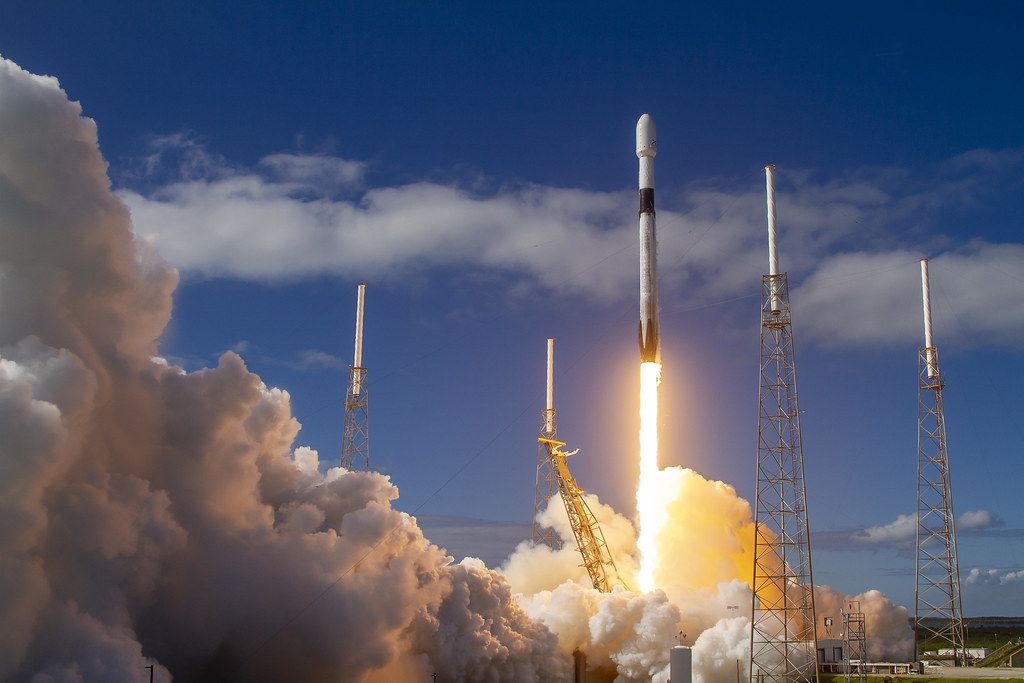
On August 11, 2026, a Falcon 9 launched another 29 Starlink satellites from Cape Canaveral Space Force Station in Florida. The mission was the 93rd Falcon 9 launch of 2026 and the 72nd Starlink-related Falcon 9 mission of the year according to the source report. Deployment was planned approximately 64 minutes after liftoff.
Design
Starlink spacecraft are flat-panel communications satellites designed for mass production, compact stacking during launch, autonomous orbital operations, and disposal by atmospheric reentry. The architecture has changed substantially between generations, so dimensions, mass, communications payloads, and propulsion details vary by version.
Structure and launch configuration
Early operational Starlink satellites used a flat-panel structure with multiple high-throughput antennas and a single solar array. The spacecraft were designed to be stacked directly for launch without a conventional individual deployment dispenser. This arrangement allowed Falcon 9 missions to carry large batches of satellites.
The early V1.0 spacecraft had a mass of about 260 kg. Later V2 Mini-class satellites became substantially heavier, with published figures varying by specific configuration. Space.com reported approximately 800 kg for the current V2 generation in July 2026, while eoPortal describes V2 Mini-class masses as variant-dependent.
Communications
Starlink satellites operate as nodes in a broadband network rather than as isolated communications spacecraft. User links and gateway connections employ phased-array antennas, principally in Ku- and Ka-band frequencies depending on generation. The low orbital altitude reduces propagation delay compared with traditional geostationary communications satellites.
Later Starlink generations introduced optical inter-satellite links. These laser terminals allow satellites to route traffic through other spacecraft, improving coverage in regions where nearby terrestrial gateways are unavailable, including remote oceanic and polar areas.
Direct-to-cell versions add equipment intended to communicate with standard compatible mobile phones without a dedicated Starlink user terminal. The service uses spectrum supplied through partner mobile-network operators and initially focused on text messaging, with broader voice and data functions planned or introduced according to market and regulatory conditions.
Propulsion and navigation
Starlink satellites use Hall-effect electric propulsion for orbit raising, station keeping, collision avoidance, and end-of-life deorbiting. Early versions used krypton as propellant. The spacecraft employ star trackers and GPS-based navigation for attitude and orbital guidance.
Autonomous collision-avoidance capability is an important part of the design because the constellation contains thousands of spacecraft in heavily used low Earth orbit. Starlink satellites can use tracking information to maneuver away from predicted conjunctions with other satellites or debris.
Orbit and disposal
Most Starlink satellites operate in low Earth orbit. eoPortal describes typical deployment shells around 540 to 570 km altitude, with a primary inclination near 53 degrees, while other shells use different altitudes and inclinations. Operating at relatively low altitude improves communications latency and also causes non-functioning spacecraft to encounter greater atmospheric drag than satellites in much higher orbits.
Operational satellites approaching the end of service are intended to use their propulsion systems to lower their orbits and reenter Earth's atmosphere. Early Starlink designs were developed for high levels of atmospheric demisability, reducing the amount of material expected to survive reentry.
Operational history
Starlink entered large-scale orbital deployment in 2019 and public beta service in 2020. The constellation expanded through frequent Falcon 9 missions from Cape Canaveral Space Force Station and Kennedy Space Center in Florida and Vandenberg Space Force Base in California.
The network provides fixed broadband service and has been adapted for mobile, maritime, aviation, government, and emergency communications. Starlink terminals have been installed on vehicles, ships, aircraft, remote infrastructure, and other sites where terrestrial broadband is limited or unavailable.
Starlink has also been used for government and military communications. During the Russo-Ukrainian war, the network became an important communications system for Ukrainian government, civilian, and military users. SpaceX separately developed Starshield for government and military customers, although Starshield is a distinct service and spacecraft application rather than the standard commercial Starlink satellite configuration.
Large-scale Starlink deployment has generated concern among astronomers because reflected sunlight and radio transmissions can interfere with observations. SpaceX introduced brightness-mitigation measures on successive spacecraft designs, but researchers have continued to study the effects of the expanding constellation. The network has also become a major factor in orbital traffic management because of the large number of satellites and frequent collision-avoidance maneuvers.
As of August 2026, launches were continuing at a high rate. The August 11 mission placed 29 additional satellites on their way to low Earth orbit, contributing to a constellation already exceeding 10,000 active spacecraft.
Variants
- Starlink v0.9: Early large-batch demonstration configuration launched in May 2019. It followed the two experimental spacecraft launched in February 2018.
- Starlink V1.0: Early operational production version introduced in November 2019. It added Ka-band capability, had a mass of about 260 kg, and incorporated design changes intended to reduce optical brightness and improve atmospheric demisability.
- Starlink V1.5: Improved first-generation configuration introduced in 2021. It incorporated optical inter-satellite laser links and was deployed across several orbital groups.
- Starlink V2 Mini: Second-generation configuration sized for Falcon 9 deployment. It entered launch service in February 2023 and incorporated Gen2 communications and performance improvements in a form smaller than the full-size second-generation concept originally associated with Starship.
- Starlink V2 Mini Direct-to-Cell: V2 Mini-derived configuration fitted with a payload for satellite-to-mobile-phone communications using partner cellular spectrum. Test and operational deployment batches began in 2024.
Operators
- SpaceX: Developer, manufacturer, launcher, and primary operator of the Starlink satellite constellation and associated broadband network.
Specifications (Starlink V1.0)
General characteristics
- Type: Low Earth orbit broadband communications satellite
- Manufacturer: SpaceX
- Mass: About 260 kg
- Configuration: Flat-panel spacecraft designed for stacked launch without an individual dispenser
- Power: Single deployable solar array
- Navigation: Star tracker with orbital guidance and autonomous collision-avoidance capability
Communications
- Primary links: Phased-array Ku- and Ka-band communications
- Network role: Broadband internet communications within the Starlink low Earth orbit constellation
Propulsion
- Propulsion type: Hall-effect electric thrusters
- Propellant: Krypton
- Functions: Orbit adjustment, altitude maintenance, collision avoidance, and end-of-life deorbiting
Orbit
- Typical operational altitude: Approximately 550 km for the principal first-generation shell
- Primary-shell inclination: Approximately 53 degrees
Related equipment
- Starshield: SpaceX government and military satellite communications system based on Starlink-derived technology and spacecraft architecture.
 Argentina
 Armenia
 Australia
 Austria
 Austria-Hungary
 Belgium
 Brazil
 United Kingdom
 Brunei
 Bulgaria
 Canada
 Chile
Chile China
China Colonial America
 Colombia
 Confederate States
 Croatia
 Czech
Czech Denmark
 Egypt
Egypt Finland
 France
 Georgia
 Germany
 German Imperial
 Greece
 Holland
 Hungary
 India
India Indonesia
 Iran
Iran Iraq
Iraq Ireland
 Israel
 Italy
Italy Japan
Japan Japan (1940)
 Jordan
 Kingdom of Italy
 Malaysia
 Mexico
 Myanmar
 Nazi Germany
 Netherlands
 New Zealand
 North Korea
 Norway
 Pakistan
 Peru
Peru Philippines
 Poland
 Portugal
 Prussia
 Romania
 Russia
 Saudi Arabia
 Serbia
 Singapore
 Slovakia
 Slovenia
 South Africa
 South Korea
 Soviet Union
 Spain
Spain Sweden
 Switzerland
 Syria
Syria Taiwan
 Thailand
 Turkey
 UAE
UAE Ukraine
 Vietnam
 Yugoslavia